Astronomy Picture of the Day is built on a simple promise: a new view of the universe every day, paired with an astronomer’s concise guide to what you’re seeing.
Astronomy Picture of the Day is built on a simple promise: a new view of the universe every day, paired with an astronomer’s concise guide to what you’re seeing. The September 27, 2026 entry tackles a question that comes up whenever a striking deep-sky image circulates online: what does the Andromeda galaxy actually look like, and how much of what we see is “real” versus digital cleanup?
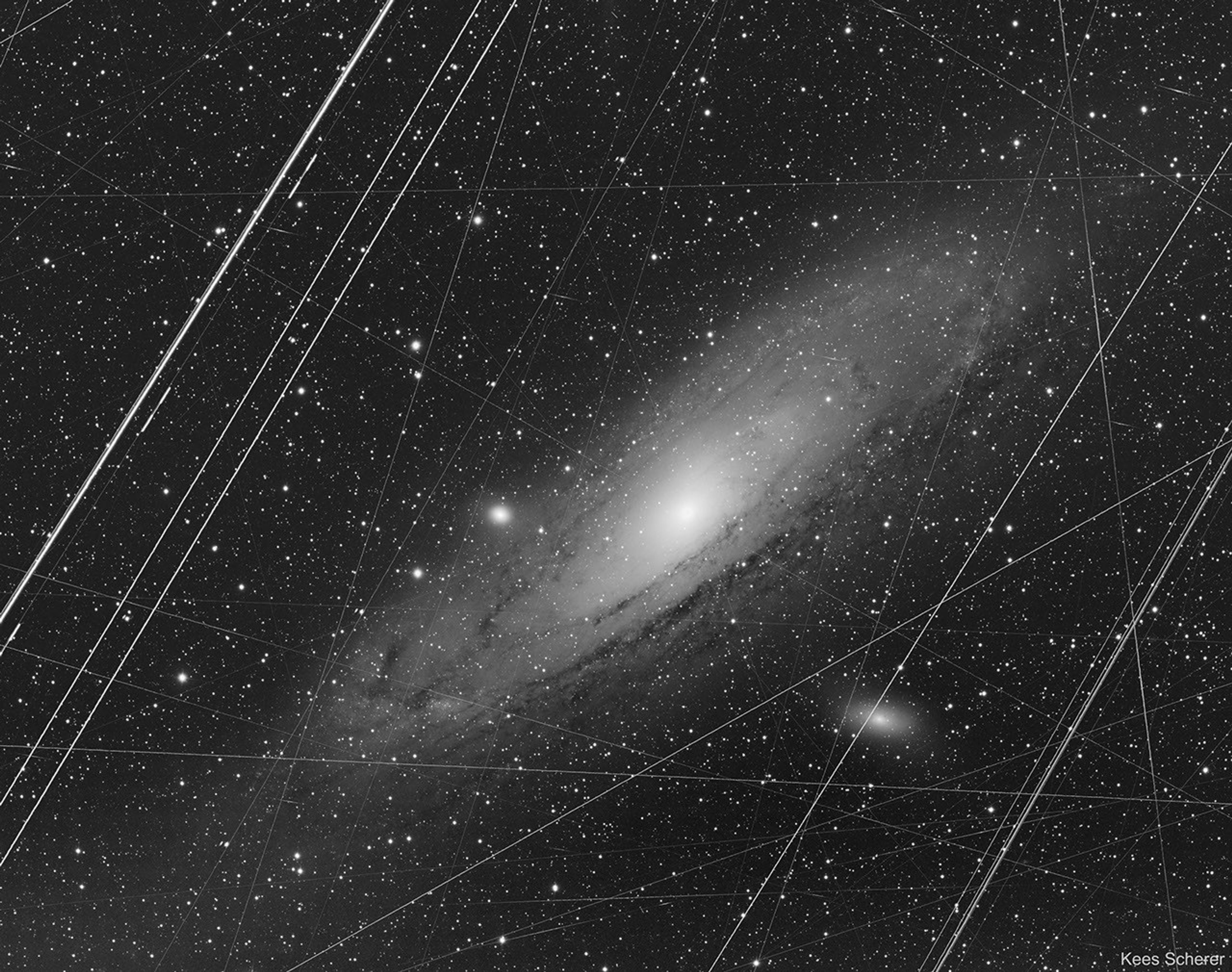
To make the point, the feature presents two versions of the same target—Andromeda (M31), the Milky Way’s nearest large galactic neighbor—captured under ordinary Earthbound conditions. The “before” view is not a failure of technique so much as an honest record of what long-exposure astrophotography must contend with when it is done through an active, modern sky and with consumer-grade sensors. The image was assembled from a substantial dataset: 223 separate frames, each exposed for 300 seconds, collected in 2019 from a garden observatory in Portugal. Stacking that many exposures allows faint details in Andromeda to emerge, but it also stacks the unwanted intrusions that arrive frame by frame.
Those intrusions are visible and familiar to many astrophotographers. Bright, nearly parallel lines cut across the field where aircraft passed during the exposures. Longer, uninterrupted streaks trace satellites crossing the camera’s view. Short, sharp marks betray cosmic rays striking the detector. And sprinkled throughout are bad pixels—small sensor defects that show up as anomalous points of light or color. None of these artifacts belong to Andromeda; they are products of observing from beneath Earth’s crowded skies with real-world equipment.
The accompanying “after” version demonstrates what happens when the goal is not to invent a more dramatic galaxy, but to suppress the local contaminants so the distant object can be represented more faithfully. The improvements were not achieved by simply painting over problems in Photoshop. Instead, the processing relied on specialized astronomy software—Astro Pixel Processor, DeepSkyStacker, and PixInsight—tools designed to align and combine many frames, reject outliers, and reduce the impact of transient streaks and sensor flaws. The result is a cleaner image in which the galaxy’s structure stands out more clearly, with Earthly distractions substantially diminished.
APOD’s explanation underscores the motive behind such processing: not to “deceive” viewers with an unrealistic digital creation, but to strip away artifacts that have nothing to do with M31. In that framing, post-processing becomes less about embellishment and more about reconstruction—an effort to approximate what Andromeda would look like without the interruptions imposed by airplanes, satellites, high-energy particles, and imperfect hardware.
The post also includes two logistical updates for the APOD community. The email address used for image submissions has changed, and prospective contributors are directed to the APOD submissions page for the current details. In addition, APOD’s primary NASA home is transitioning from apod.nasa.gov to science.nasa.gov/apod. The following day’s image teaser is titled “cosmic latte.”