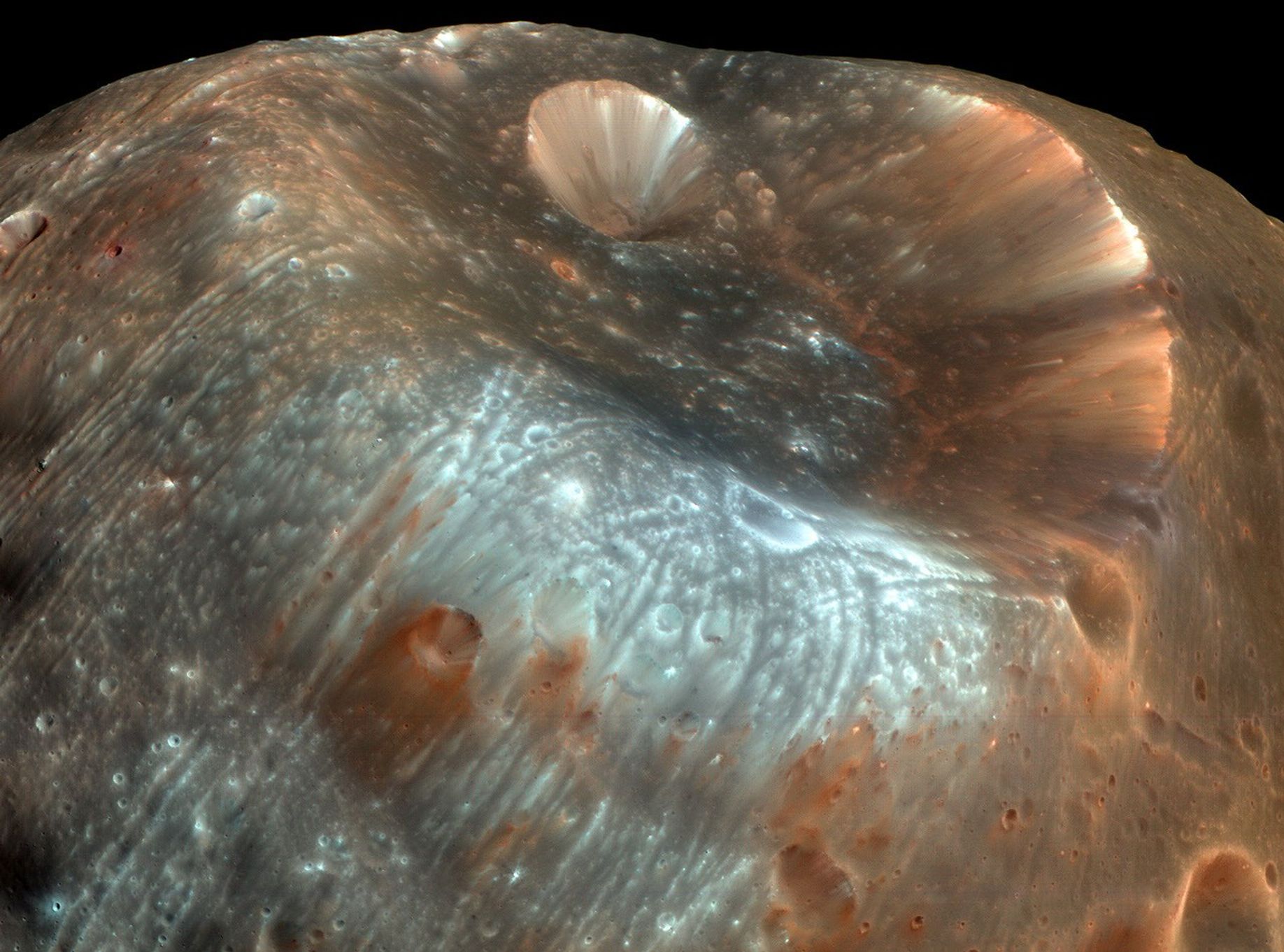
An enhanced-color HiRISE image spotlights Stickney, a massive Phobos crater that may have nearly shattered the moon and helps probe its grooves, slides and tidal stresses.
Stickney Crater dominates the battered face of Phobos, the larger and closer of Mars’ two small moons. The feature is named in honor of Chloe Angeline Stickney Hall, a mathematician and the wife of astronomer Asaph Hall. Hall discovered both martian moons—Phobos and Deimos—in 1877, and the crater’s name links that scientific milestone to the person who supported his work.
By Phobos standards, Stickney is enormous. The crater spans more than 9 kilometers, nearly half the moon’s overall diameter. Its scale hints at a violent past: the collision that excavated Stickney was so energetic that it may have come close to breaking the tiny body apart. Phobos, often described as asteroid-like, is small enough that a single major impact can reshape it—and potentially threaten its structural integrity.
A close look at Stickney and the terrain around it comes from an enhanced-color view captured by HiRISE, the High Resolution Imaging Science Experiment camera aboard NASA’s Mars Reconnaissance Orbiter. The spacecraft recorded the scene during a flyby in March 2008, passing within roughly 6,000 kilometers of Phobos. The color processing helps emphasize subtle differences in surface materials and exposure, revealing details that would be difficult to distinguish in a more naturalistic rendering.
Despite Phobos’ exceptionally weak gravity—less than one-thousandth of Earth’s—its landscape still shows signs of change. Linear streaks inside Stickney suggest that loose debris has slowly slid down the crater’s steep interior walls over time. In such low gravity, even small disturbances can mobilize surface material, leaving behind telltale tracks that map the moon’s ongoing “mass wasting” processes.
Near the crater’s rim, lighter bluish patches stand out in the enhanced-color image. These areas may represent relatively fresh surfaces, where impacts or slumping have exposed material that has not been as heavily altered by space weathering. On airless bodies like Phobos, constant micrometeoroid bombardment and radiation gradually darken and modify surface grains, so newly uncovered regions can appear distinct.
The view also highlights one of Phobos’ enduring puzzles: a network of long, shallow grooves etched across the moon’s exterior. Their precise origin remains uncertain. Researchers have suggested they could be linked to tidal forces as Phobos orbits extremely close to Mars, stressing and fracturing the moon’s crust. Another possibility is that the grooves are connected to the Stickney-forming impact itself, either from shock fracturing or from debris ejected and re-impacting the surface.
Why it matters
Phobos is a natural laboratory for understanding how small, low-gravity worlds respond to major impacts and intense tidal forces. Insights from features like Stickney and the mysterious grooves can refine models of surface evolution for moons and asteroids—and inform future missions that may attempt to visit, sample, or even use Phobos as a staging point for Mars exploration. Scientists will be watching for new high-resolution observations and modeling work that can pin down how these grooves formed and how close Phobos may be to structural failure over time.