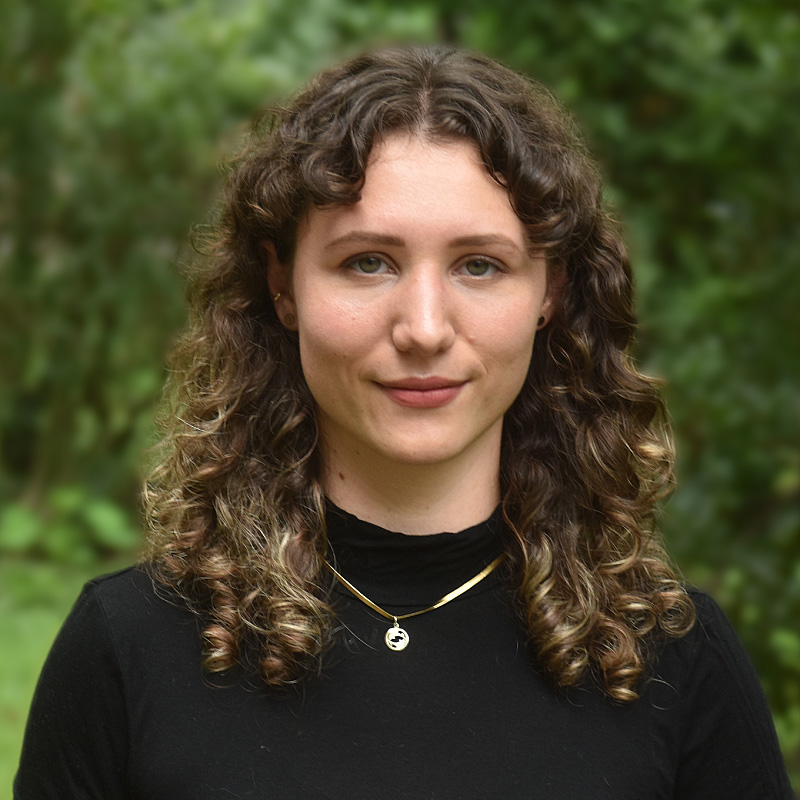
CMU robotics researcher Andrea Bajcsy has been named a Packard Fellow, receiving nearly $986,000 to advance AI safety models for dependable robots in real-world settings.
Andrea Bajcsy, an assistant professor at Carnegie Mellon University’s Kenneth C. Griffin School of Computer Science, has been named a 2026 Packard Fellow for Science and Engineering.
The highly competitive fellowship, administered by the David and Lucile Packard Foundation, supports early-career researchers with $985,834 in flexible funding distributed over five years. Bajcsy is among 20 scientists and engineers selected in the 2026 cohort, a group recognized for pursuing ambitious ideas with the potential to open new directions in their fields.
Bajcsy’s work sits at the crossroads of robotics, machine learning and AI safety. Based in CMU’s Robotics Institute, she studies how to build robots that are not only more capable, but also more dependable—machines that can interpret the situations they encounter and respond appropriately amid the uncertainty of the real world.
That challenge is growing more urgent as AI-enabled robots gain the ability to move through homes, hospitals, warehouses and public spaces, where mistakes can carry real physical consequences. Bajcsy argues that safe deployment will require safety frameworks that go beyond simple rule sets or narrowly defined “do’s and don’ts.” Instead, robots will need a deeper, context-sensitive grasp of safety—one that reflects the meaning of what they perceive, the messy physics that are difficult to model precisely, and broader risks including security vulnerabilities and privacy concerns.
At the core of Bajcsy’s research agenda is a guiding hypothesis: sophisticated safety behavior depends on equally sophisticated internal representations of the world. In other words, a robot can only act with appropriate caution and judgment if it has a rich understanding of its environment and the implications of its actions within it.
With support from the Packard Fellowship, Bajcsy’s group plans to strengthen the scientific underpinnings of AI safety for “embodied” systems—robots that operate in the physical world rather than purely in software. The work will focus on developing new models and algorithms intended to help robots navigate complex environments more reliably, with safety considerations integrated into how they interpret and decide, not bolted on afterward.
Bajcsy’s longer-term goal is to enable robots to make decisions with something closer to human-like nuance, while ensuring that the standards shaping those decisions are not set solely by technical teams. She envisions systems whose behavior can be influenced by a wide array of stakeholders, ranging from engineers to policymakers and everyday users.
More details about the program are available on the Packard Fellowships website.
Why it matters
As robots become more autonomous in real-world settings, failures can threaten physical safety, security and privacy, affecting consumers, workers and the public. Flexible funding like the Packard Fellowship can accelerate foundational research that determines how responsibly these systems scale. The next key question is whether new safety models can translate into practical tools and standards that guide deployment beyond the lab.