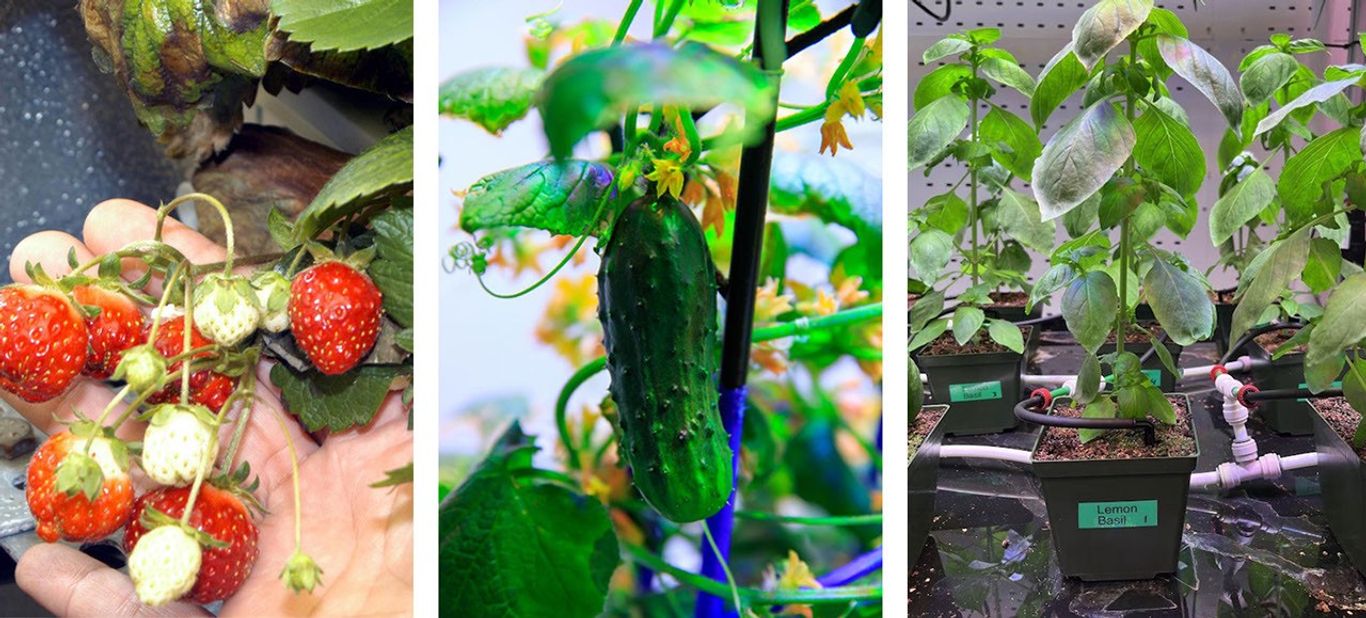
NASA is testing strawberries, cucumbers and lemon basil as “space crops” that could provide fresh food and support life-support systems on future Moon and Mars missions.
NASA is narrowing in on a new set of “space crops” that could one day help feed astronauts living and working far from Earth, including on the Moon and eventually Mars. With long-duration missions on the horizon—and holiday meals highlighting the importance of food variety—researchers are weighing which plants can deliver fresh produce, good nutrition, and welcome novelty in tightly controlled spacecraft and habitat environments.
Recent studies and tests have put three candidates in the spotlight: strawberries, cucumbers, and lemon basil. Beyond adding color and flavor to menus, plants can play practical roles in closed life-support systems by taking up carbon dioxide, releasing oxygen, and helping recycle water—functions that grow more valuable the farther crews travel from resupply lines back home.
That work is progressing both on the ground and in orbit. NASA’s Biological and Physical Sciences Division is preparing a new investigation for the International Space Station that will debut a prototype plant growth chamber. The goal is to gather data that can guide the design of crop production systems intended for future lunar base habitats and Mars missions.
Among the most enticing prospects are strawberries—one of the few sweet fruits being seriously considered for spaceflight. They bring aroma and nutrients, and they can self-pollinate, an important advantage in environments without natural pollinators. At NASA’s Kennedy Space Center in Florida, researchers are cultivating strawberries in “flight-like” growth chambers to see how they perform under conditions meant to mimic space. NASA is also drawing on international expertise through partners at the Australian Research Council Centre for Excellence in Plants for Space.
In a collaboration involving NASA Kennedy, the University of Melbourne, and the University of Western Australia, scientists recently compared a wild strawberry to NASA’s current front-runner variety, ‘Delizz,’ under simulated space conditions. The results, published in September in Life Sciences in Space Research, showed striking differences. Delizz produced large, red berries, while the wild type yielded smaller yellow fruit—a color linked to a recessive genetic mutation. When grown from seed, however, the wild strawberry produced roughly twice as many buds, flowers, and fruits as Delizz. Even so, Delizz retained its lead because the wild strawberry generated too many runners, which would consume precious volume in spacecraft or compact habitat farms.
Cucumbers are also gaining traction—and could break new ground. Although a range of plants has already been cultivated in space, no member of the gourd family has yet made the list. NASA-funded researchers recently assessed cucumbers for growth, yield, and nutritional traits in spaceflight-like settings. According to an August paper in HortScience, the plants showed some signs of enlarged leaves but still delivered a consistent supply of edible cucumbers. Scientists say adding crops such as cucumbers can support both astronaut diet quality and psychological well-being, while greater biodiversity in a plant-growing system may boost overall resilience during long missions.
For flavor and variety, NASA is also testing lemon basil, a citrus-scented herb intended to make packaged meals more appealing. At Kennedy, the herb has cleared an initial round of crop screening and successfully completed seed sanitization, a required step to remove microorganisms before sending seeds to space. Next, researchers will evaluate how well lemon basil grows in “plant pillows,” the space station’s compact growth units.
Why it matters
As missions extend to the Moon and Mars, crews will need more than calories—they’ll need reliable, diverse, and psychologically satisfying food sources that also support life-support recycling. The crop choices NASA makes now will shape the design of future space greenhouses and habitat systems. Watch for results from the new ISS growth chamber and further testing that determines which plants can thrive in limited space with minimal waste and maximum nutritional payoff.