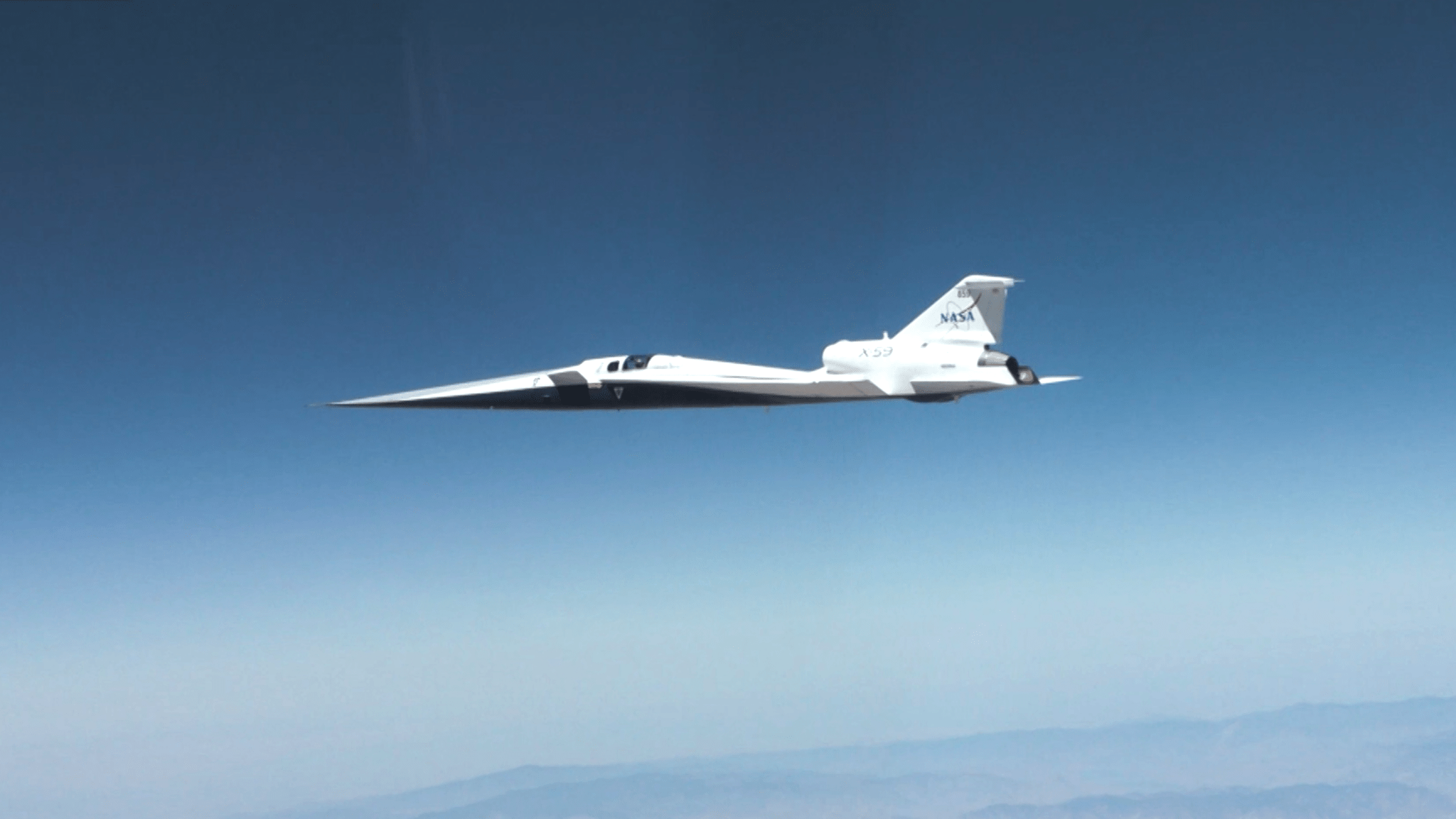
NASA’s experimental X-59 jet has crossed a major threshold in its quest to make supersonic travel less disruptive.
NASA’s experimental X-59 jet has crossed a major threshold in its quest to make supersonic travel less disruptive. On June 5, 2026, the aircraft exceeded the speed of sound for the first time, a milestone that NASA says sets up the program’s next phase: proving that the plane can fly supersonically while producing a much quieter sonic signature.
The historic test flight was conducted from Edwards Air Force Base in California, a longtime hub for cutting-edge aerospace trials. At the controls was NASA test pilot Jim “Clue” Less, who took the X-59 aloft, guided it through planned maneuvers, and returned it safely to the same base. During the 81-minute sortie, the jet accelerated from subsonic regimes into supersonic flight, ultimately reaching about Mach 1.1—roughly 713 miles per hour.
According to NASA, the objective of this first supersonic run was not simply to post a speed number, but to evaluate how the aircraft handled across key parts of its performance envelope. The flight team emphasized assessments of the jet’s flying qualities—how it responds to control inputs, behaves in different speed ranges, and performs as it transitions from below the sound barrier to above it. Those data are expected to inform subsequent flights as the program expands testing.
The X-59 is the focal point of NASA’s Quesst mission, an effort designed to tackle one of the central barriers that has limited supersonic passenger travel for decades: noise. Traditional supersonic aircraft generate a loud sonic boom when shock waves reach the ground, a phenomenon that has contributed to restrictions on routine commercial supersonic flight over land. The X-59 program is intended to demonstrate that new designs can reduce that disturbance, with NASA describing the goal as “quiet” supersonic capability.
By gathering flight results and ultimately demonstrating reduced noise impacts, NASA aims to provide evidence that could support future changes enabling commercial supersonic operations over land across the globe. If such aircraft become viable at scale, they could shorten travel times by allowing faster point-to-point flights, potentially letting passengers spend less time in the air while reaching destinations more quickly.
The June 5 achievement marks the beginning of that demonstration journey: the first time the X-59 has broken the sound barrier, and a concrete step toward the broader ambition of making supersonic flight compatible with communities on the ground.