He is here to hope for a very different American South than we have had, well, ever: Jamelle Bouie: <https://bsky.app/profile/jamellebouie.net/post/3mziatdhmuk2y : ‘Not…
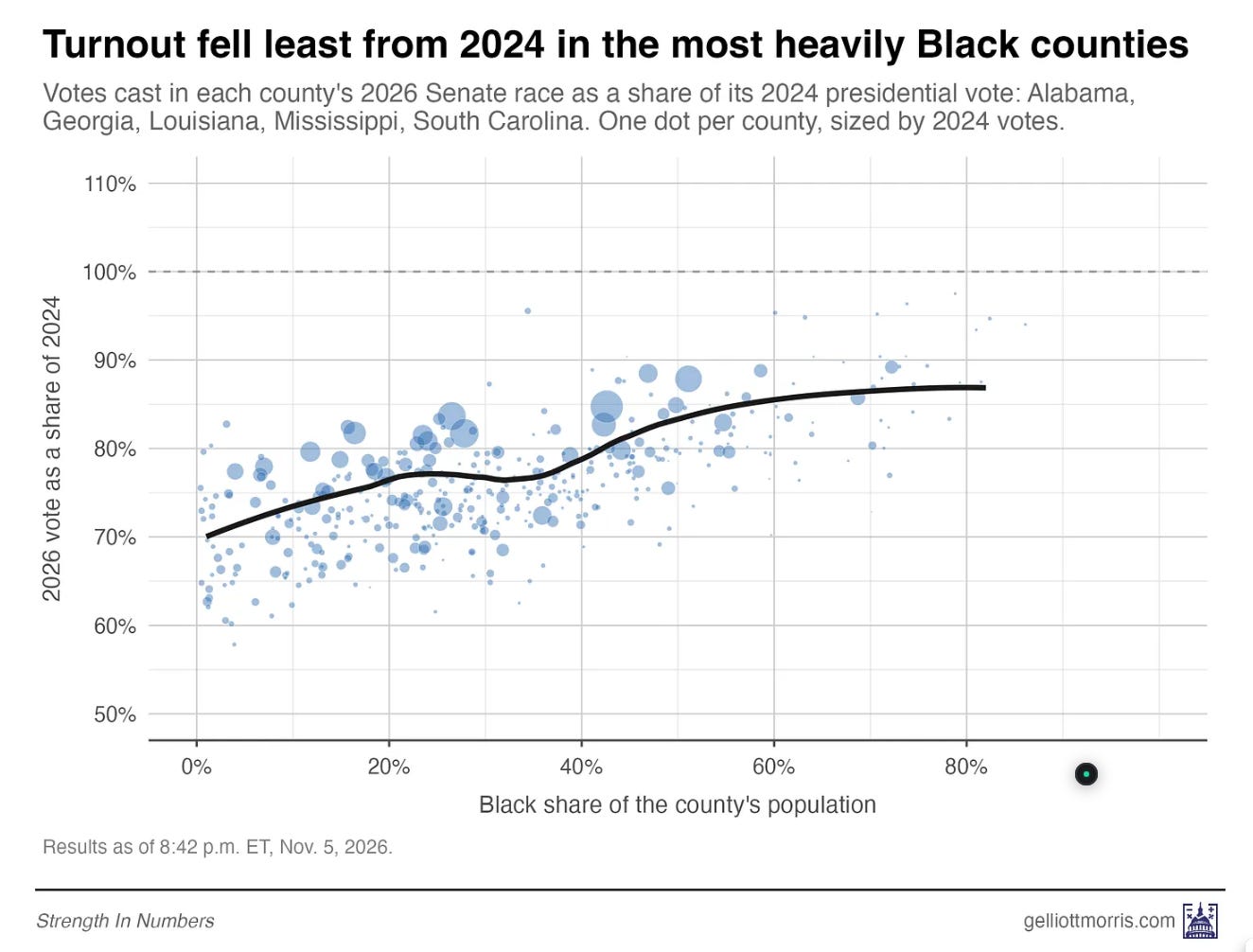
He is here to hope for a very different American South than we have had, well, ever: Jamelle Bouie: https://bsky.app/profile/jamellebouie.net/post/3mziatdhmuk2y: ‘Not only was this the first truly decisive election in 15 years, not only was it the first real repudiation the MAGA Republican Party has experienced, but it is an earthquake in the South. with investment — and with laws protecting the right to vote — the whole region could be blue. The future of american politics is southern (laudatory)… G. Elliott Morris: Turnout Among Black Voters Surged in the Deep South https://www.gelliottmorris.com/p/2026-11-10-black-turnout-south: ‘Black voters made up a larger share of the electorate than in 2024, helping to (maybe) flip a Senate seat in Mississippi…. Mississippi Democrat Scott Colom leads Republican Sen. Cindy Hyde-Smith by about 1,800 votes out of roughly 952,000 cast… with thousands of… ballots still being processed…. Trump carried Mississippi by 22 points two years ago…. White Mississippians… backed Trump by 67 points in 2024, [but] voted far less Republican this time around…. [Relative] turnout surged among Black voters;they made up 33%of Mississippi’s electorate this year, up from30% in 2024…. In the counties in the Deep South where Black voters make up 0% of the population, the number of ballots cast for 2026 House races was about 70% of the number of ballots cast in the 2024 presidential election in the same counties. But in the counties with the largest share of Black residents — around 80 to 85% on the top end — turnout was about 90% of 2024 numbers…. [Part of] the story of the 2026 midterms in the South is… that Republicans spent the months before the election trying to cheat Black voters out of their votes, and Black voters responded by casting more of them. In Mississippi, that surge may have been enough to elect the… senator. In Alabama, it helped Shomari Figures survive a redistricting effort that stripped nearly 9 points off the Black voting-age share of his district. And in South Carolina, it helped deliver another Democratic Senate victory. We can’t know exactly how much of this turnout surge was a direct response to the Supreme Court’s decision inCallais. But the geographic pattern is striking… I agree. This is a sign that the future of American democracy in the Deep South might, just might, be much brighter than it has ever been in the past. First, 1965: On his 36th birthday, January 15, 1965, almost two months before Bloody Sunday in Selma, Alabama, Martin Luther King Jr. talked on the phone to then-President Lyndon Baines Johnson. They said https://d29j0x7vue4ie8.cloudfront.net/2021-05/WH6501-04-6736-6737%20-%20A%20Right%20to%20Vote.pdf: Johnson: There’s not going to be anything, though, Doctor, as effective as all of them voting. Johnson: That will get you a message that all the eloquence in the world won’t bring, because a fellow will be coming to you, then, instead of you calling him. King: And it’s very interesting, Mr. President, to notice that the only states that you didn’t carry in the South—the five southern states—have less than 40 percent of the Negroes registered to vote. Very interesting to notice that. And I think a professor at the University of Texas, in a recent article, brought this out very clearly, so it demonstrates that it’s so important to get Negroes registered to vote in large numbers in the South. And it would be this coalition of the Negro vote and the moderate White vote that will really make the New South… King was 100% wrong. The New South that was made was one in which the dominant political coalition was lily-white. It was solid Republican South that gloried in not seeking Black votes, and in casting off the Republican Party’s origins and its commitment to Negro Uplift. It could well happen. What King and Johnson could not bring to pass in the 1960s might come to pass in the 2020s. Here is Lyndon Johnson speaking at the Jung Hotel in New Orleans in 1964: [Huey Long] never… ma[de] a speech that I didn’t think was calculated to do some good for some people who needed some speeches made for them and couldn’t make them for themselves…. The things I am talking about from coast to coast tonight and tomorrow and next week are the things that he talked about 30 years ago. He thought that every man had a right to a job, and that was long before the Full Employment Act. He thought that every boy and girl ought to have a chance for all the education they could take, and that is before the GI bill of rights. He thought that the old folks ought to have social security and old age pensions, and I remember when he just scared the dickens out of Mr. Roosevelt and went on a nationwide radio hookup talking for old folks’ pensions. And out of this probably came our social security system. He believed in medical care for those so that they could live indecency and dignity in their declining years, without their children having to come and move them into their house with them. He was against poverty and hated it with all his soul and spoke until his voice was hoarse. Well, like Jack Kennedy, he believed in those same things. But their voices are still tonight, but they have left some to carry on. And as long as the good Lord permits me, I am going to carry on. Now, the people that would use us and destroy us first divide us…. If they divide us, they can make some hay. And all these years they have kept their foot on our necks by appealing to our animosities, and dividing us…. When Mr. [Sam] Rayburn came up as a young boy of the House, he went over to see the old [ex-Democratic Majority] Leader, one evening…. He was talking about economic problems. He was talking about how we had been at the mercy of certain economic interests, and how they had exploited us. They had worked our women for 5 cents an hour, they had worked our men for a dollar a day, they had exploited our soil, they had let our resources go to waste, they had taken everything out of the ground they could, and they had shipped it to other sections. He was talking about the economy and what a great future we could have in the South, if we could just meet our economic problems, if we could just take a look at the resources of the South and develop them. And he said, “Sammy, I wish I felt a little better. I would like to go back down [home] there and make them one more Democratic speech. I just feel like I have one in me. The poor old State, they haven’t heard a Democratic speech in 30 years. All they ever hear at election time is “n_gger, n_gger, n_gger!”… Sidney Blumenthal reports that Johnson then got an eight-minute standing ovation. We had a very different opportunity in the American South open to us back then, in the mid-1960s. A very few Republicans tried to grasp it: Jack Kemp comes to mind. Barry Goldwater and Richard Nixon and Ronald Reagan and Newt Gingrich and many many others in their company made sure that trajectory was closed off because they thought it redounded to their clear electoral advantage not to try for the Black vote but, rather, to try 110% for the anti-Black vote. Now the ice may be cracking and things may be in motion again. They certainly are in Georgia. Again, Jamelle: Jamelle Bouie: https://bsky.app/profile/jamellebouie.net/post/3mzl4p6chn22s: ‘What i can't get over, looking at louisiana and mississippi and even alabama, is that the votes are there. It is absolutely possible with long term investment to make them competitive states… https://braddelong.substack.com/p/hoisted-from-e-archives-lee-atwater You start out in 1954 by saying ‘n_gger, n_gger, n_gger’. By 1968... that hurts you.... You... get... abstract... talk... about... cutting taxes and all these things... totally economic things, and the byproduct often is Blacks get hurt worse than whites.... If it is getting that abstract and that coded, that we’re doing away with the racial problem one way or the other... The Atwater quote is mentioned a lot. Wha