NASA’s Perseverance rover has captured a wide-angle look back toward the outer lip of Jezero Crater, revealing a steep slope strewn with unusually bright rocks and the…
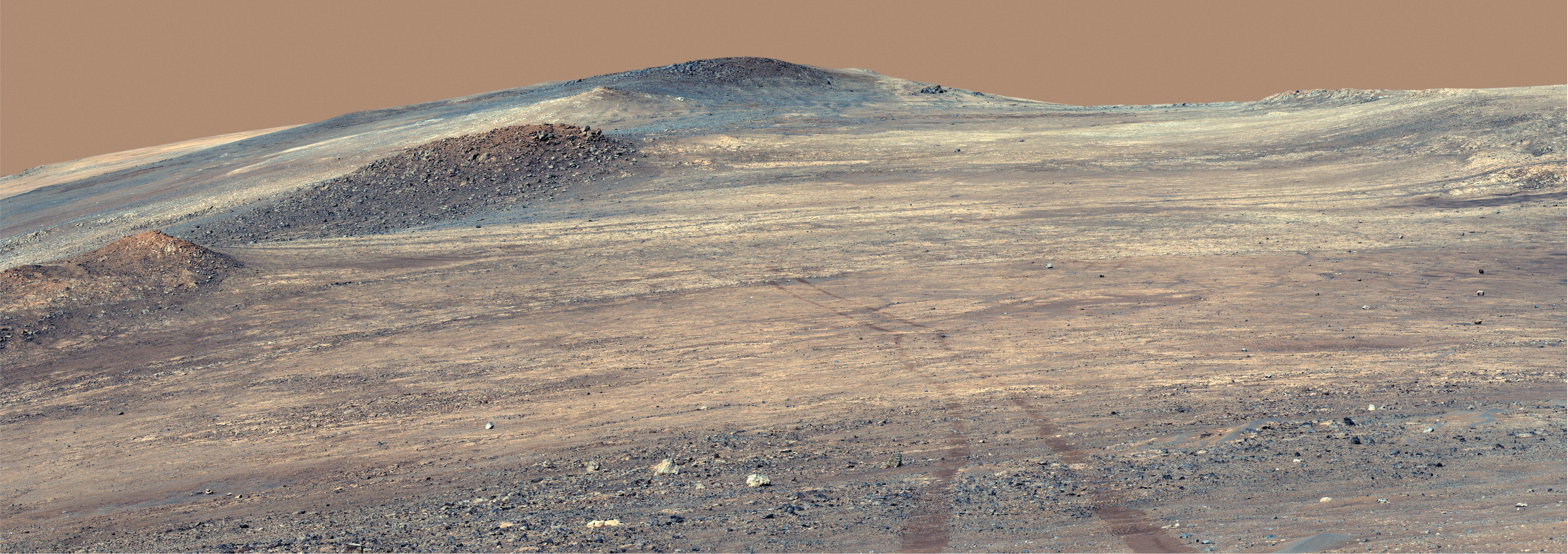
NASA’s Perseverance rover has captured a wide-angle look back toward the outer lip of Jezero Crater, revealing a steep slope strewn with unusually bright rocks and the rover’s own tracks marking its route down the rim.
The image was taken on May 15, 2025, by Perseverance’s Mastcam‑Z camera system during sol 1,505 of the mission. It looks uphill at the crater’s rim, which rises about 490 feet (150 meters) above the rover’s position. Cutting across the slope from left to right is an exposure of pale-toned, layered bedrock that mission scientists have grouped into a unit they call the “Broom Point member.”
That rock package is substantial: a roughly 245‑foot‑thick (75‑meter‑thick) stack of ancient layers. Based on the team’s geologic assessment, it likely predates 3.9 billion years, placing it among the oldest terrain ever inspected up close by a rover on Mars. Such age makes the outcrop especially valuable for reconstructing the planet’s early history, when impacts and large-scale geologic reshaping were common across the solar system.
Perseverance’s observations also point to a dramatic origin. Evidence gathered by the rover suggests the thick succession was assembled through repeated asteroid impacts. Those events did more than just pile up material: the layers are now sharply tilted—nearly vertical in places—with angles exceeding 80 degrees. Scientists attribute that extreme deformation to later, enormous collisions, including the impacts that excavated the vast Isidis Basin and ultimately formed Jezero Crater itself.
The scene includes another reminder of the rover’s ongoing traverse: Perseverance’s wheel tracks snake along the incline, documenting its descent along the crater rim’s steep slope as it continues scouting the geology of this ancient landscape.
Perseverance was built at NASA’s Jet Propulsion Laboratory (JPL), which is managed for the agency by the California Institute of Technology in Pasadena, and JPL also leads rover operations. The Mastcam‑Z instrument is operated under the leadership of Arizona State University. The camera system was developed in collaboration with Malin Space Science Systems in San Diego, which contributed to the design, fabrication, testing, and operation of the cameras. The calibration targets used to ensure the instrument’s accuracy were designed, fabricated, and tested with the Niels Bohr Institute at the University of Copenhagen.
More information about the mission is available at science.nasa.gov/mission/mars-2020-perseverance/.