To mark the United States’ 250th birthday, NASA is showcasing the cosmos in a distinctly patriotic palette.
To mark the United States’ 250th birthday, NASA is showcasing the cosmos in a distinctly patriotic palette. The agency has released a set of four new images from the Chandra X-ray Observatory presented in red, white, and blue hues, pairing the visuals with newly produced “sonifications” that convert astronomical measurements into sound.
The top image highlights Cassiopeia A, the well-known supernova remnant left behind after a massive star exploded. In this composite, Chandra’s X-ray data appears in blue and purple tones, while infrared observations from NASA’s James Webb Space Telescope supply the reds and whites. Chandra’s view traces the shock front—the blast wave that ripped outward through the star—and identifies chemical elements strewn through the debris, including iron, calcium, and oxygen. Webb’s infrared contribution reveals the expanding shell of ejected material and shows dust spread throughout the remnant.
The lower row begins with a new look at NGC 3603, a nebula inside the Milky Way that hosts a huge cluster of massive stars. Here, Chandra’s X-rays (rendered in red and white) capture both a faint, widespread glow near the region’s center and numerous pinpoint X-ray sources scattered across the middle of the scene. Those X-ray points signal energetic young stars. Data from the Hubble Space Telescope—in optical, infrared, and ultraviolet light—adds reds, oranges, greens, blues, and yellows, bringing out the dense stellar core and lanes of gas and dust toward the bottom. Combined, the layers yield an overall red-white-blue impression, with the X-ray detections giving the star-forming region a sparkling, high-energy character.
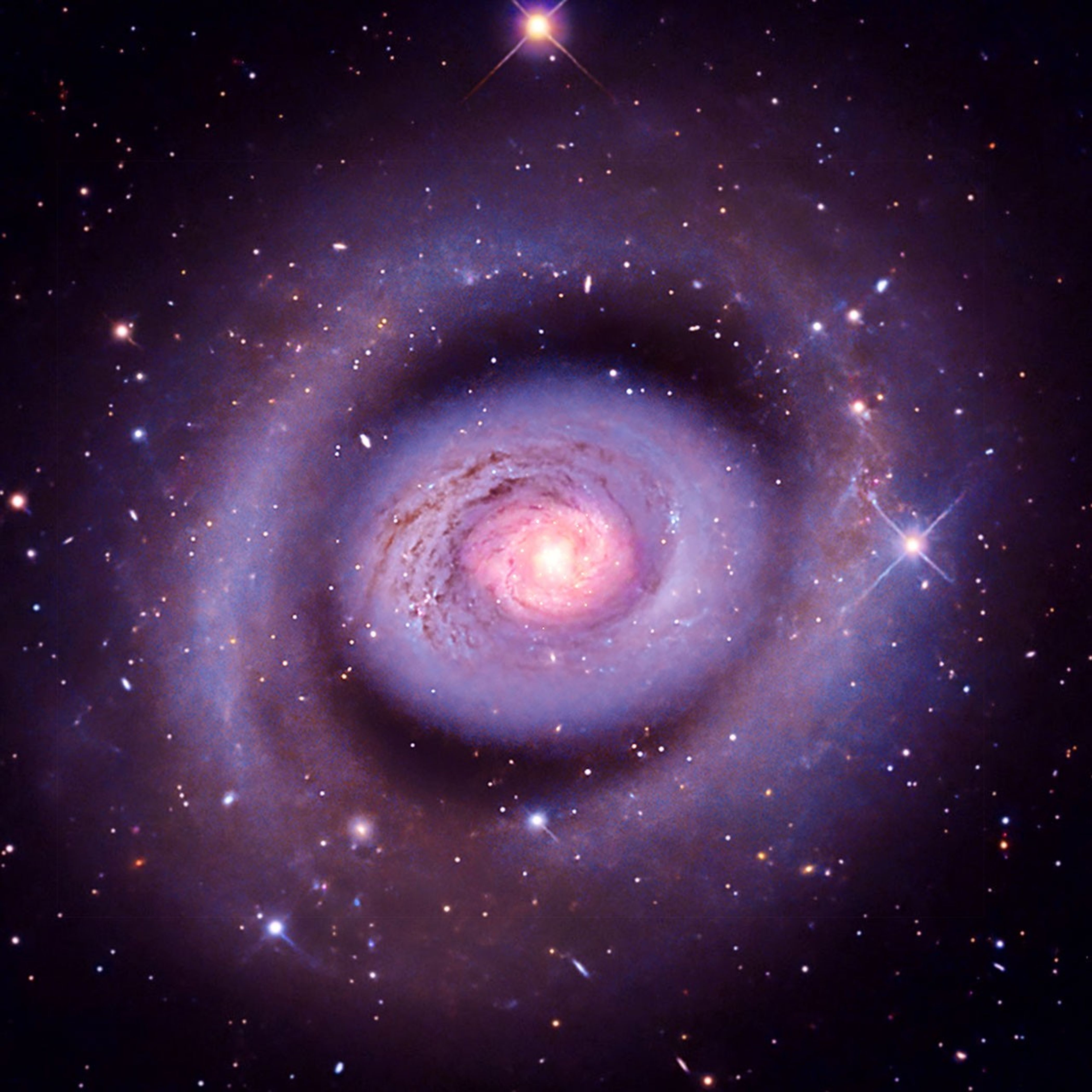
Next is the spiral galaxy NGC 4736, better known as Messier 94. This composite merges Chandra X-rays at multiple energies (shown in red, orange, and blue) with visible-light imagery collected by ground-based astrophotographers (mapped in red, green, and blue). Messier 94 is notable for a bright inner ring—a “starburst ring”—where star formation is actively underway. Astronomers suggest the activity may be sustained by gas channeled inward by the galaxy’s unusual oval-shaped structure, visible in the image.
The final panel features ZwCl 0024+1652, a faraway galaxy cluster used in studies of dark matter. Specially processed Hubble data (colored blue) indicates the presence of dark matter through its gravitational effects, while another Hubble view shows the cluster’s individual galaxies as yellow and white points. Chandra contributes the red component: an immense pool of extremely hot gas permeating the cluster. That gas represents far more mass than the galaxies alone.
Alongside the imagery, NASA has released new sonifications for the three lower-row targets, offering an alternate way to encounter the data. For NGC 3603, the soundscape sweeps from left to right; brightness controls loudness. Chandra’s compact X-ray sources become piano notes, diffuse X-ray emission is assigned to a span of audio frequencies, and Hubble’s optical information appears as sustained tones and acoustic-guitar harmonics.
In the Messier 94 sonification, a radar-like scan rotates clockwise as volume follows brightness. Chandra’s X-rays are rendered as wind-like sounds shaped by the emission’s structure, while compact sources—such as neutron stars and stellar-mass black holes—are translated into pitched notes played on a glass marimba. Ground-based optical data forms a low, musical drone, with stars and background galaxies represented by soft piano.
For ZwCl 0024+1652, a circular scan begins at the outer edge and moves inward, rising in volume with brighter regions. The audio peaks once as it passes the inferred dark matter signal and again at the cluster’s core, with background stars swelling underneath the main tones.