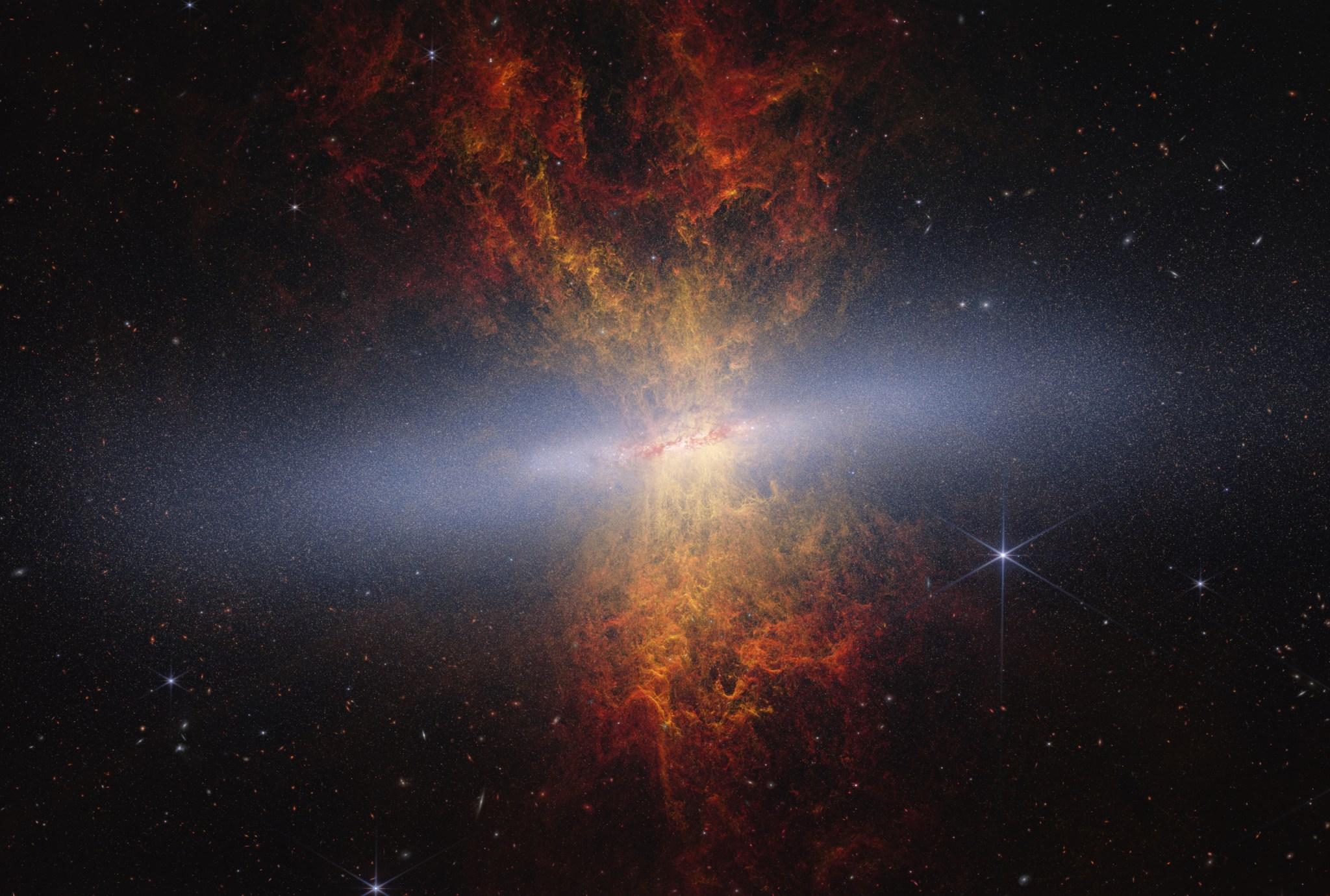
NASA’s James Webb Space Telescope has turned its powerful infrared vision toward Messier 82, the edge-on starburst system better known as the Cigar Galaxy, revealing…
NASA’s James Webb Space Telescope has turned its powerful infrared vision toward Messier 82, the edge-on starburst system better known as the Cigar Galaxy, revealing details that are difficult to capture in visible light alone. By pairing Webb’s new observations with archival imagery from NASA’s Hubble Space Telescope, astronomers now have a more rounded look at both the structure and the intense stellar activity that define this nearby galaxy.
M82 is famous for forming stars at an unusually rapid pace—a hallmark of so-called starburst galaxies. Seen from the side, its disk is heavily veiled by thick lanes of dust and gas that can obscure the galaxy’s interior when viewed in optical wavelengths. Webb’s ability to detect infrared light changes that equation. Infrared observations can penetrate much of the dust, allowing the telescope to trace the underlying shape of the galaxy and to pick out vast numbers of individual stars that would otherwise be hidden from view.
In the new Webb-enabled view, researchers estimate they can discern roughly 16.5 million stars within M82. The count underscores both the richness of the galaxy’s stellar population and the advantage of combining data from telescopes that observe different parts of the spectrum. Hubble contributes high-resolution optical context, while Webb adds the dust-piercing capability needed to see deeper into the crowded, obscured regions where much of the action is taking place.
The galaxy’s frenetic star formation is widely thought to have been triggered by an encounter and merger with another galaxy. Such a burst, however, is not expected to last long by cosmic standards. Starburst phases are transient episodes in a galaxy’s life, and M82’s current intensity is likely a relatively brief chapter rather than its long-term norm.
There is also a built-in contradiction at the heart of M82’s fireworks. The same extreme activity that produces abundant newborn stars can also sow the seeds of its own slowdown. Observations show large plumes of material being expelled above and below the galaxy’s disk—outflows driven by the energetic processes associated with rapid star formation. As this material is pushed out, it can disrupt the supply of gas needed to form future generations of stars, effectively choking off the very process that made M82 a starburst in the first place.
The latest imagery, credited to NASA, ESA, and CSA along with researchers Adam Smercina (STScI, Tufts) and Thomas Williams (University of Manchester) and image processor Alyssa Pagan (STScI), offers a striking snapshot of a galaxy caught in an intense but temporary phase—one where creation and disruption occur side by side.