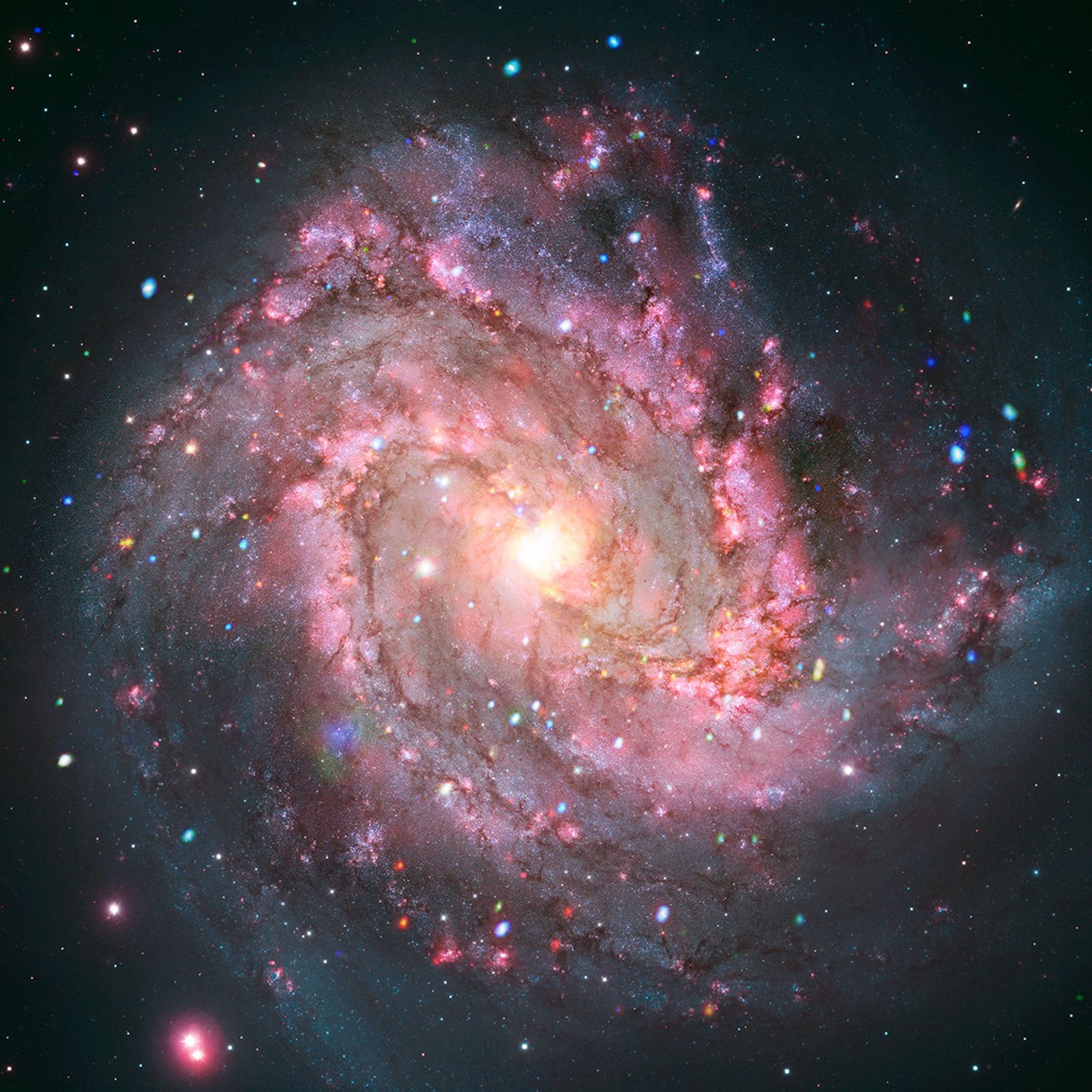
Supernova remnants are typically thought of as cosmic embers: expanding shells of shock-heated gas that, over decades and centuries, cool and dim.
Supernova remnants are typically thought of as cosmic embers: expanding shells of shock-heated gas that, over decades and centuries, cool and dim. That expectation was upended in the nearby spiral galaxy Messier 83, where NASA’s Chandra X-ray Observatory has revealed that many presumed remnants don’t simply fade—they flicker.
The findings, presented at a meeting of the American Astronomical Society in Pasadena, California, and reported in The Astrophysical Journal, come from a long-baseline look at M83, a prolific star-forming galaxy about 15 million light-years from Earth. By examining 14 years of Chandra observations taken between 2000 and 2014, researchers tracked X-ray emission from sources previously classified as supernova remnants—debris fields left behind after massive stars explode.
What they saw was not the slow, steady decline expected for remnants older than roughly a century. Instead, about half of the 22 X-ray sources in their remnant sample showed significant brightness changes across the 14-year dataset. Such variability is common among certain kinds of compact objects, but it was not anticipated in a population labeled as supernova debris.
“We knew that individual X-ray sources could vary dramatically,” said study leader Andrea Prestwich of the Catholic University of America. “But finding that so many supernova remnants were behaving this way was a real surprise.” She noted that identifying the underlying cause is difficult because M83 is far enough away that key details are hard to resolve.
One object in the sample does have a clear explanation: SN 1957D, the aftermath of a supernova observed nearly 70 years ago. In that case, the brightening is consistent with the expanding wreckage plowing into dense material near the explosion site, generating bursts of X-rays. But that mechanism cannot plausibly account for the widespread variability across the rest of the sample, particularly because there is no indication that all of the remnants formed within the last century.
To explain the broader pattern, the team points to an intriguing possibility: the variable sources may not be “ordinary” remnants at all, but systems in which a star survived its companion’s supernova. In this picture, each source began as a binary pair of massive stars. The heavier star exploded, leaving behind either a black hole or an ultra-dense neutron star, while the companion endured. The compact remnant then draws gas from the surviving star; as that material falls inward, gravity heats it to extreme temperatures, producing powerful X-ray emission.
“It may be that this galaxy contains a collection of supernova remnants where one massive star survives the supernova and becomes locked into an orbit with a black hole or neutron star,” said co-author Michael McCollough of the Center for Astrophysics | Harvard & Smithsonian. These pairings—called high-mass X-ray binaries—are among the most variable X-ray sources known, making them a natural match for Chandra’s fluctuating signals.
High-mass X-ray binaries themselves are not new to astronomy. What is striking in M83 is the apparent connection to supernova remnants: across all galaxies, only a small number of remnants linked to such binaries have been identified. Finding more than 20 strong candidates in a single galaxy would be unprecedented. Supporting the idea, the variable sources tend to sit in regions where massive stars are more densely clustered than elsewhere in M83, increasing the odds of binaries and recent explosions.
The researchers also raise another possibility: rather than siphoning gas from a surviving companion, the black hole or neutron star could be capturing some of the supernova ejecta that was originally thrown outward. Either way, the “afterglow” of these stellar deaths may be far more dynamic than astronomers once assumed.