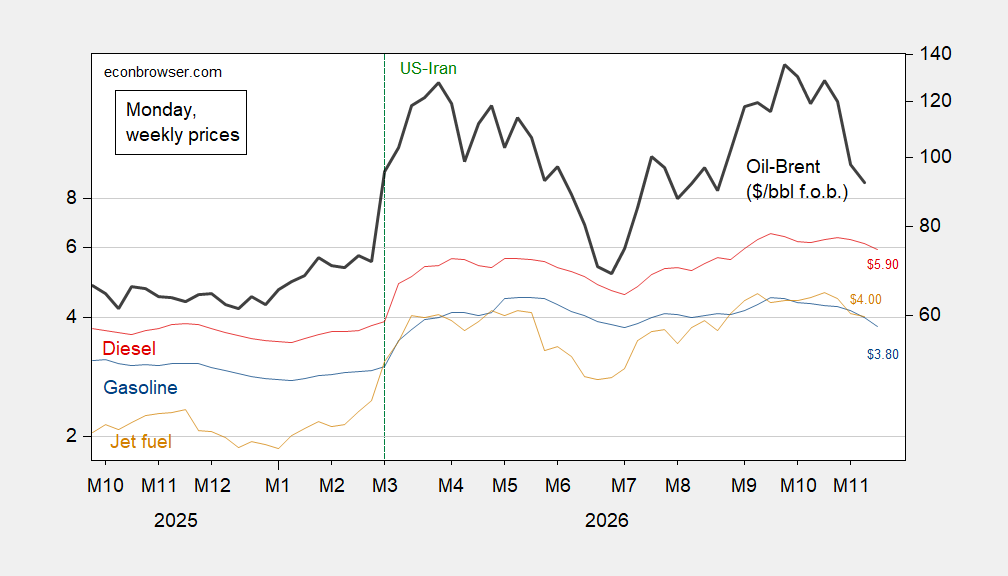
EIA data show Brent crude has eased while diesel and jet fuel prices remain elevated, pointing to sticky refining, transport and insurance costs keeping distillates high.
New data from the U.S. Energy Information Administration (EIA) highlight a growing disconnect between crude oil and key refined fuel prices.
In the latest weekly snapshot (prices as of Monday), regular gasoline, diesel, and kerosene-type jet fuel are shown in dollars per gallon, while Brent crude—the global benchmark—is presented in dollars per barrel on a separate scale. The comparison makes one point stand out: Brent has retreated notably from earlier levels, but diesel and jet fuel prices have not fallen by anything close to the same degree.
That divergence is clearer when the series are indexed to a common starting point. Using Feb. 23, 2026 as the baseline, the EIA data are plotted in logarithmic terms to show percentage-type changes over time rather than absolute dollar moves. By this measure, as of Nov. 10 Brent crude (free on board) was higher by about 26% relative to the Feb. 23 baseline. Over the same period, diesel prices were up roughly 48%, while jet fuel was “about the same” as diesel—meaning jet fuel increases have tracked close to diesel rather than crude.
Put differently, the refining and distribution side of the market is not passing through crude oil’s easing in a way consumers and fuel-intensive industries might expect, at least for diesel and aviation fuel. Gasoline, diesel, and jet fuel do not move one-for-one with Brent even in normal times, because taxes, refinery margins, seasonal blending requirements, regional supply constraints, and distribution costs all sit between a barrel of crude and a gallon at the pump or airport rack. But the current data suggest those non-crude components are playing an unusually large role.
One explanation flagged alongside the EIA comparison is that costs tied to moving and insuring fuel remain elevated. Higher transportation charges—whether for shipping refined product, moving feedstocks, or handling longer and more complex logistics—can keep delivered fuel prices sticky even when crude benchmarks soften. Insurance costs can have a similar effect, especially when supply routes are riskier or when volatility increases the cost of coverage. In that environment, the wedge between crude and refined products can persist.
The upshot is that the recent relief in Brent is not translating proportionately into lower diesel and jet fuel prices. For trucking fleets, industrial users dependent on distillate fuels, and airlines whose largest operating expense is often fuel, that means costs may remain high even as headlines focus on crude oil’s pullback.
Why it matters
Diesel and jet fuel are central inputs for freight and air travel, so their resilience relative to Brent can feed directly into shipping rates, ticket prices, and broader inflation pressures. The data suggest that logistics and insurance expenses—not just crude—are shaping what end users pay. Watch whether transportation bottlenecks ease or risk premiums fall; without that, refined fuel prices may stay elevated even if crude prices drift lower.