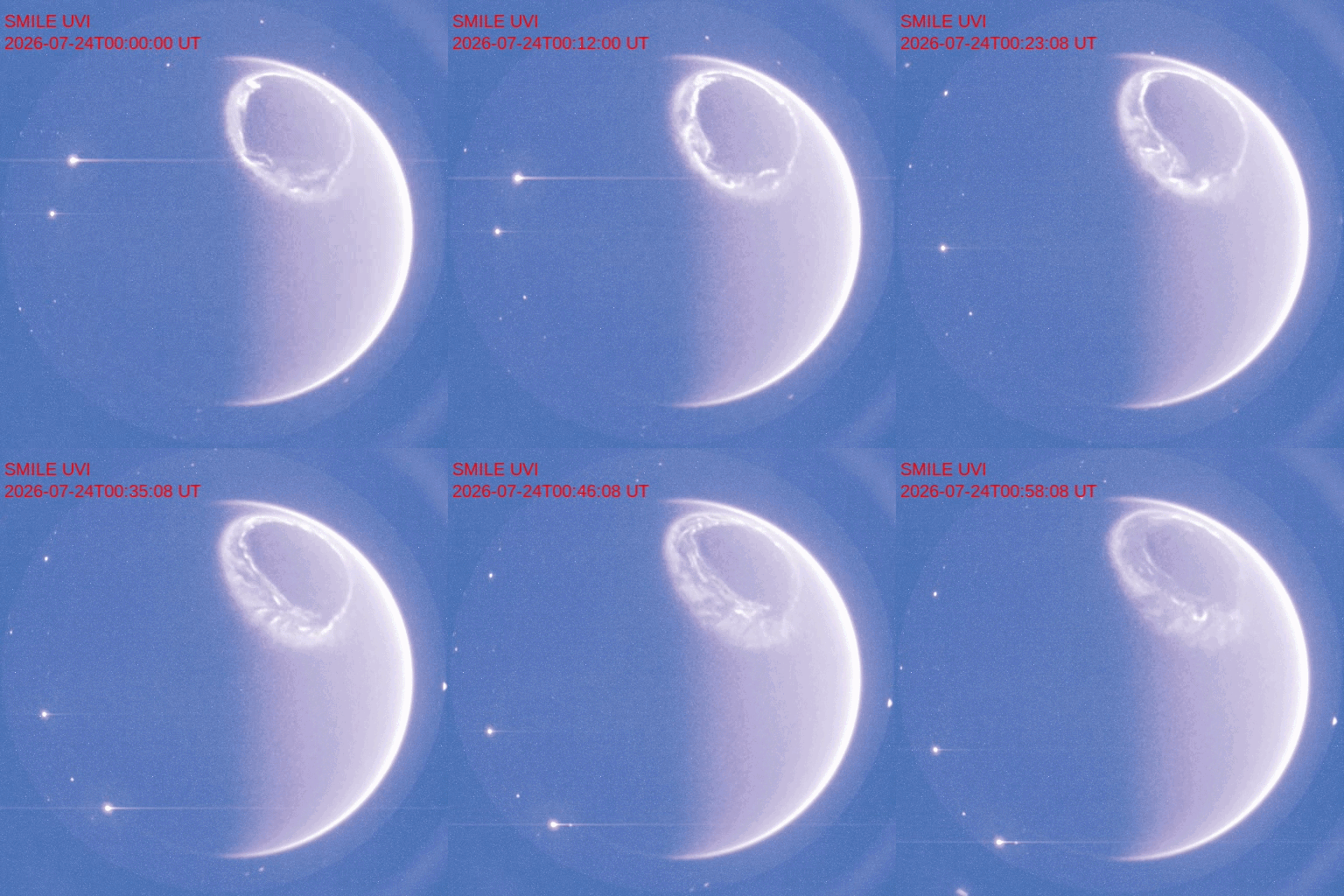
APODScienceAPODAPOD: 2026 October 6 – A…Today’s APODArchiveSubmissionsIndexSearchCalendarRSSEducationAboutDiscuss APOD Astronomy Picture of the Day Discover the cosmos! Each day a different image or photograph of our fascinating universe is featured, along with a brief explanation written by a professional astronomer. ESA, CAS, SMILE, UVI A Complete Auroral Oval from SMILE Explanation: Have you ever seen a […]
Seeing the aurora usually means looking north or south from the ground and watching curtains of light ripple across the sky. But the spectacle has a much larger geometry that’s impossible to appreciate from Earth’s surface: the aurora often forms an enormous ring encircling a magnetic pole, known as an auroral oval. Because that circle spans such a wide area, no observer on the ground can view it in its entirety at once.
A new time-lapse from the SMILE mission—an uncrewed spacecraft operated jointly by the European Space Agency (ESA) and the Chinese Academy of Sciences (CAS)—captures exactly that broader perspective. The video shows a complete auroral oval from space, offering a planet-scale view of the phenomenon as it unfolds around one of Earth’s magnetic poles.
What makes the footage especially notable is how it was recorded. Instead of relying on visible light, SMILE’s camera observed the aurora in ultraviolet wavelengths. That approach allowed the spacecraft to image an auroral oval occurring on Earth’s dayside, when sunlight would normally overwhelm auroral glow in conventional imagery.
The sequence spans roughly one hour and was recorded in late July. Over that relatively short period, the aurora’s true nature becomes clear: it is not a static halo but a dynamic system that continually reshapes itself. Bright regions intensify, dim, and shift, underscoring how variable and turbulent auroral activity can be even on hour-long timescales.
The time-lapse also includes faint points of light near the edges of the frame. These are not additional auroral features but distant stars. They appear to drift because SMILE’s viewpoint changes as the spacecraft travels along its orbit, subtly shifting the camera’s line of sight relative to the star field.
Beyond the visual impact, the imagery illustrates the scientific motivations behind SMILE. One of the mission’s central goals is to deepen understanding of how the solar wind—a stream of charged particles flowing outward from the Sun—interacts with Earth’s magnetosphere. Those interactions can energize particles and drive them into the upper atmosphere, producing auroras. The same processes, however, can also contribute to space weather events that disrupt technology.
By studying the chain of events linking solar wind conditions to magnetospheric response and auroral behavior, SMILE aims to improve researchers’ ability to characterize and ultimately anticipate the effects of solar storms. Such knowledge is increasingly practical: severe space weather can threaten astronauts, harm spacecraft systems, and interfere with electrical infrastructure on the ground, including power grids.
Why it matters
Auroras are a visible sign of space weather, and SMILE’s global view helps scientists connect what’s seen in the atmosphere to what’s happening in near-Earth space. Better understanding of solar wind–magnetosphere interactions can strengthen forecasting of solar storms that endanger satellites, astronauts, and critical electrical systems. The next key step will be translating these kinds of observations into more reliable warnings for operators and agencies that depend on space- and ground-based technology.