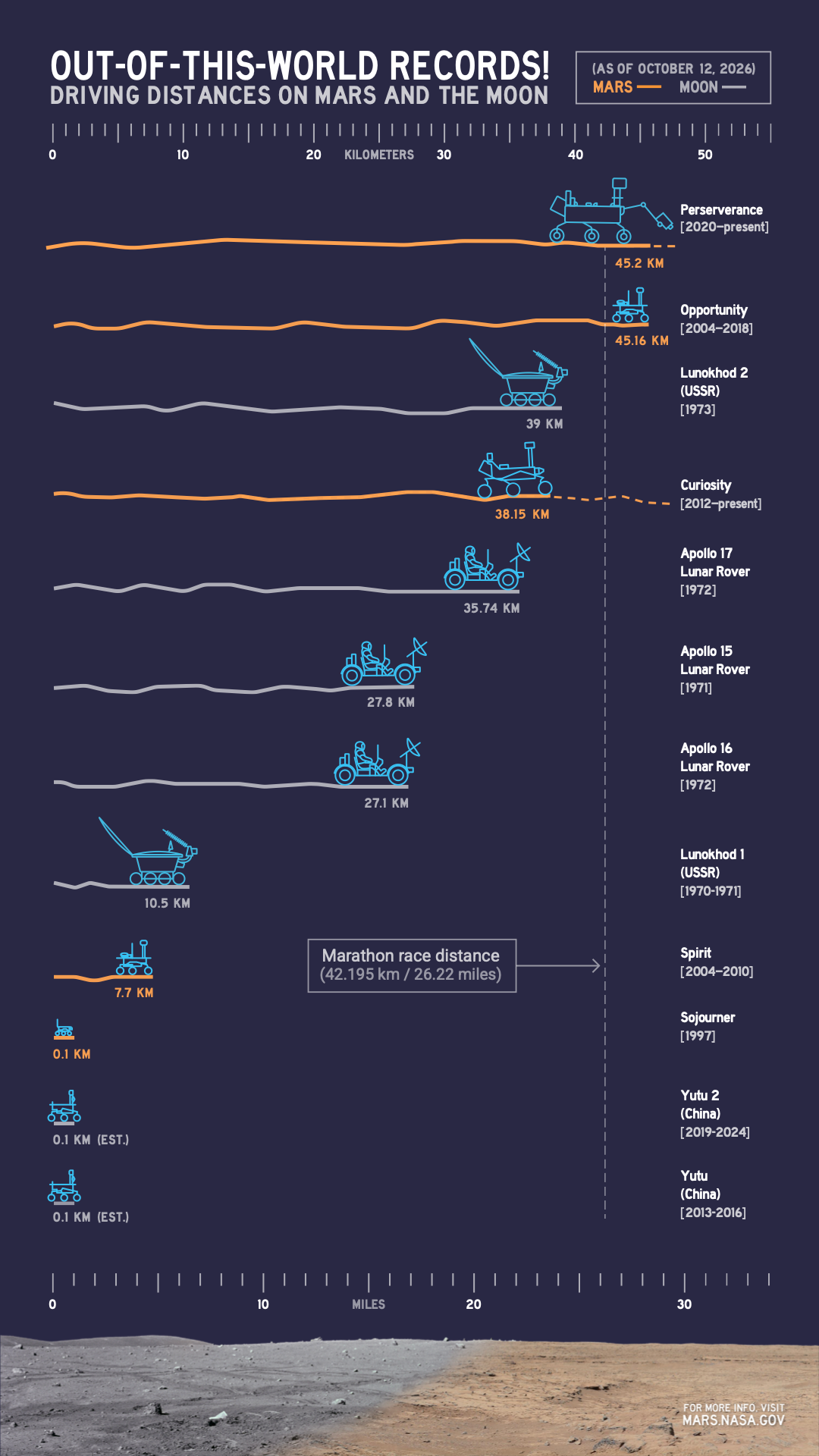
A NASA infographic compares the total distances driven by rovers on the Moon and Mars, showing Perseverance overtaking Opportunity to become the longest-traveling Mars rover.
An infographic released by NASA compares how far robotic explorers have traveled across the surfaces of the Moon and Mars, putting decades of off-world driving into a single snapshot.
The graphic tallies the cumulative distances driven by a range of rovers that have operated on the two worlds. Among the vehicles included, only two remain active: NASA’s Mars rovers Perseverance and Curiosity, both of which are still moving and conducting science operations on the Red Planet. Because their journeys are ongoing, the distances shown for these two missions represent totals recorded as of Oct. 11, 2026.
That date also marks a milestone in the long-running story of Mars exploration. By Oct. 11, 2026, Perseverance had surpassed the previous distance record set by NASA’s Opportunity rover. Opportunity—one of the most enduring planetary missions ever flown—ended its mission in 2018 after it could no longer be reached. Before that final silence, Opportunity had logged approximately 28.1 miles (45.16 kilometers) of driving on Mars, establishing a benchmark that stood for years.
Perseverance’s new lead underscores both the rover’s sustained mobility and the incremental nature of surface exploration, in which every meter must be earned through careful route planning, hazard avoidance, and system health checks. While the infographic focuses on distance as a headline metric, the totals also reflect the operational demands of navigating real terrain—rocks, slopes, and dust—on another planet.
Behind Perseverance’s traverse is a large engineering and operations enterprise. The rover was built by NASA’s Jet Propulsion Laboratory (JPL), which is managed for NASA by Caltech in Pasadena, California. JPL also leads day-to-day mission operations on behalf of NASA’s Science Mission Directorate in Washington, with Perseverance functioning as part of the agency’s broader Mars Exploration Program.
NASA continues to provide mission information and updates about Perseverance through its public mission pages, including details on the rover’s ongoing activities and milestones: https://science.nasa.gov/mission/mars-2020-perseverance/
Why it matters
Driving distance is more than a record book statistic: it signals a rover’s ability to reach new terrain, expand the range of measurements, and pursue scientific targets that would otherwise be inaccessible. Perseverance overtaking Opportunity highlights how mission longevity, improved engineering, and careful operations can extend the scientific return from Mars surface missions. With Perseverance and Curiosity still active, the next milestones will depend on how effectively they can keep moving while continuing to meet their science objectives.