NASA and SpaceX are preparing to launch the company’s 34th Commercial Resupply Services mission to the International Space Station, aiming for a mid-May liftoff that…
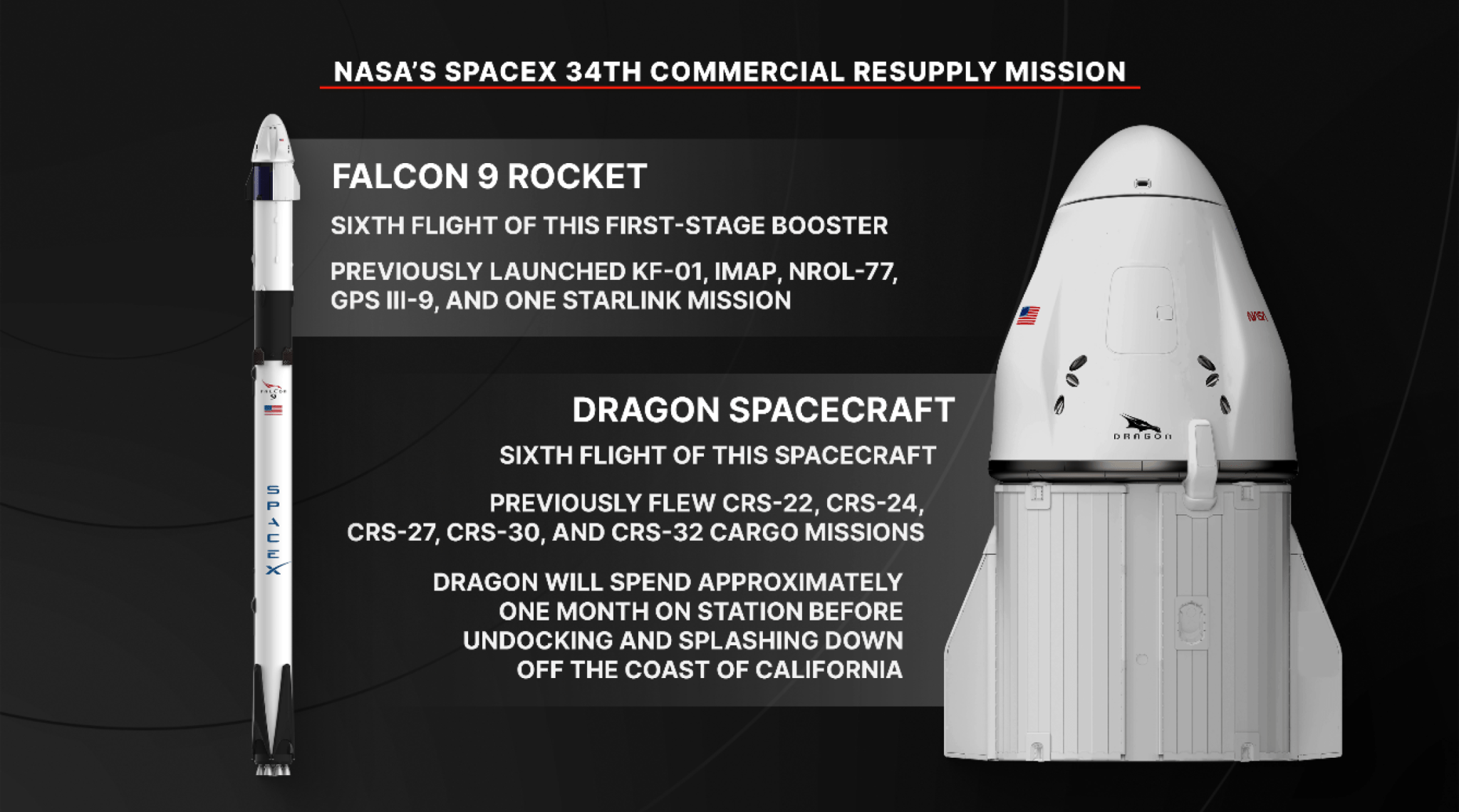
NASA and SpaceX are preparing to launch the company’s 34th Commercial Resupply Services mission to the International Space Station, aiming for a mid-May liftoff that will carry new research projects alongside critical hardware and everyday supplies for the orbiting crew. The cargo—about 6,500 pounds in total—will fly inside a SpaceX Dragon spacecraft launched on a Falcon 9 rocket from Launch Complex 40 at Cape Canaveral Space Force Station in Florida.
After reaching orbit and completing its rendezvous, Dragon is set to dock on its own at the forward-facing port of the station’s Harmony module. NASA plans to provide launch and arrival coverage on NASA+, Amazon Prime, and the agency’s YouTube channel, with additional viewing options available through NASA’s online platforms and social media.
The flight continues a logistics pipeline that has become central to sustaining the station’s research output. The International Space Station has been continuously used for microgravity investigations for more than a quarter century, enabling researchers from over 110 countries to run more than 4,000 experiments. Results from the ISS support the development of longer-duration human exploration—work tied to NASA’s Artemis program for missions to the Moon and, eventually, Mars—while also producing knowledge and technologies with potential benefits on Earth.
Among the investigations launching on this Dragon are several experiments aimed at improving both spaceflight capabilities and basic scientific understanding. ODYSSEY will test how accurately ground-based microgravity simulators replicate the conditions of space. The study will focus on bacterial behavior in orbit and compare those findings with parallel experiments performed in Earth-based simulators.
Another payload, STORIE, is designed to track charged particles in Earth orbit—an environment that changes in response to space weather. Those variations can influence infrastructure and technology, including satellites and power grids, and the instrument is expected to help researchers refine how such disturbances are predicted and managed.
A third experiment, Laplace, will examine how dust particles move and collide in microgravity. By observing how small particles behave when gravity-driven settling is removed from the equation, researchers hope to build a clearer picture of processes linked to Earth’s origins and the formation of planets in our solar system and beyond.
Several investigations on the manifest also focus on human health. Green Bone will study how bone cells grow and mature in space using a wood-based scaffold. Data from the microgravity environment could inform improved treatments for conditions involving weak or brittle bones, including osteoporosis. SPARK will investigate how red blood cells and the spleen respond to spaceflight by analyzing human samples and imagery collected before, during, and after a mission—work intended to guide countermeasures that protect astronaut health during long-duration expeditions.
NASA astronaut Jack Hathaway and European Space Agency astronaut Sophie Adenot are slated to monitor Dragon’s approach and docking. Once attached, the spacecraft is expected to stay at the station for roughly a month before departing for a Pacific Ocean splashdown, returning time-sensitive research samples and hardware for analysis on Earth.
In addition to science, the mission is delivering multiple replacement and maintenance items to support station operations. These include a new power cable for the European Enhanced Exploration Exercise Device, a catalytic reactor used in the Water Recovery and Management System to oxidize volatile organics in wastewater, and two Universal Pretreat Concentrate Tanks—plus an adapter to connect with a Russian hose—to support waste management systems in tandem with the Russian pretreat tanks currently in use. Also flying are an Ultraprobe ultrasonic inspection tool to replace worn equipment, a Remote Sensor Unit to replenish spares for the station’s vibration monitoring system, and flexible patches intended for sealing the station’s pressure hull if necessary. The cargo also includes an updated ARMADILLO cartridge and hose assemblies aimed at improving water processing.