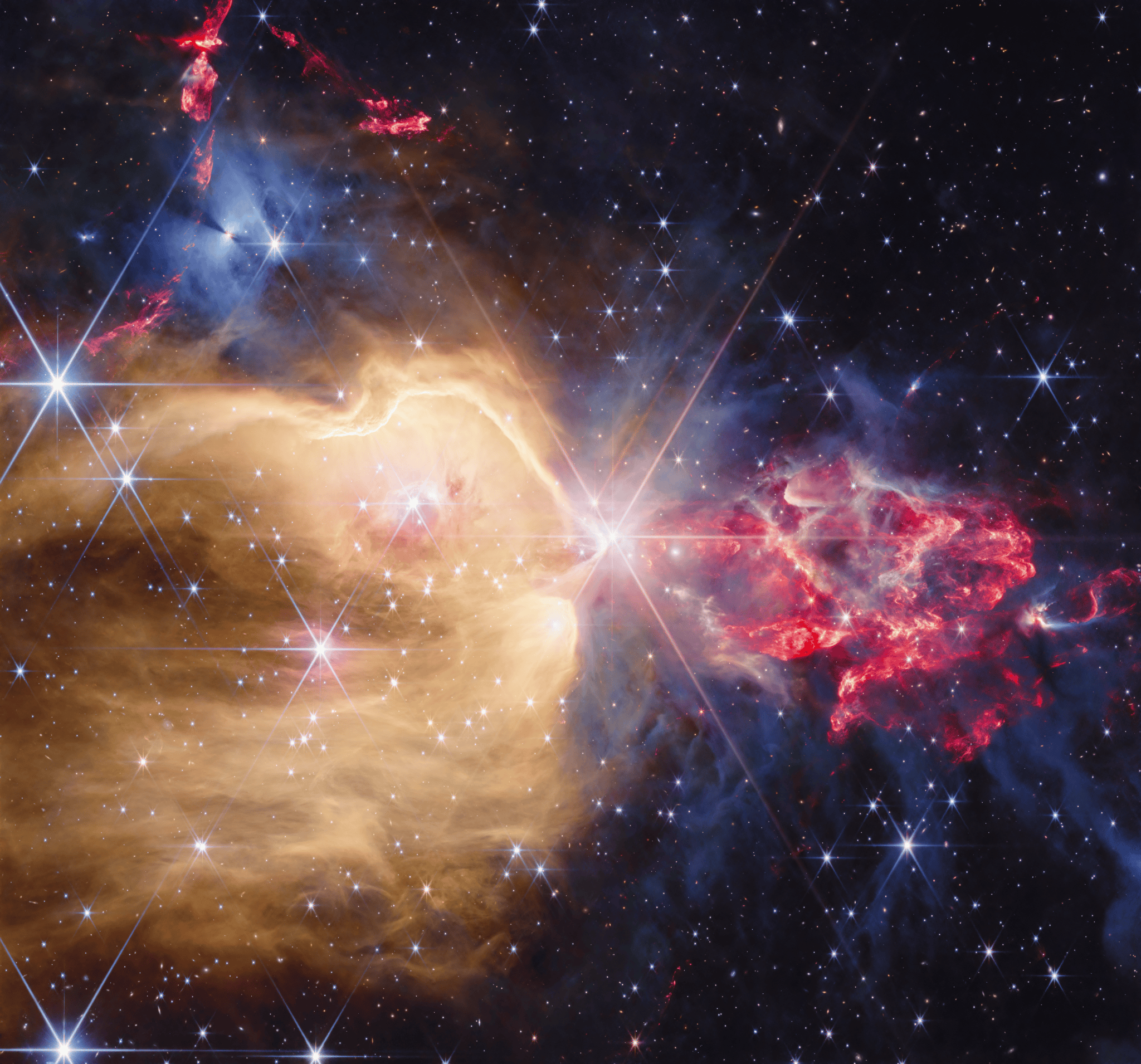
A new James Webb Space Telescope image reveals the star-forming nursery NGC 7129 in unprecedented detail, peering through dust to uncover many hidden young stars.
NASA released a new image from the James Webb Space Telescope on Oct. 6, 2026, offering a vivid look into an active star-forming environment long obscured from view. The scene centers on NGC 7129, a stellar nursery located roughly 3,300 light-years from Earth, where dense clouds of gas and dust serve as the raw material for new stars.
Using Webb’s powerful infrared capabilities, astronomers were able to peer through much of the dust that blocks visible-light observatories, revealing a far richer population of young stars than previously seen. The image presents the region as a turbulent, glowing pocket of “cosmic creation,” where radiation and outflows from newborn stars reshape their surroundings and carve structure into the surrounding material.
NGC 7129 has been studied for decades as a nearby example of the processes that build stars, but Webb’s view highlights details and objects that were effectively hidden behind dusty veils. By bringing these embedded stars into view, the telescope helps researchers better trace where stars are forming within the cloud and how their early activity influences the evolution of the nursery.
The image was produced through an international collaboration involving NASA, the European Space Agency (ESA), and the Canadian Space Agency (CSA), with image processing credited to Alyssa Pagan of the Space Telescope Science Institute (STScI). Alongside the release, NASA points audiences to additional information about NGC 7129 and offers a way to explore the region through an interactive, guided experience designed to help viewers navigate the complex structures captured by Webb.
Why it matters
Star-forming regions like NGC 7129 are laboratories for understanding how suns—and potentially planetary systems—take shape, but dust often hides their earliest stages. Webb’s ability to uncover previously unseen young stars gives scientists a clearer census of stellar birth and the forces that sculpt these nurseries. What comes next will be follow-up analysis of the newly revealed objects, including their ages, masses, and how their outflows and radiation are transforming the cloud.