As the Martian calendar ticked toward the Fourth of July, NASA’s Curiosity rover spent a busy stretch of sols closing in on a striking geological transition: a boundary…
As the Martian calendar ticked toward the Fourth of July, NASA’s Curiosity rover spent a busy stretch of sols closing in on a striking geological transition: a boundary separating a notably smooth, slightly sandy surface from a tougher, more exposed bedrock unit. Having left behind the polygon-patterned ground it had been traversing, Curiosity reached its first worksite of the week on Sol 4939. The next sol (4940), the rover scanned for dust devils with its navigation cameras and carried out an autonomous AEGIS-selected chemistry observation with ChemCam, paired with Mastcam images of a target chosen by onboard software. No suitably sized rocks were available at that stop for cleaning with Curiosity’s Dust Removal Tool (DRT).
On Sol 4941, the mission turned to close-up and compositional work on small rock fragments. Curiosity’s MAHLI hand-lens camera examined two light-toned pieces named “Malpartida” and “Pico del Tunari,” while the APXS instrument measured their chemistry using X-ray spectroscopy. ChemCam then fired its laser at another pale bedrock fragment, “Kunturiri,” and switched to passive measurements on “Mecoyita,” a darker “float” rock that appears to have been transported from elsewhere. ChemCam’s Remote Micro-Imager (RMI) also targeted sedimentary layers near the base of the Cordillera butte, while Mastcam built mosaics of a ridge of sand mixed with rock fragments dubbed “Sitajana.”
The following sol (4942) extended that campaign. Mastcam continued imaging Sitajana, and ChemCam RMI collected additional views of Cordillera. Atmospheric monitoring ran in parallel: Navcam recorded a suprahorizon cloud movie and another dust-devil movie. ChemCam also analyzed a dark bedrock target called “Toconce,” with Mastcam providing documentation images. Mastcam additionally observed “Sierra Vicuña Mackenna,” a partially exposed rock that appears to be releasing sand into a nearby patch of small dune ripples.
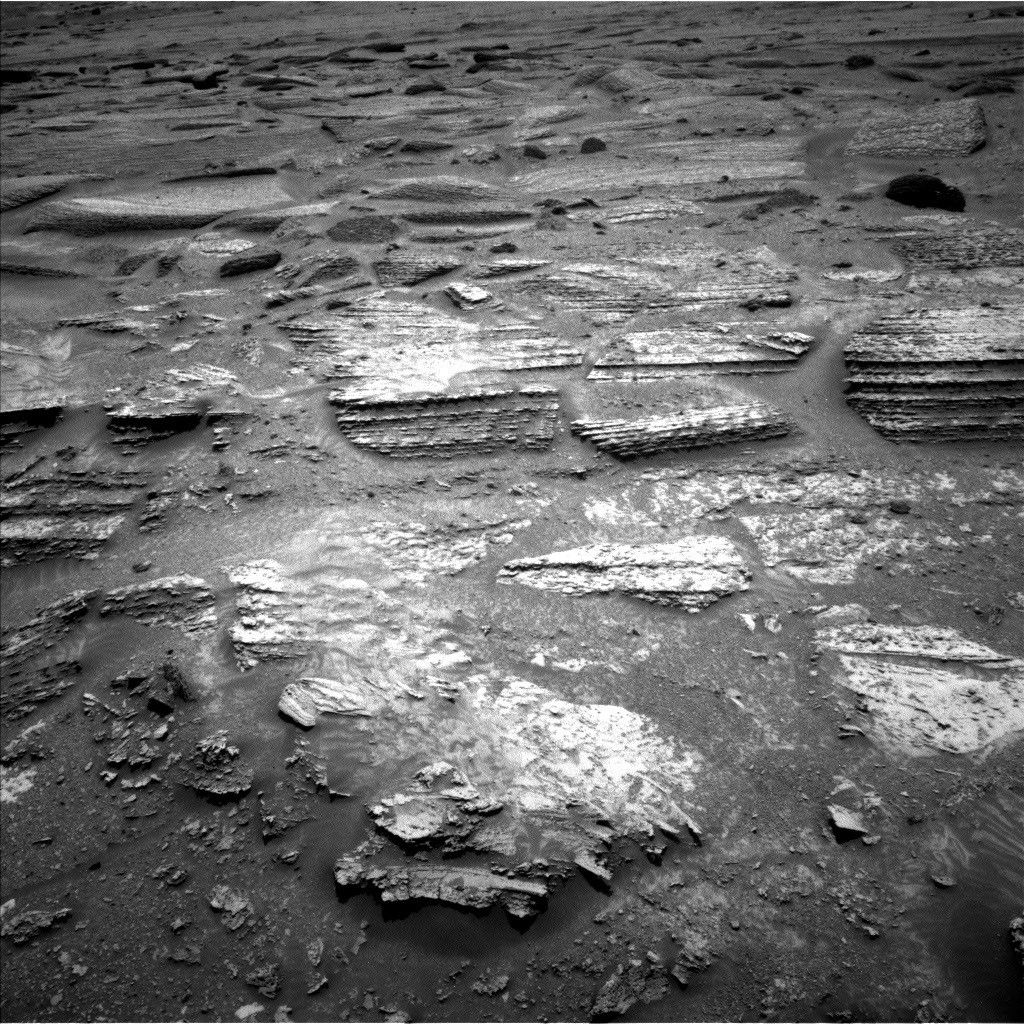
Later on Sol 4942, Curiosity drove roughly 36 feet (about 11 meters) to the edge of the contact zone. Post-drive panoramas from Navcam and Mastcam revealed a broad field of bedrock outcrops marked by crisp, “pinstriped” layering. Navcam then performed an AEGIS observation to nominate a soil-and-rock target for ChemCam. That target was subsequently analyzed on Sol 4943 using ChemCam laser spectroscopy, again with Mastcam imaging for context. The rover also captured another dust-devil movie and a Mastcam observation to gauge atmospheric dust.
Plans for Sol 4944 focused on hands-on sampling of the newly encountered bedrock. Two neighboring light-toned targets—“Laguna Fea” and “Laguna Lejia”—were chosen for brushing with the DRT, detailed MAHLI imaging, and APXS measurements to determine composition. ChemCam was scheduled to probe a darker bedrock ledge named “Hornillos.” Although MAHLI would image Hornillos up close, the surface was judged too rough for brushing. Mastcam’s agenda included a large mosaic of the striped outcrop field “Cerro Castillo,” plus a smaller mosaic of a nearby trough. ChemCam RMI was set to examine a dark layer on Cordillera that appears to be shedding dark boulders, while Navcam continued routine monitoring with dust-devil and cloud movies.
On Sol 4945, ChemCam was slated to analyze “Laguna Lejia” and use RMI to inspect another location at Cordillera’s base where the distribution of large stones hints that ice-related processes may have influenced the slope. A lengthy overnight APXS atmospheric observation was also planned. Later activities included ChemCam work on a target called “La Puntilla,” a passive sky measurement, and a drive of about 56 feet (17 meters) toward a prominent dark boulder visible ahead.