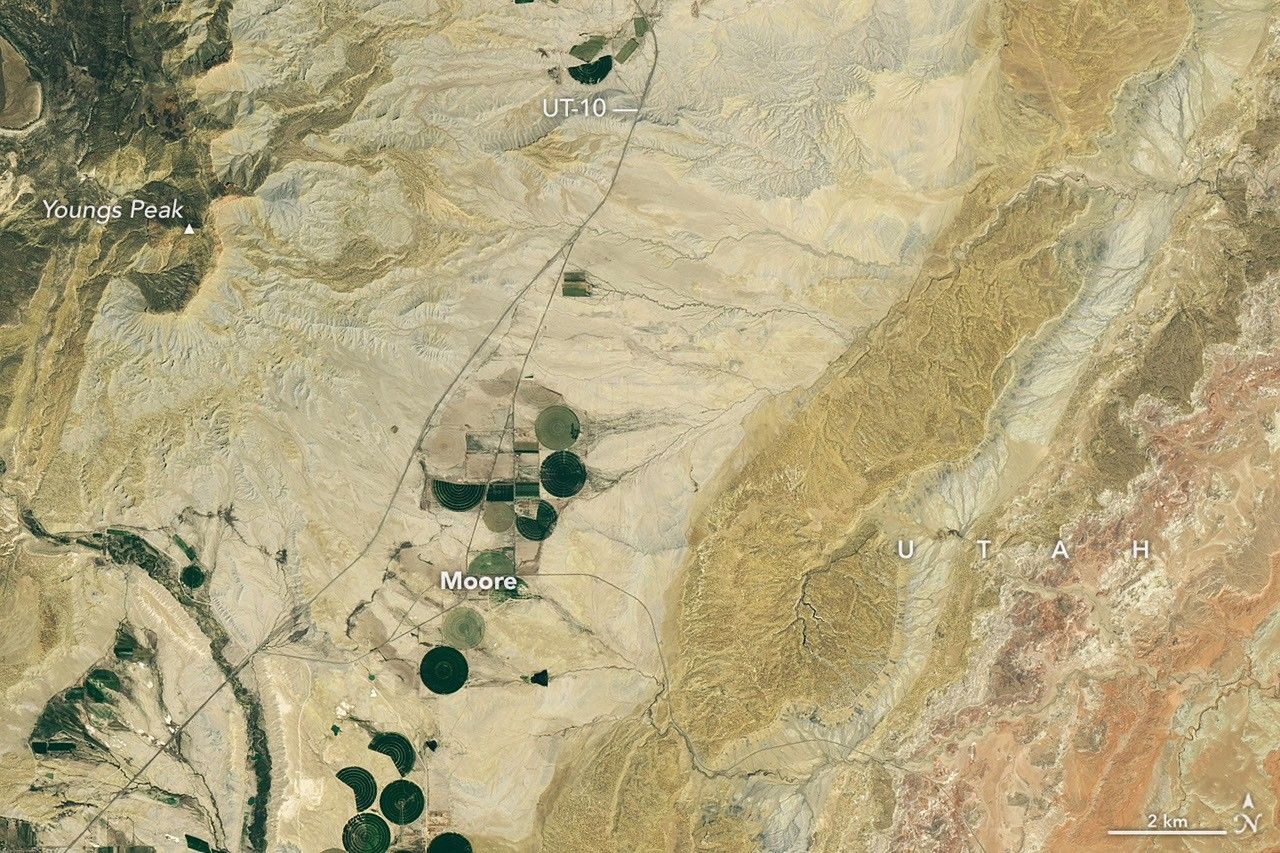
Utah’s new solar power and battery storage facility is among the largest in the region.
Utah’s new solar power and battery storage facility is among the largest in the region. Historically, central Utah’s Castle Valley has been a coal hub, withmining operationson the slopes of the Wasatch Plateau to the west active since the late 1800s. A different energy development arrived in the region in June 2026, when a large solar power and battery storage plant came online in thesunny valleyabout 130 miles (210 kilometers) southeast of Salt Lake City. The recently constructed Green River Energy Center, seen in theLandsat 8image above (right), features nearlyone million solar panelsand roughly 500 batteries on several square miles of previously undeveloped land. The facility has 400 megawatts of solar-generating capacity with another 400 megawatts of battery storage. That places it among the many utility-scale solar power and battery storage projects that theU.S. Energy Information Administrationexpects to be plugged into the country’s grid in 2026. The Utah facility is slated to supply power to Salt Lake City and other areas across the state, according tonews reports, and project staff estimate it could produce enough electricity for more than 100,000 homes. With its integrated battery storage, the plant has the potential to generate power at all hours, even when the Sun isn’t shining. And the Green River Energy Center can build on Castle Valley’s energy legacy by utilizingexisting transmission linesoriginally built for coal-fired power plants in the area. Though Utah adopted coal as its state rock and has long relied on it for energy, other sources, such as solar and geothermal, are becoming larger parts of the state’s energy mix. In 2025, coal fueled about half of thestate’s electricity generation, down from about 75 percent in 2015. Meanwhile, solar grew to account for about 14 percent of generation in 2025, up from nearly zero a decade before.Satellite datacan be useful to planners and policymakers involved in energy transitions for assessing the potential of renewable energy systems and tracking their adoption and performance. NASA Earth Observatory images by Lauren Dauphin, using Landsat data from theU.S. Geological Survey. Story by Lindsey Doermann. Stay up-to-date with the latest content from NASA as we explore the universe and discover more about our home planet. A recent analysis revealed where artificial light at night has intensified, as well as where it has diminished. From a geothermal hotspot to the one-time “Lighthouse of the Pacific,” the heat is on beneath the volcanic landscape of… An astronaut’s photo, taken en route to the Moon, reveals our planet and its place in space in a novel… Subscribe to the Earth Observatory and get the Earth in your inbox. NASA's Earth Observatory brings you the Earth, every day, with in-depth stories and stunning imagery. Open access to NASA’s archive of Earth science data