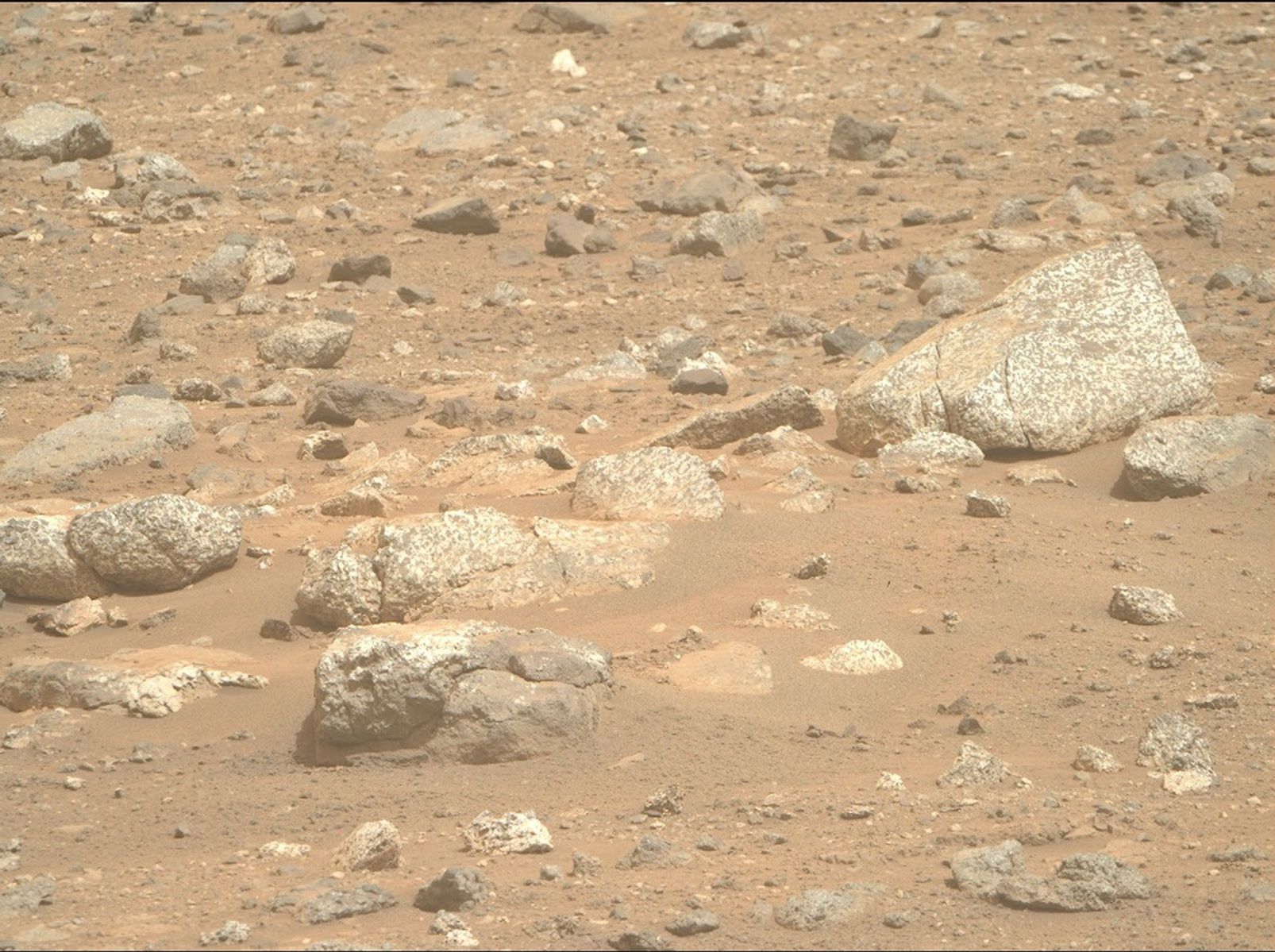
NASA’s Perseverance rover has found an unusual spread of pale rocks near Jezero crater, with early data pointing to gabbro and possible impact-made breccia.
After half a year traversing “Lac de Charmes,” a swath of ancient terrain just beyond the western rim of Jezero crater, NASA’s Perseverance rover has encountered something that stands out against Mars’ typically dark landscape: an extensive scatter of pale, light-toned rocks spread across the surface.
On a planet where basalt—dark, volcanic rock—dominates most visible outcrops and boulder fields, the sheer abundance of light-colored material in one location has quickly drawn the attention of the mission’s science team. The questions are straightforward but consequential for reconstructing Mars’ deep history: What are these rocks made of, and how did they end up here?
To get at the first question, Perseverance has been examining both the chemistry and the physical textures of the light-toned blocks. Measurements so far indicate that many of the rocks are gabbro, an igneous rock rich in iron- and magnesium-bearing minerals. On Earth, gabbro is typically associated with magma that cools slowly and crystallizes at depth, producing coarse-grained rock within the crust rather than at the surface.
That finding immediately raises the second question. If gabbro usually forms deep underground, why are fragments of it now sitting on the Martian surface, strewn across a hillside in and around Jezero’s rim region?
In the past week, the rover has begun probing a nearby patch that may represent local bedrock, exposed between the pale boulders and the loose surface debris known as regolith. Early imagery of this outcrop suggests it contains an assortment of angular, light-and-dark rock pieces locked together—features characteristic of a breccia. Geologists use that term for rocks made from broken fragments that have been cemented into a single mass.
One working idea is that the bright boulders scattered across the slope may have weathered and eroded out of this breccia unit. If the bedrock is indeed a breccia, it would point toward an energetic origin: breccias are commonly produced by violent events that shatter rock, move it, and redeposit it in ways that preserve sharp-edged fragments.
Impacts are a leading suspect. Previous observations of breccia layers outside Jezero crater have been linked to asteroid strikes during Mars’ early history. The team is now considering whether similar impacts—or possibly processes connected to the Jezero-forming impact itself—could have excavated deeper crustal material such as gabbro and emplaced it where Perseverance can examine it today.
For now, the rover is still in the evidence-gathering phase, combining close-up imaging with compositional measurements to determine how the pale blocks, the surrounding regolith, and the suspected breccia outcrop relate to one another. As the mission continues, Perseverance’s ongoing fieldwork will help clarify whether these rocks represent a window into Mars’ deep crust, a record of ancient bombardment, or both.
Why it matters
If Perseverance is seeing gabbro brought up from depth, it could provide rare, direct clues about the composition and evolution of Mars’ crust—information that is usually hidden below the surface. Confirming an impact-related breccia origin would also strengthen the timeline of early asteroid bombardment around Jezero. The next key step is tying the loose boulders to a specific bedrock source, which would sharpen interpretations and guide future sampling decisions.