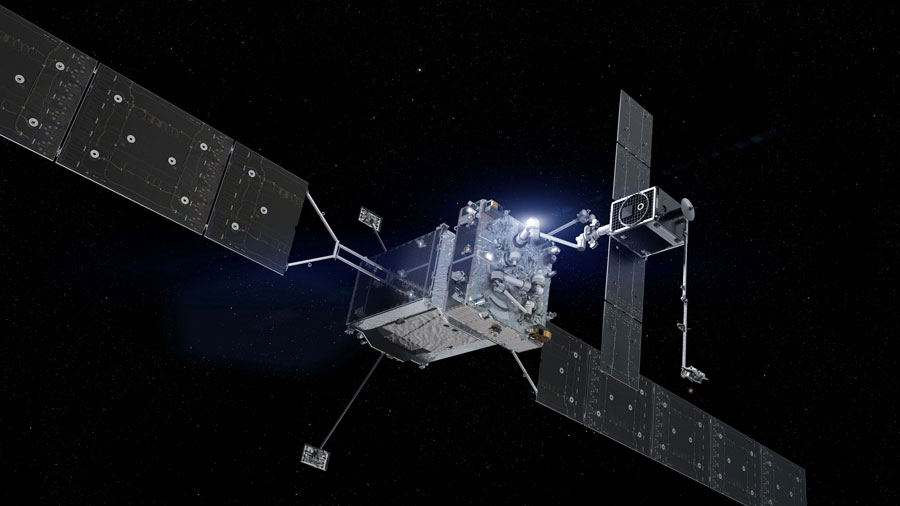
Northrop Grumman and Carnegie Mellon are refining a “peg-in-hole” docking method so servicing spacecraft can securely attach to satellites and perform refueling and repairs in geosynchronous orbit.
Placing a peg into a hole is a task most people master in childhood. Doing the same thing in space—more than 22,000 miles above Earth—becomes a high-stakes robotics problem where a slight misalignment can jeopardize an entire mission. Northrop Grumman is betting that it can solve that challenge to unlock a new era of satellite servicing in geosynchronous orbit, and it has turned to Carnegie Mellon University’s Robotics Institute for help.
The work centers on a capability known in robotics as “peg-in-hole”: reliably inserting a probe into a receptacle when both objects may be moving, visibility can be limited, and precise force control is required. For satellites in geosynchronous orbit, the payoff is potentially enormous. Thousands of satellites circling Earth are no longer operational, Carnegie Mellon professor Howie Choset said, often because they have depleted their fuel. The prevailing model has long been “launch once, use once,” he noted—but in-orbit servicing could allow valuable spacecraft to stay in operation far longer, potentially indefinitely.
Northrop Grumman has already flown multiple servicing missions, and its latest vehicle—the Mission Robotic Vehicle (MRV)—is designed to expand what those spacecraft can do. The MRV launched in July from Cape Canaveral, Florida. Roughly comparable in size to a short school bus, it is built to rendezvous with client satellites in geosynchronous orbit and attach securely enough to support refueling and other operations.
According to Andrew Kwas, a senior fellow at Northrop Grumman Space, one of the biggest technical obstacles has been the fact that many satellites were never designed to be grabbed or docked with. Without a standardized interface, creating a stable mechanical connection is difficult. The approach developed with Carnegie Mellon uses a probe that enters the nozzle of a target satellite’s liquid apogee engine—typically the spacecraft’s main engine—so the two vehicles can be joined firmly. Once docked, the servicing spacecraft can hold the client satellite steady for refueling through a separate port and for robotic work.
Kwas said the Robotics Institute contributed analytical and modeling expertise that helped validate the docking method and prepare for edge cases. After years of joint contingency analysis before the first successful mission, he said, the docking process has now been carried out on orbit multiple times.
So far, servicing missions have focused mainly on extending satellite life by adding fuel. But the MRV broadens the menu. Kwas said the platform is intended to support repairs, component replacement, and upgrades while spacecraft remain in orbit. One example is addressing issues with solar panels—another common failure point—such as freeing a stuck panel or fixing a mechanism that prevents full deployment.
For Choset, the collaboration draws on a long history of tackling peg-in-hole problems in terrestrial robotics. Successful insertion depends not only on vision-based alignment but also on “feel”—haptic feedback that helps a robot sense contact forces and correct its motion. Choset is well known for developing snake-like robots, including systems his team recently used in Venezuela to search for survivors in rubble after a June earthquake.
That work helped inspire a key enabling technology: a “series elastic actuator,” developed years ago by Choset’s former student David Rollinson, that measures the forces it applies—akin to how human muscles both exert and sense pressure. Rollinson is now chief technology officer at HEBI Robotics, a company Choset founded in 2014.
Choset’s group also built a robotic test environment—dubbed a “holodeck”—with two robotic arms mounted on a rail to emulate how robotic systems behave in microgravity. Combined, those tools and experience made the Robotics Institute a strong fit for refining docking operations in space, Kwas said.
Why it matters
Many satellites fail not because their electronics break, but because they run out of propellant—turning expensive infrastructure into debris or dead weight in valuable orbits. Reliable in-orbit docking and servicing could extend spacecraft lifetimes, reduce replacement launches, and enable repairs and upgrades that were previously impossible. The next key question is how broadly such docking methods can be applied across satellite designs and how quickly servicing can become routine rather than bespoke.