A manufacturing method originally pushed forward by NASA’s drive to design livable structures on the Moon is now influencing how buildings are made on Earth—delivering…
A manufacturing method originally pushed forward by NASA’s drive to design livable structures on the Moon is now influencing how buildings are made on Earth—delivering architectural components that are lighter, tougher, and more visually distinctive.
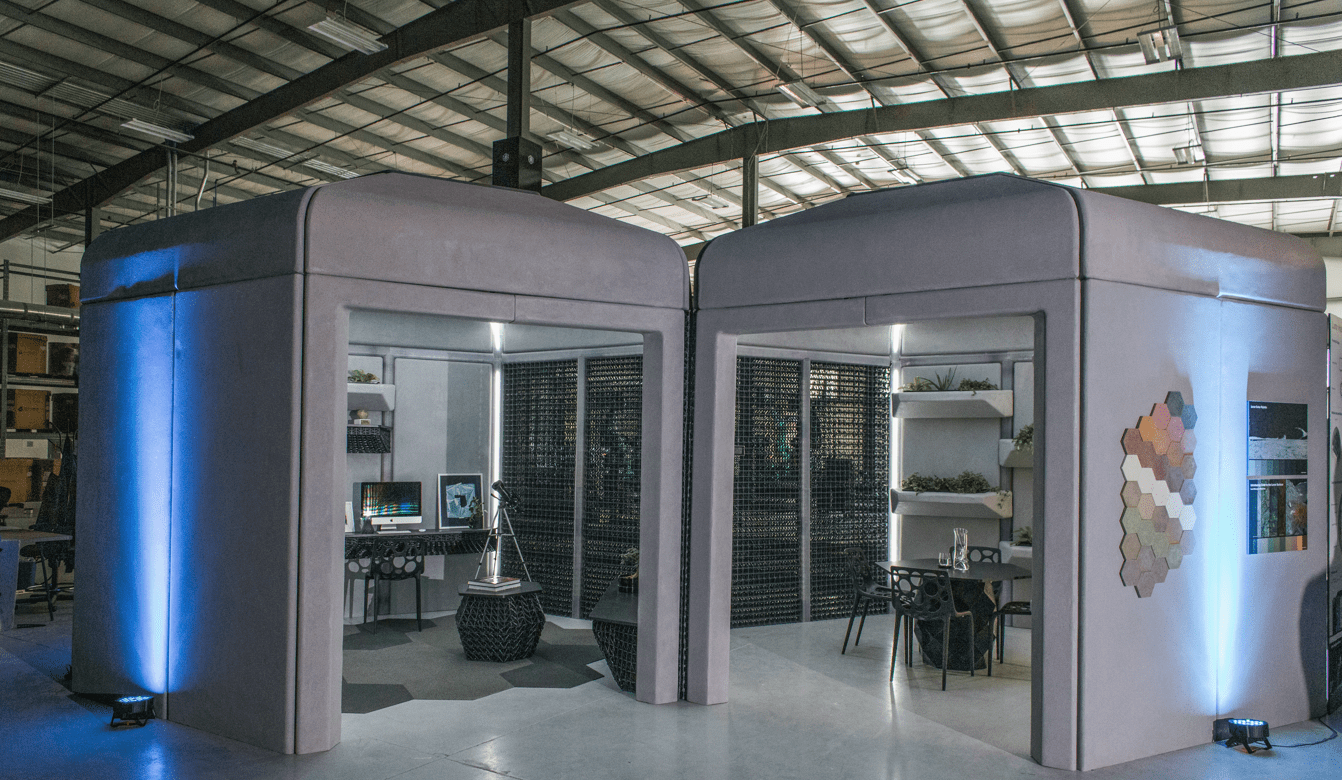
Branch Technology Inc., based in Chattanooga, Tennessee, has developed what it calls Freeform 3D Printing. Unlike conventional additive manufacturing that stacks material in solid, continuous layers, Branch’s approach prints airy, skeletal lattice frameworks. Those lattices can then be filled, coated, or skinned depending on the application. The result is a family of modular construction elements—such as wall panels and exterior cladding—that can achieve complex shapes without the weight and material use typically associated with fully solid prints.
“Our process eliminates a ton of material from something that otherwise might be printed solid all the way through,” said David Goodloe, who leads the company’s Advanced Concepts team and oversees Branch Technology’s collaborations with NASA.
The company’s space-related momentum accelerated in 2017, when Branch won Phase II of NASA’s 3D-Printed Habitat Challenge, a public competition aimed at developing ways to build habitats suitable for deep-space exploration. The challenge wasn’t only about whether teams could fabricate a large shell on another world. It also raised a practical question: once a habitat is built and pressurized, how would a crew outfit it with the internal systems, tools, and supplies needed to live and work?
Tracie Prater, a technical manager in the Habitat Systems Development Branch at NASA’s Marshall Spaceflight Center in Huntsville, Alabama, served as a subject matter expert for the competition and later worked with Branch through a cooperative agreement. She emphasized that the company’s work extended beyond exterior structures to what could be made on demand inside a functioning habitat. In that setting, a fabrication process capable of producing customized interior components could expand design options and reduce the need to launch every spare part from Earth.
NASA’s performance requirements for the habitat challenge also shaped Branch’s hardware. To meet the competition’s goals, the company refined its extrusion nozzles so they could print both unconventional lattice geometries and standard layered sections. That combination has since become central to Branch’s building products: lattice regions minimize mass, while traditionally printed areas provide solid attachment points where fasteners and other hardware need reliable substrates.
Materials development was another direct outgrowth of the NASA work. The challenge encouraged teams to consider “in-situ” resources—materials analogous to Martian dust and rocks—along with recyclables that might be available during a mission. Branch’s research led to a basalt fiber–reinforced plastic and, from that foundation, the company derived an optimized loading recipe for the printable “inks” it uses in terrestrial manufacturing today.
The pathway from lunar-habitat concepts to Earth construction reflects the broader purpose of NASA’s Technology Transfer efforts within the Space Technology Mission Directorate: adapting innovations developed for space into practical tools that improve everyday life. For half a century, the agency has tracked those downstream benefits in its Spinoff publication, which documents how aerospace-driven advances migrate into commercial products and services.