Astronomers mining NASA’s Hubble Space Telescope archives say they have cracked a decades-old mystery surrounding a faint stellar remnant—and, in the process, may have…
Astronomers mining NASA’s Hubble Space Telescope archives say they have cracked a decades-old mystery surrounding a faint stellar remnant—and, in the process, may have found evidence for an unusual kind of world: a “second-generation” planet built from a star’s own discarded material.
In research published Monday in Nature Astronomy, a team reports that the white dwarf HS 0209+0832 shows an unexpectedly strong chemical signature of niobium, a relatively rare element whose presence could point to planet formation occurring after the star’s death. White dwarfs are the dense cores left behind when low-mass stars exhaust their nuclear fuel and shed their outer layers into space. Most known planets, including those in our solar system, are “first-generation,” assembled from gas and dust left over from a star’s birth. A second-generation planet, by contrast, would form later—out of the material expelled as the star transitions into its white dwarf phase.
Jamie Williams, a University of Warwick doctoral researcher and the study’s lead author, reexamined Hubble spectra taken in 1999. At the time, the observations contained roughly 100 spectral features that astronomers could not identify. Using more modern atomic databases, Williams found that many of those puzzling lines match niobium.
The element itself isn’t exotic on Earth—niobium is used in applications ranging from jewelry to medical imaging—but it is astrophysically distinctive. As team member Nicholas Stone, a theoretical astrophysicist at the University of Wisconsin–Madison, explained, elements heavier than iron are generally not produced by the steady fusion reactions that power normal stars. Instead, they are forged in short-lived, extreme episodes associated with stellar death. Niobium, the researchers argue, is a chemical breadcrumb indicating that HS 0209+0832 once expelled “death-throes” material enriched with heavy elements.
The team’s scenario is that some of this enriched ejecta ultimately coalesced into a gas giant planet, while the rest dispersed into interstellar space. Warwick astronomer Boris Gaensicke, a co-author on the paper, said the identification was startling because niobium had not previously been reported in any other white dwarf studied in this way.
To bolster the case, the researchers compared the Hubble findings with observations from NASA’s now-retired Far Ultraviolet Spectroscopic Explorer (FUSE), which also shows strong niobium signatures associated with HS 0209+0832.
They then turned to a different kind of evidence: the system’s brightness. NASA’s Transiting Exoplanet Survey Satellite (TESS) monitored the white dwarf for four months and detected periodic variations consistent with an orbiting companion. The implied orbital distance is about 3.7 million miles (6 million kilometers)—well inside Mercury’s orbital radius around the Sun.
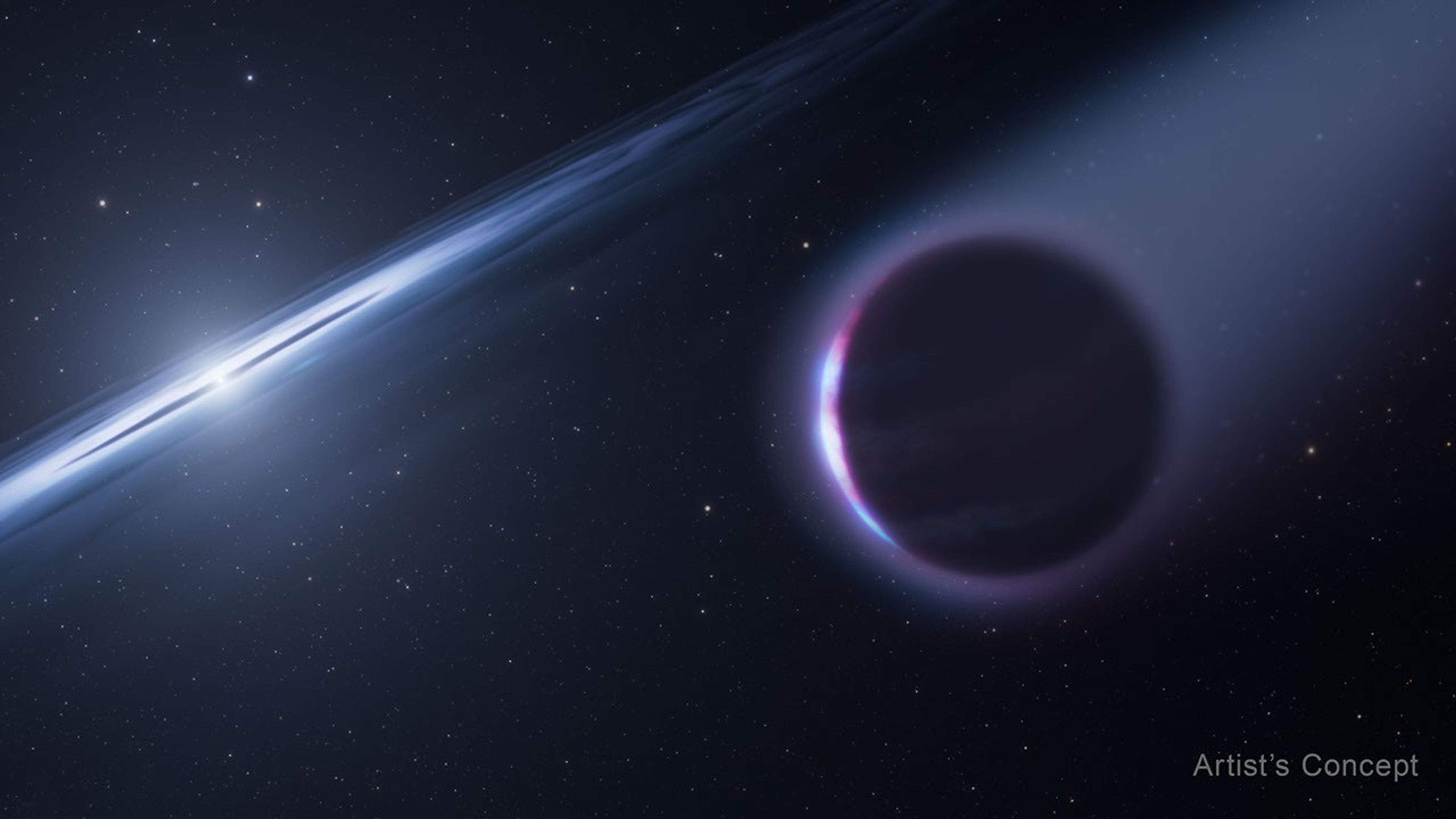
Based on the data, the candidate planet is estimated to be roughly Jupiter-sized and losing atmosphere quickly. The white dwarf is thought to be comparatively young and still extremely hot, bombarding the nearby planet with intense radiation that can strip away its outer layers. That escaping material could trail the planet like a comet tail, forming a disk around the white dwarf and eventually falling onto the star’s surface—where Hubble would then detect the heavy-element pollution, including niobium.
Why it matters
If confirmed, HS 0209+0832 would offer rare observational support for planets forming from a star’s leftover debris rather than its birth cloud, extending the timeline of when planetary systems can arise. The work also shows how revisiting archival space telescope data with updated tools can reveal new discoveries. Astronomers will now want follow-up observations to pin down the planet’s properties, confirm the source of the niobium, and determine how common second-generation worlds might be.