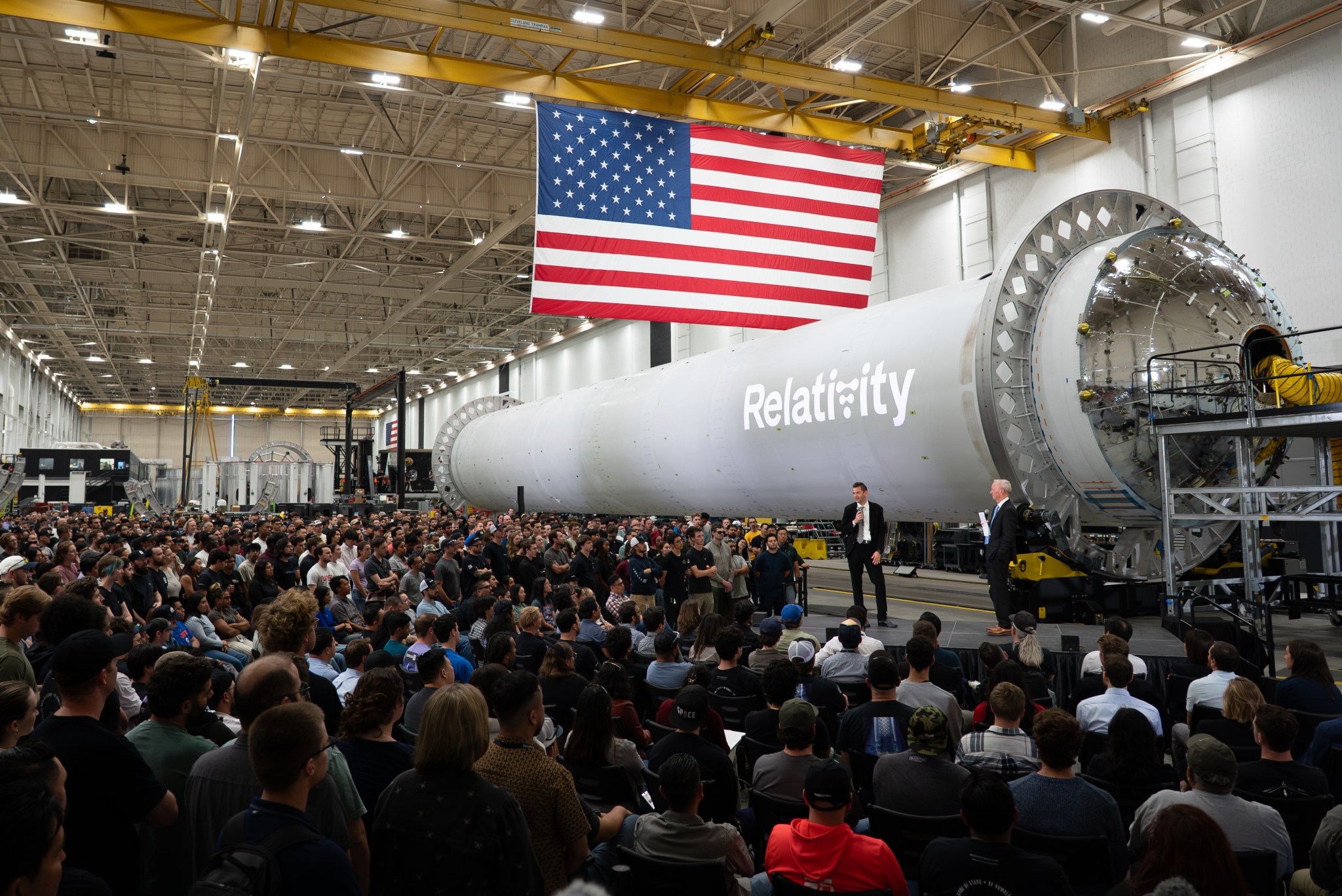
NASA has unveiled a new public-private collaboration aimed at speeding up the pace of Mars atmospheric research by pairing government-built science hardware with commercially provided spaceflight services.
NASA has unveiled a new public-private collaboration aimed at speeding up the pace of Mars atmospheric research by pairing government-built science hardware with commercially provided spaceflight services. Announced Wednesday, the arrangement assigns NASA responsibility for the Aeolus atmospheric-science payload, while Relativity Space will supply the spacecraft and launch vehicle and handle cruise operations to carry the instruments to Mars.
Agency leaders framed the partnership as part of NASA’s broader shift toward mission models that can deliver scientific returns more frequently while laying practical groundwork for eventual human exploration. By leaning on private-sector investment and development capacity for major transportation and spacecraft elements, NASA says it can concentrate more of its budget and expertise on the scientific instruments and the data researchers need—particularly information that could make future landings on Mars safer.
“Public-private partnerships like this are a force multiplier for science,” NASA Administrator Jared Isaacman said, arguing that combining NASA’s instrument capabilities with commercial innovation can increase how often missions fly and shorten the time it takes to put critical measurements in the hands of scientists preparing for future crewed journeys to Mars.
The Aeolus mission is slated for launch in 2028. It consists of a NASA-developed set of four instruments designed to deliver what the agency describes as the first integrated, daily, global picture of key elements of the Martian atmosphere—winds, temperature, airborne dust, and clouds. Those measurements are intended to sharpen atmospheric models, including how dust and wind patterns evolve with the seasons. Such improvements are not only central to basic planetary science; NASA emphasizes that they also translate into engineering knowledge needed to reduce hazards for both robotic and human missions.
More detailed understanding of the Martian environment is expected to directly support the design and operation of entry, descent, and landing systems. By better anticipating wind fields, temperature profiles, and dust activity, mission planners can aim for more reliable predictions of atmospheric behavior—an essential factor for landing heavier payloads and, eventually, astronauts.
Aeolus also extends a long line of NASA investigations of Mars’ atmosphere. The new mission builds on insights from orbiting spacecraft including MAVEN (Mars Atmosphere and Volatile Evolution), the Mars Reconnaissance Orbiter, and Mars Odyssey, while pushing toward more comprehensive global monitoring than previous efforts have provided.
Work on the payload will be led at NASA’s Ames Research Center in California’s Silicon Valley, where teams will design, build, and integrate the instrument suite. Relativity Space will oversee spacecraft development and mission operations. Ames Director Eugene Tu called the project an example of how collaboration can accelerate science while advancing capabilities needed for a future human landing on Mars.
Under the agreement, NASA will operate the science instruments for at least one Martian year, while Relativity Space will be responsible for maintaining the spacecraft. NASA will also develop the data-processing pipeline to convert raw instrument readings into calibrated, high-quality data products intended for broad use by the scientific community.
The partnership is supported through NASA’s first six-year reimbursable Space Act Agreement, which the agency said is meant to provide a stable structure for long-term cooperation, consistent development, and continuity across the mission timeline.