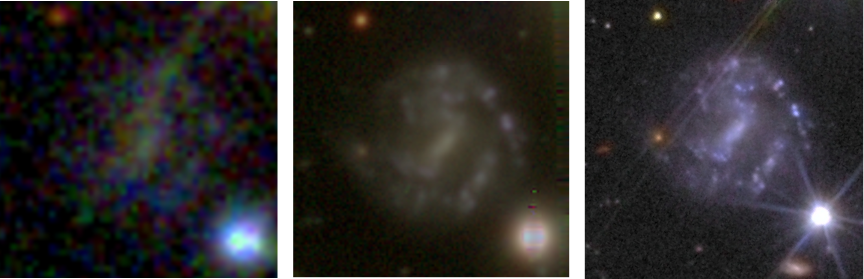
Astronomers have been intrigued for decades by a peculiar class of galaxies that look anything but smooth.
Astronomers have been intrigued for decades by a peculiar class of galaxies that look anything but smooth. First recognized in the mid-20th century, these “clumpy” galaxies are speckled with unusually bright, compact patches—immense star-forming regions where new stars appear to ignite at extraordinary rates. One of the enduring puzzles is historical: surveys show that clumpy galaxies were far more prevalent in the early universe than they are today, yet scientists still don’t know what caused them to fade from prominence over cosmic time.
A new flood of data may help explain what happened. The European Space Agency’s Euclid space telescope—built through an international effort with key contributions from NASA—has begun delivering images of millions of galaxies. The scale of the mission is transformative: Euclid can capture high-quality views across enormous swaths of sky, including detailed snapshots of galaxies that contain these bright star-forming clumps. With enough examples, researchers can start to answer basic but crucial questions: Which kinds of galaxies host clumps? Where do the clumps sit within their galaxies? Do clumps migrate, merge, or disperse as galaxies evolve? And what physical conditions allow such intense stellar nurseries to form in the first place?
The challenge is that the dataset is far too large for professional astronomers to classify by hand. To cope with the volume, scientists are building a “digital assistant” using machine learning—software that can be trained to recognize patterns in images and make consistent, repeatable identifications. That automated approach is essential, but it still depends on carefully vetted examples. Algorithms can be misled by unrelated objects and imperfections: a foreground star can masquerade as a clump, and instrumental artifacts or imaging glitches can trigger false detections.
This is where the public can make a direct scientific contribution. Through the citizen-science project Galaxy Zoo: Clump Scout II, volunteers help refine and improve the machine-learning system by checking Euclid galaxy images that the algorithm has already flagged. Participants will see squares placed by the software at locations it believes contain genuine clumps. The task is straightforward: adjust the squares if they’re slightly off target, remove them when the “clump” is actually a star or a flaw in the image, or add new squares when the algorithm misses a real feature. Each correction becomes feedback that helps the system learn what clumps truly look like across a range of distances, galaxy types, and image conditions.
The effort builds on training work from an earlier initiative, “Galaxy Zoo: Clump Scout,” and now aims to push the classification tool to a higher level of accuracy and reliability. With better identifications at scale, astronomers can systematically study how giant star-forming complexes arise, how they change as galaxies mature, and why clumpy galaxies—once common in the young universe—became comparatively rare.
Participation requires no specialized equipment: a laptop or smartphone is enough to join in. By helping map these bright stellar nurseries across Euclid’s vast image archive, volunteers assist in turning an overwhelming data torrent into a clearer story about how galaxies form stars—and how the universe’s most chaotic-looking galaxies may have settled into the more orderly systems we often see today.