NASA’s Perseverance has found unusually pale rocks on Mars confirmed to be hydrated silica, pointing to past water activity and raising astrobiology interest.
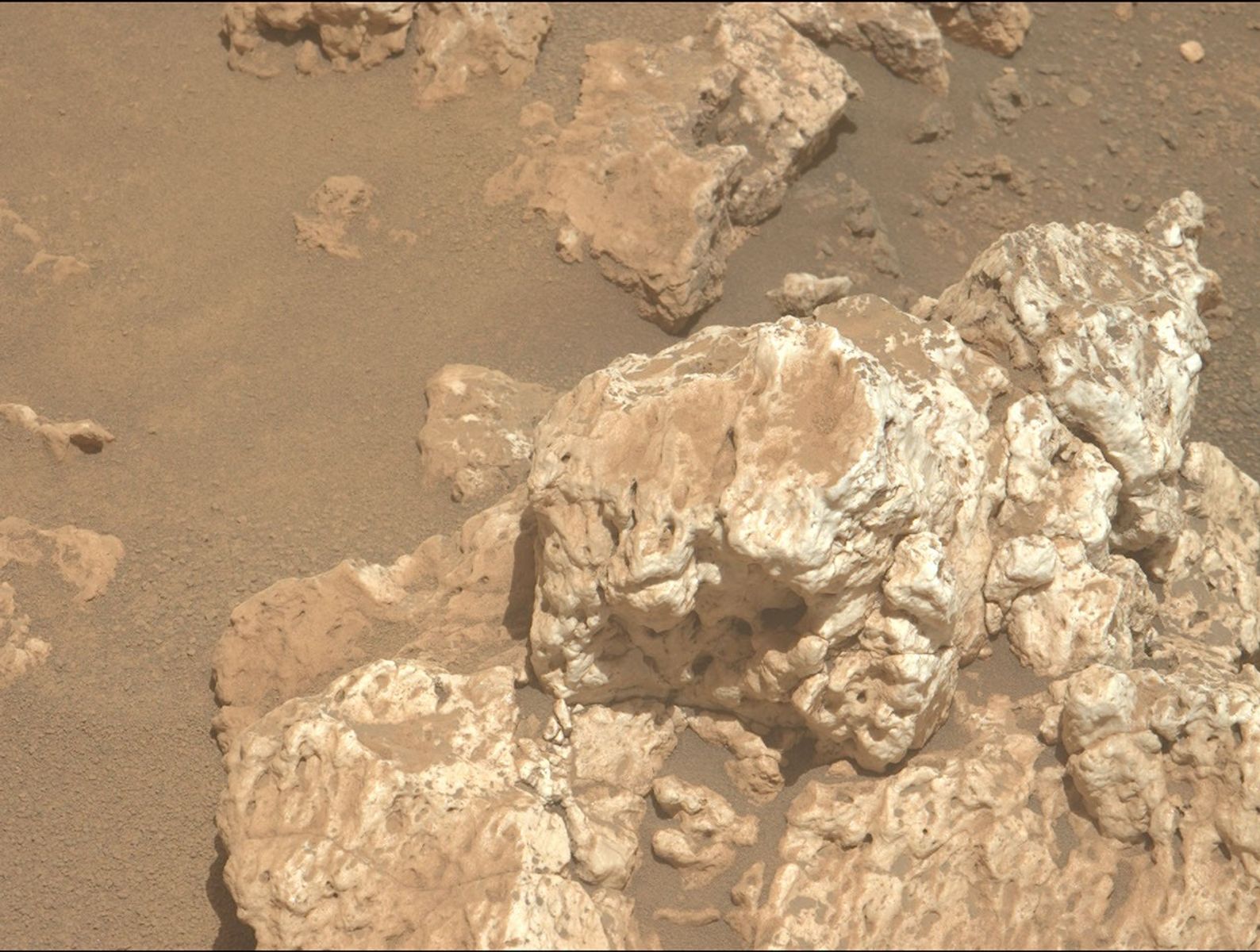
NASA’s Perseverance rover has encountered a striking new set of targets on Mars: a cluster of unusually pale rocks at a site called “Idubi,” where ancient crust is exposed in the Lac de Charmes region outside Jezero crater. Against the planet’s typically dark, dust-coated surface, these fragments appear almost ghostly—standing out even more strongly than the igneous and impact-generated rocks the rover has studied in recent investigations.
The contrast was compelling enough that the science team suspected the rocks might represent something fundamentally different from the volcanic materials that dominate much of the surrounding terrain. To test that idea, Perseverance turned to SuperCam, the rover’s remote-sensing instrument suite designed to probe chemistry and mineralogy from a distance. The newly returned SuperCam observations confirm the hunch: the light-toned rocks are not igneous. Instead, they are enriched in hydrated silica.
That finding matters because hydrated silica is closely linked to water-driven processes. On Earth, similar silica-rich deposits can form in a range of wet environments, including hydrothermal systems, soils shaped by water (pedogenic settings), and groundwater circulation. Translating those possibilities to Mars, the Idubi outcrops could be remnants of past aqueous activity—exactly the kind of evidence scientists use to reconstruct the planet’s hydrological history.
For astrobiology, the implications are especially tantalizing. Several of the environments capable of producing hydrated silica on Earth are also places where microbial life can thrive. Even more importantly, silica can be exceptionally good at preserving microscopic structures over geologic time. In terrestrial settings, silica deposits are known for their ability to entomb and protect microfossils, making them prime materials for searching for traces of ancient life.
Perseverance has crossed paths with silica-rich rocks before. Earlier in the mission, the rover identified similar compositions on the inner rim of Jezero crater. But those occurrences were limited in size, leaving too little material for the rover to carry out an up-close campaign with its high-resolution instruments—the kind of detailed chemical and mineralogical work needed to narrow down how the deposits formed and how well they might preserve potential biosignatures.
Idubi appears to change that equation. The silica-bearing rocks there occur at a scale that makes more intensive investigation feasible, and the mission team has already begun a dedicated proximity science campaign. By examining these targets in greater detail, researchers hope to determine which water-related process produced the hydrated silica and what that reveals about the region’s past conditions.
The work also ties into Perseverance’s broader role as the opening stage of NASA’s Mars Sample Return campaign. While the rover’s day-to-day science focuses on understanding Mars’ geology and habitability, its longer-term objective includes identifying the most compelling materials—especially those linked to ancient water—that could one day be returned to Earth for laboratory analysis.
Why it matters
Hydrated silica can record the story of water on Mars and, crucially, may preserve evidence of ancient microbes if they ever existed. If the Idubi deposits prove to have formed in habitable settings, they could become high-priority targets for future sample collection and, eventually, return to Earth. The next key step is determining exactly how these silica-rich rocks formed—and whether their textures and chemistry show any signs consistent with biosignature preservation.