A newly identified high-temperature material tested at NASA’s Glenn Research Center in Cleveland may make it easier for future lunar crews to rely less on what they haul from Earth.
A newly identified high-temperature material tested at NASA’s Glenn Research Center in Cleveland may make it easier for future lunar crews to rely less on what they haul from Earth. The advance supports NASA’s push toward in-situ resource utilization—technologies designed to help astronauts “live off the land” by processing Moon soil and rock to obtain useful products such as metals for construction and oxygen for fuel and life support.
The discovery emerged from a research collaboration between Dr. Kevin Yu—then working under NASA’s Space Technology Graduate Research Opportunities fellowship and now a technologist at NASA’s Jet Propulsion Laboratory in Southern California—and Dr. Jamesa Stokes, a materials research engineer at NASA Glenn. The pair set out to examine how different candidate materials behave when exposed to molten lunar regolith, a harsh, chemically reactive melt that would be central to any system that liquefies Moon dust to extract resources.
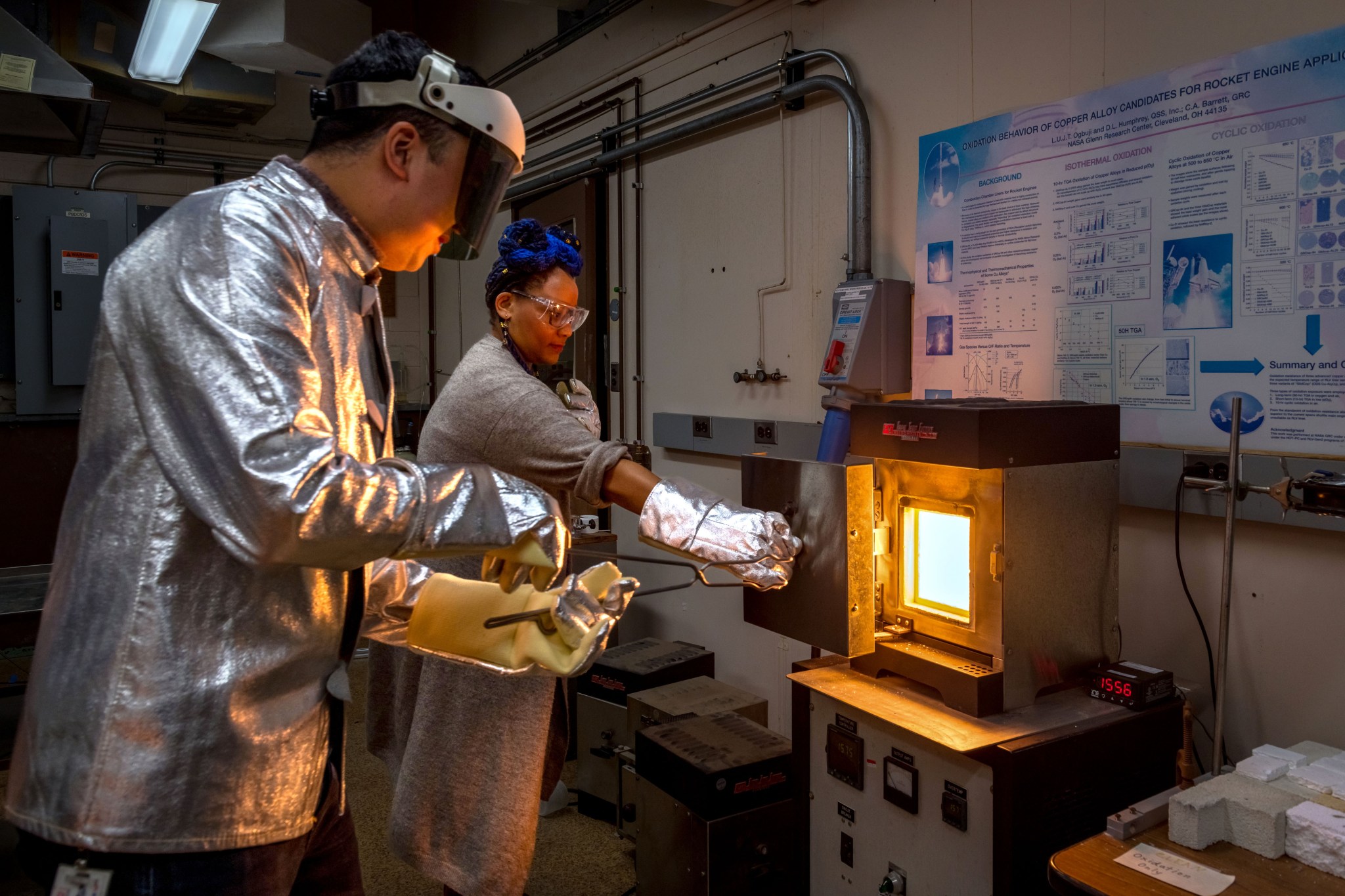
Roughly six months into the study, the team noticed something unexpected. When they blended simulated lunar dust with scandium oxide and then heat-treated the mixture in a furnace heated to a red glow, a previously unknown material appeared to form. They verified their procedures and repeated measurements, then compared the resulting X-ray signatures against a database containing more than one million known substances. No match turned up—suggesting they had produced a compound that had not been characterized before.
With no prior literature to guide them, the researchers began basic characterization from the ground up, including measurements of chemical composition. To create small, isolated batches for controlled testing, they used specialized lab equipment to grind and mix about eight fundamental oxide ingredients in ethyl alcohol. The mixture was then baked at temperatures exceeding 2,900 degrees Fahrenheit.
The powder’s appearance offered an unexpected cue during preparation. Yu noted that it enters the process with a distinctive pink hue—comparable to strawberry milk—and shifts to a light beige or tan once the reaction proceeds correctly, providing a built-in visual indicator of success.
Early performance results were encouraging for lunar applications. The new substance resisted corrosion from molten regolith and tolerated the extreme heat required to liquefy Moon soil—temperatures far beyond household ovens, reaching levels up to six times hotter. Those traits are critical for any practical “melting Moon rocks” approach, where containers, channels, and other components must survive repeated exposure to aggressive, high-temperature melts.
Cost is also part of the equation. Although the material incorporates scandium oxide, which can be pricey, the researchers say it remains significantly cheaper than precious metals such as platinum, which are often used in demanding high-temperature industrial environments.
If further development confirms its promise, the material could influence designs for future lunar resource-extraction systems, potentially serving as the material for pipes, crucibles, or basins that hold and transport molten regolith. Beyond space exploration, the same durability at extreme temperatures points to terrestrial uses as well—particularly as protective coatings for jet engine parts that operate in similarly punishing heat.
In tests aimed at coating applications, the team found the material to be lighter and less dense than current state-of-the-art coating options, while also offering improved thermal insulation. Yu and Stokes have completed initial evaluations and plan to refine the material further, with goals that include improving purity and reducing production costs.
The work underscores how materials science sits at the center of operating in the Moon’s unforgiving environment—and how innovations driven by spaceflight needs can reverberate back to Earth. The research is supported by NASA’s Space Technology Mission Directorate and NASA’s Aeronautics Research Mission Directorate.