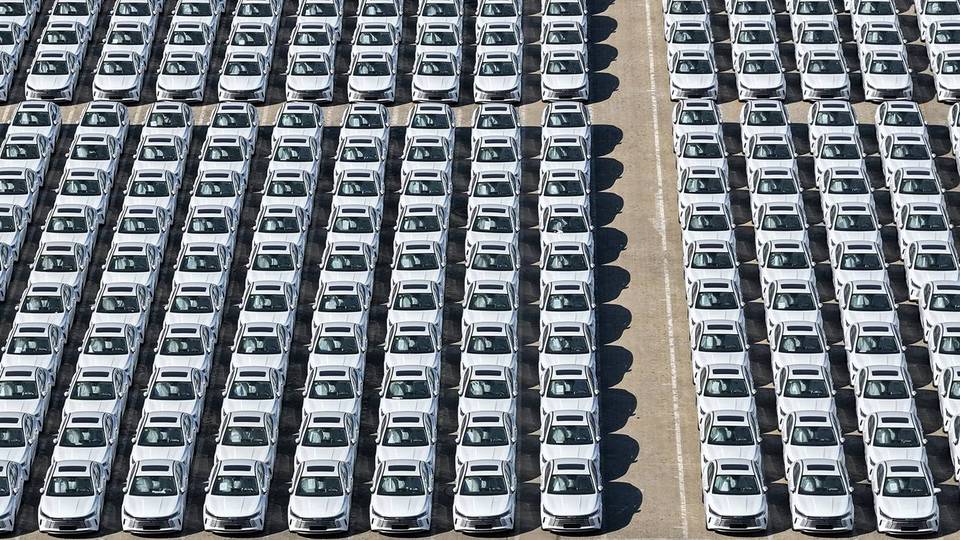
The EU and China are nearing a deal to cap Chinese hybrid car exports to Europe via a voluntary quota, aiming to protect industry while avoiding broad tariffs.
European governments are once again caught between two competing demands: shielding homegrown manufacturers from intense foreign competition while still allowing households to benefit from lower-priced imports. A newly reported arrangement between the European Union and China over automobile trade shows how policymakers are trying to split the difference — and why some economists see this kind of deal as less damaging than blunt, across-the-board tariffs.
Bloomberg reports that EU and Chinese negotiators have reached a tentative understanding to curb Chinese exports of hybrid vehicles into Europe. Under the plan, shipments would be limited to roughly 350,000 cars per year, with the quota expanding by about 6% annually. Rather than an EU-imposed barrier at the border, the mechanism would be structured as a voluntary export restraint, meaning China would effectively police the limit itself.
The political logic is straightforward. European carmakers and their suppliers have argued that a surge of competitively priced vehicles from China — increasingly including hybrid models as well as fully electric cars — risks undermining domestic production and employment. At the same time, European consumers have shown strong interest in more affordable models, particularly as high interest rates and broader cost-of-living pressures weigh on household budgets. A hard tariff wall could satisfy industry demands but at the cost of higher prices and fewer choices on dealer lots.
A voluntary export restraint attempts to manage those trade-offs more surgically. By limiting volumes, the policy reduces the immediate competitive shock to European manufacturers without removing Chinese brands from the market altogether. The annual growth factor — the cap rising by 6% per year — also signals a managed transition rather than a permanent freeze, giving European companies time to adjust product lines, capacity, and pricing strategies while still leaving room for imports to expand.
But the distribution of benefits and costs is uneven. European automakers are clear winners: fewer imported hybrids mean less pricing pressure and potentially higher sales margins. The EU’s political leadership also gains a talking point, showing it is responding to industrial concerns without resorting to maximalist protectionism.
Consumers, by contrast, may pay more than they would in a fully open market. When supply is artificially constrained, the remaining imported cars — and their domestic substitutes — can command higher prices. Meanwhile, Chinese manufacturers lose the ability to grow sales freely in Europe, even if demand is strong. And as with many managed-trade solutions, the arrangement can create incentives for gaming: companies may try to shift exports toward higher-margin trims or re-route production and assembly to avoid the cap, depending on how the agreement defines eligible vehicles.
The bigger question is whether deals like this should become a model for future trade disputes in strategic industries. Supporters argue that, compared with punitive tariffs, a voluntary export restraint can reduce the risk of escalation while keeping markets partially open. Critics counter that such agreements still distort competition and can function as a quota system that quietly raises prices.
What is clear is that the EU-China hybrid-car cap represents an uneasy compromise — one designed to cool a politically sensitive trade fight without shutting down commerce entirely.
Why it matters
Europe’s auto sector employs large numbers of workers and anchors major supply chains, so even modest changes in import flows can have outsized economic and political effects. For consumers, the deal could mean fewer low-cost hybrid options than a free market would provide, though likely less disruption than sweeping tariffs. The next test will be enforcement and whether similar restraints are proposed for other categories, including fully electric vehicles and broader clean-tech trade.