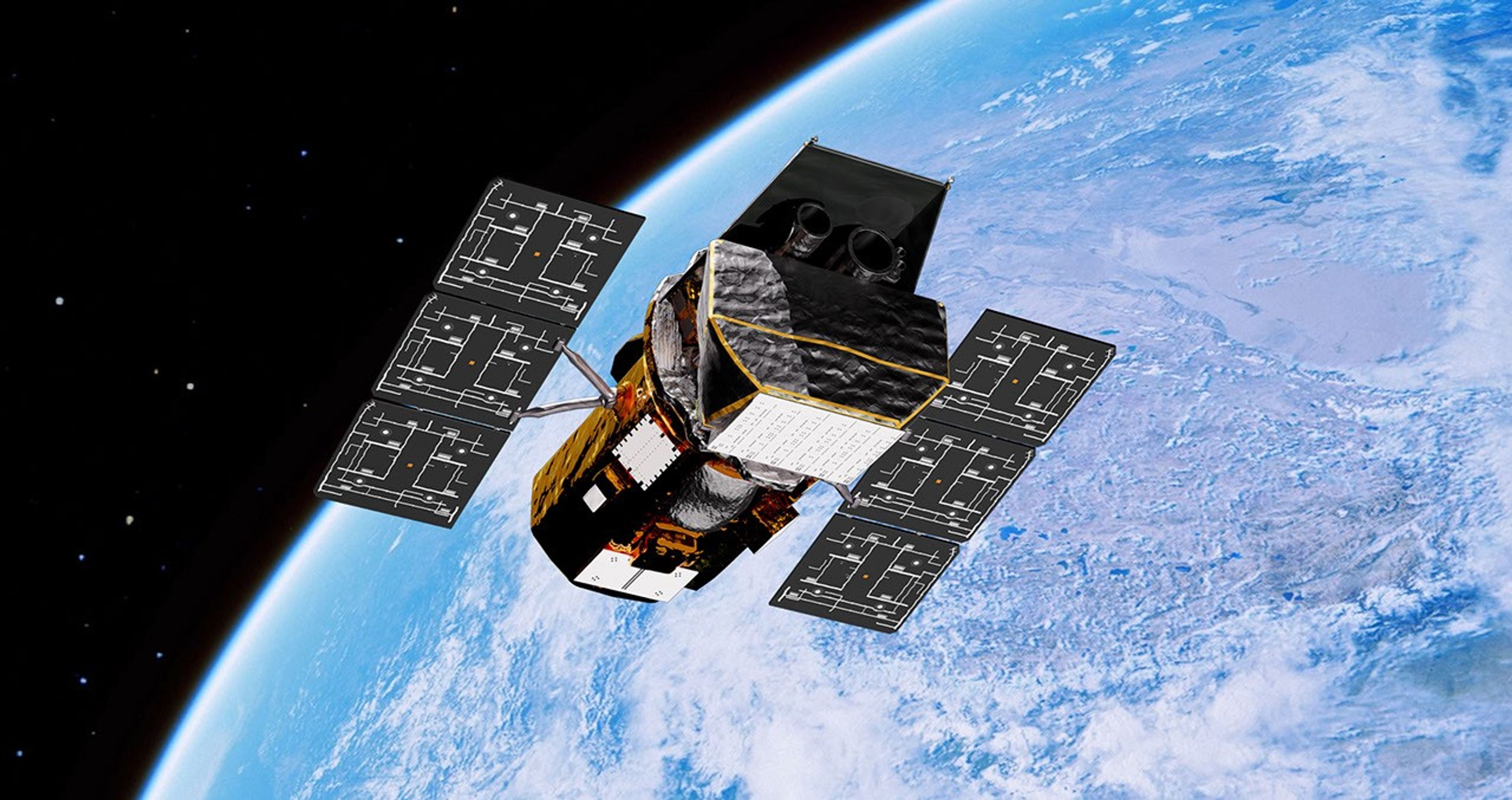
A privately built spacecraft sent to raise the orbit of NASA’s Neil Gehrels Swift Observatory has ended its flight without delivering the long-sought boost, but NASA…
A privately built spacecraft sent to raise the orbit of NASA’s Neil Gehrels Swift Observatory has ended its flight without delivering the long-sought boost, but NASA says the effort has already produced hard-won lessons for the emerging field of in-space servicing.
“This was a high-risk, high-reward mission from the start,” said Shawn Domagal-Goldman, director of NASA Headquarters’ Astrophysics Division in Washington. Agency officials had been tracking Swift’s steady orbital decay and warned that, without help, the spacecraft was expected to re-enter Earth’s atmosphere by the end of the year. Even as NASA prepares for the observatory’s eventual retirement, Domagal-Goldman said the boost attempt was designed to advance U.S. satellite servicing technology, stress-test operations under an unusually compressed schedule, and explore new ways of extending spacecraft lifetimes in low Earth orbit.
Swift launched in November 2004 to investigate gamma-ray bursts—brief, extraordinarily energetic explosions that can outshine entire galaxies. Over two decades, the mission’s impact widened far beyond its original mandate, contributing to studies of comets and asteroids in the solar system, multiple kinds of cosmic explosions, and flares from black holes in distant galaxies.
The problem threatening Swift is shared by many satellites that lack their own propulsion: atmospheric drag. Even at the edge of space, traces of Earth’s upper atmosphere act like a brake, slowly lowering orbital altitude. A period of heightened solar activity intensified that drag on Swift, accelerating its descent and forcing NASA to consider an intervention on a schedule far shorter than typical science missions.
After deciding to explore a rescue attempt, NASA moved within months to solicit ideas through its Center of Excellence for Collaborative Engineering and to support early design work through the Small Business Innovation Research program. In September 2025, the agency selected Katalyst Space of Flagstaff, Arizona, to carry out the mission. The contract set an aggressive pace: roughly one year to design, build, test, and launch a spacecraft capable of rendezvous with Swift, physically capturing it, and then raising its orbit.
Katalyst’s vehicle, called LINK, launched from Kwajalein Atoll in the Republic of the Marshall Islands in July on a Northrop Grumman Pegasus XL rocket. The company chose Pegasus to meet the mission’s tight schedule and match the required orbit and program constraints. LINK reached space and completed initial checkout procedures, but soon began suffering intermittent communication dropouts and problems with attitude control—issues that complicated efforts to stabilize and command the spacecraft.
After intensive, around-the-clock troubleshooting by NASA and Katalyst teams, the partners agreed to narrow the mission’s scope. LINK would no longer attempt to grapple or boost Swift. Instead, it would focus on demonstrations intended to strengthen commercial servicing capabilities, including exercising its xenon-fueled propulsion system and testing three robotic arms designed to allow flexible grappling options on a client spacecraft.
NASA formally ended its participation in the LINK mission on Sept. 3. The spacecraft re-entered Earth’s atmosphere on Sept. 25.
“LINK was built to tackle a problem without an easy solution,” said Katalyst Space CEO Ghonhee Lee. He called the project ambitious and tightly scheduled, noting that while the team did not meet every target, it progressed from concept to the launch and operation of what he described as the first commercial space robot in under a year—experience he said can serve as a base for future missions.
NASA emphasized that, unlike typical science spacecraft that take years to develop and then operate for decades, the Swift boost effort was driven by a single dominating constraint: time. Agency predictions indicated Swift could sink toward an “altitude of no return” of roughly 185 miles (300 kilometers) in fall 2026, shaping every major decision about risk and execution and underscoring the need for a more agile model of project management for future servicing attempts.