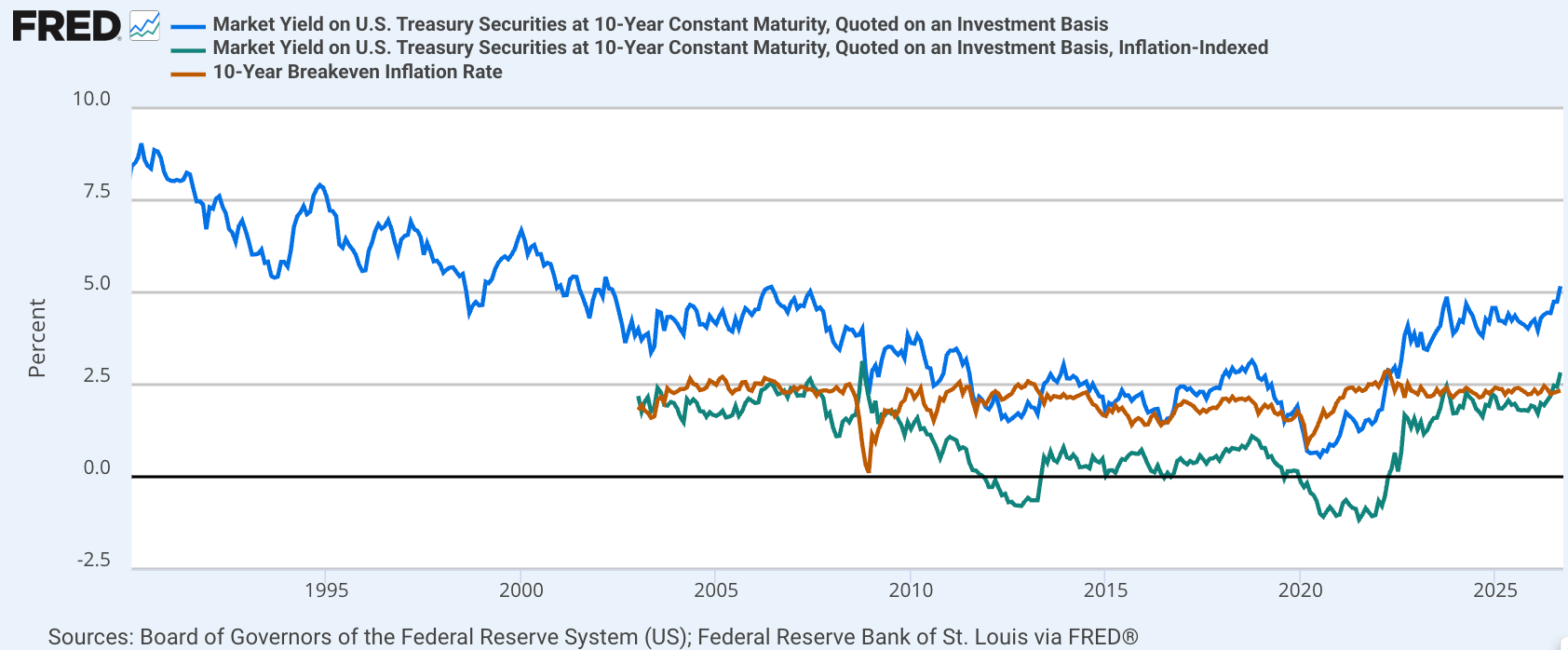
The yield on the benchmark 10-year U.S. Treasury note has climbed to about 5.25%, a level that has set off a familiar round of explanations.
The yield on the benchmark 10-year U.S. Treasury note has climbed to about 5.25%, a level that has set off a familiar round of explanations. The quick, convenient story pins the move on the Iran war and the inflation shock that followed. But a closer look at how bond markets are pricing inflation and real returns suggests the jump in long-term rates is not primarily about investors bracing for permanently higher inflation. Instead, the rise appears more consistent with a combination of an extraordinary investment boom—now heavily associated with artificial intelligence—and a potentially more troubling shift: the diminishing “safe asset” advantage that has long allowed the United States to borrow at unusually low rates.
The current 10-year Treasury, which matures in late 2036, can be decomposed into three market signals: the nominal yield, the inflation-adjusted yield implied by Treasury Inflation-Protected Securities (TIPS), and the inflation “breakeven” rate that represents expected inflation over the life of the bond. Those components matter because they help distinguish whether higher yields reflect changing inflation expectations or changing real interest rates.
Paul Krugman, writing about the surge in yields, outlines four main narratives circulating among economists.
The first is war-driven inflation. The Iran conflict has disrupted global oil supplies, on top of earlier distortions linked to the Russia–Ukraine war that tightened diesel and other refined-product markets. In this account, the inflation burst forced central banks to keep policy tight and lifted longer-run expectations about inflation and interest rates.
A second story emphasizes an AI-fueled investment wave. Firms are pouring money into new capacity and infrastructure to support AI deployment, even though the ultimate productivity payoff remains uncertain. Large investment booms tend to push up real interest rates by increasing demand for capital, so elevated long-term yields would be an unsurprising byproduct.
The third narrative focuses on the “safe-asset premium.” For years after the 2008 financial crisis, a worldwide shortage of assets considered truly safe helped drive investors into U.S. Treasuries, allowing the U.S. government to borrow cheaply. That privilege depends partly on scarcity and confidence. With the volume of U.S. debt having expanded substantially, some analysts argue the scarcity element is fading, eroding the premium and forcing Treasury yields higher.
The fourth possibility is debasement: a fear that heavily indebted governments may try to reduce their real debt burdens through inflation. The fiscal strains are not limited to the United States; countries such as France and the United Kingdom are also running large deficits without clear political pathways to major correction. In emerging markets, the temptation to inflate away debt is often treated as a live risk. Some commentators argue advanced economies may be moving in that direction as well.
Market pricing, however, offers an important clue. If war-and-inflation pressures or deliberate debasement were the dominant force, inflation breakevens would be expected to rise as nominal yields rise. That pattern has not appeared, pushing the analysis back toward the investment-boom and safe-asset explanations.
Skeptics of the safe-asset story argue that such a premium should fade only slowly. But if the premium rests on a shared belief that Treasuries are uniquely safe and liquid, it may behave less like a dial and more like an equilibrium: stable until it isn’t. If that belief weakens, the adjustment could be abrupt.
The most plausible conclusion, then, is not a single-cause diagnosis. The rise toward 5.25% likely reflects both stronger real-rate pressure from an AI-era investment surge and a reassessment—potentially sudden—of how special U.S. government debt really is.