NASA’s Transiting Exoplanet Survey Satellite, better known as TESS, has unveiled its most comprehensive panorama of the night sky yet—an all-sky mosaic that closes gaps…
NASA’s Transiting Exoplanet Survey Satellite, better known as TESS, has unveiled its most comprehensive panorama of the night sky yet—an all-sky mosaic that closes gaps left by earlier releases and highlights the mission’s growing catalog of worlds beyond our solar system.
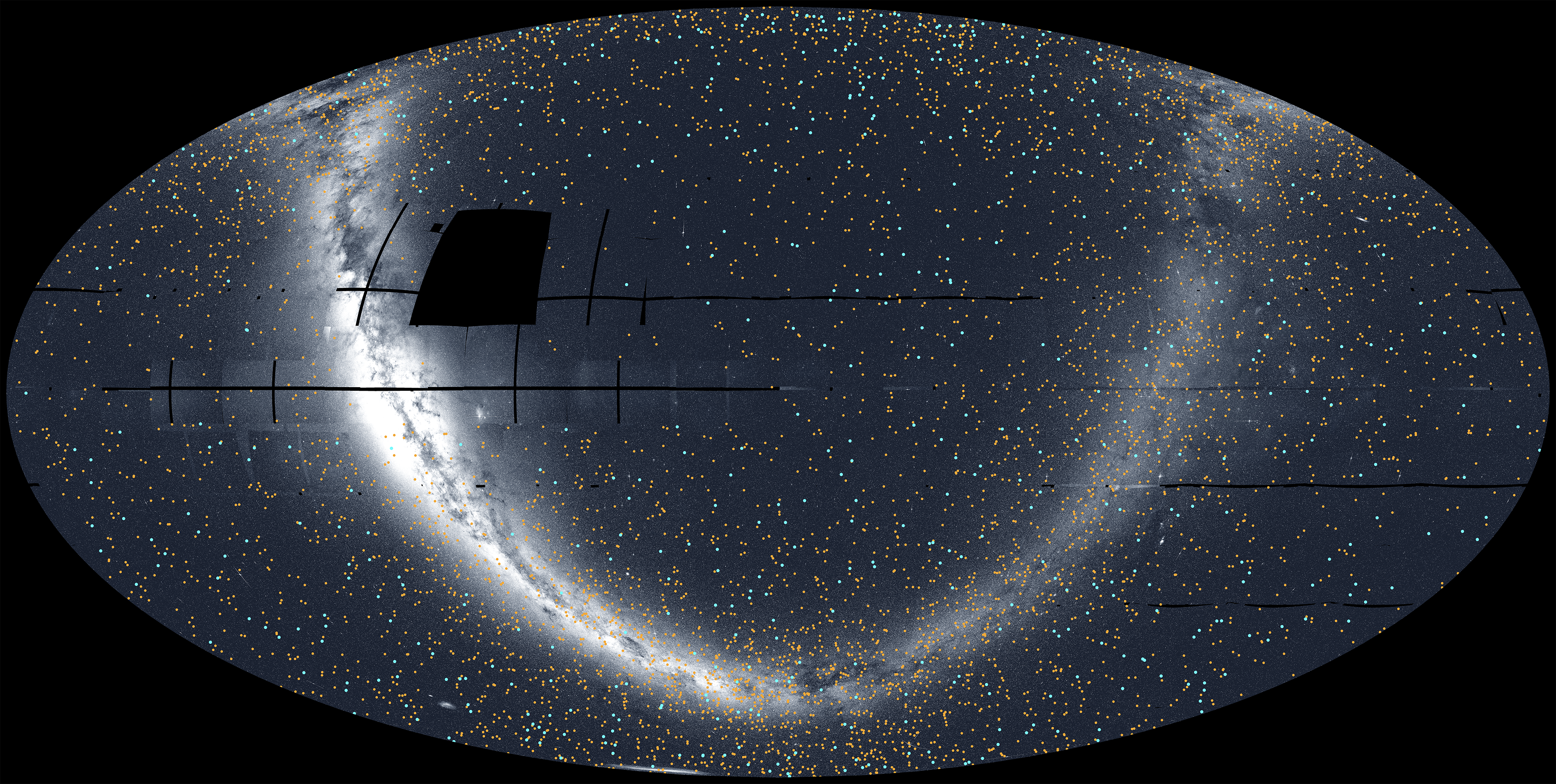
In the newly assembled view, nearly 6,000 colored markers pinpoint where TESS has found either confirmed exoplanets or promising candidates. The tally reflects the mission’s discoveries as of September 2025, marking the close of TESS’s second extended mission. Rebekah Hounsell, an associate project scientist for TESS at the University of Maryland Baltimore County and NASA’s Goddard Space Flight Center in Greenbelt, Maryland, described the past eight years of observations as an outpouring of results. TESS, she said, has revealed planets spanning an enormous range—from small, Mercury-sized bodies to giants larger than Jupiter. Some of these worlds orbit within their stars’ habitable zones, the region where temperatures could allow liquid water to exist on a planet’s surface, a key consideration in the wider search for life elsewhere.
TESS conducts its survey by repeatedly scanning large slices of the sky called sectors. Using four cameras, the spacecraft watches each sector for roughly a month at a time. Those prolonged observations let scientists track subtle rises and dips in the brightness of tens of thousands of stars—signals that may be produced when an orbiting planet passes in front of its host star from our viewpoint.
The full mosaic is built from 96 sectors observed from April 2018, when TESS began routine science operations, through September 2025. Within the image, blue markers denote nearly 700 exoplanets that had been confirmed as of September 9. The confirmed set includes particularly dramatic examples: worlds that may be dominated by volcanic activity, planets that appear to be eroding under intense stellar radiation, and even systems where a planet orbits two stars, potentially experiencing double sunrises and sunsets.
Orange markers represent the mission’s much larger pool of leads—more than 5,000 candidate planets still awaiting follow-up checks and formal confirmation. TESS is one contributor to a broader, rapidly expanding census: scientists have now confirmed more than 6,270 exoplanets in total using space missions including TESS and NASA’s now-retired Kepler Space Telescope, along with observations from other facilities.
The new image is also a portrait of our cosmic neighborhood. The bright band of the Milky Way stretches across the center as a luminous arc. In the lower left, two striking white ovals mark the Large and Small Magellanic Clouds—satellite galaxies of the Milky Way located about 160,000 and 200,000 light-years away, respectively.
According to Allison Youngblood, the TESS project scientist at NASA Goddard, the mission’s vast dataset continues to yield unexpected findings, especially as researchers apply automated search methods. Beyond exoplanets, TESS has helped scientists investigate streams of young stars, probe changing behavior within the galaxy, and keep watch on asteroids that pass near Earth. And as the survey grows more complete, Youngblood noted, the next surprise could be anywhere in the sky.
NASA is also inviting the public to help. Through the Planet Hunters TESS citizen-science project, volunteers can learn to interpret stellar light curves—graphs of starlight over time—and potentially spot the telltale signatures of new worlds.