NASA’s Psyche spacecraft has begun turning its cameras toward Mars as it closes in for a key gravitational assist that will help propel the mission onward to its…
NASA’s Psyche spacecraft has begun turning its cameras toward Mars as it closes in for a key gravitational assist that will help propel the mission onward to its ultimate destination: the metal-rich asteroid Psyche.
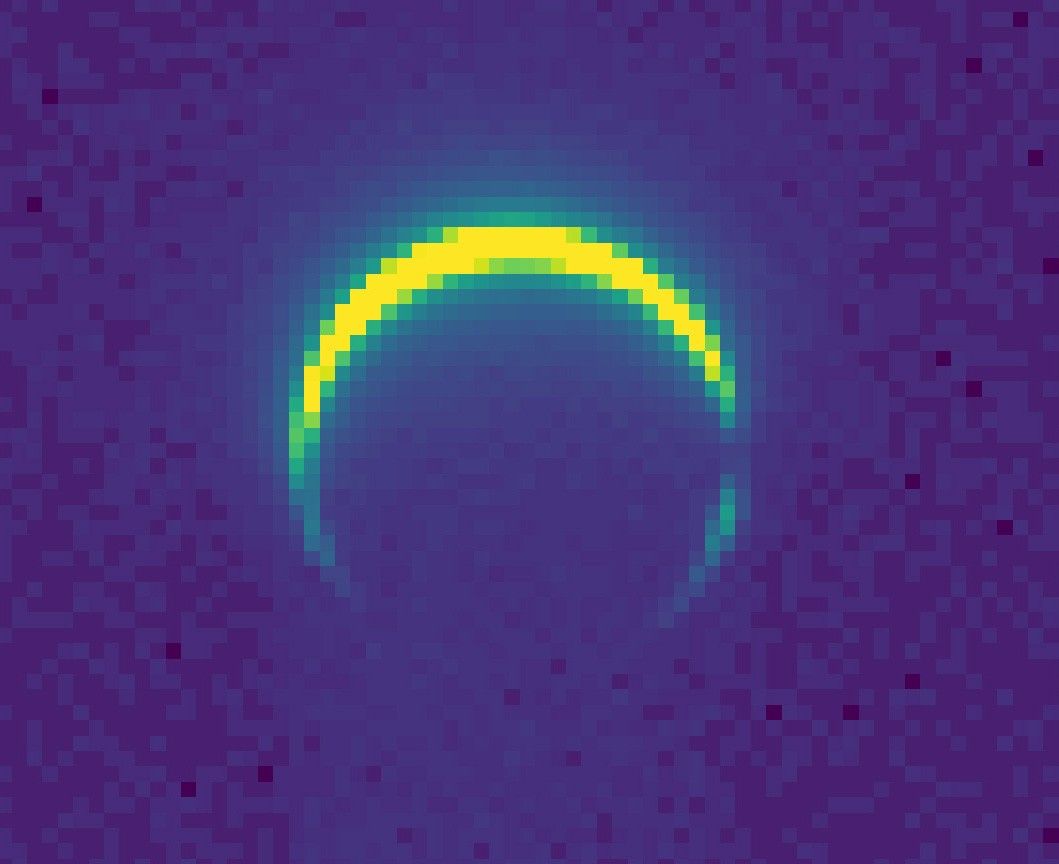
On May 3, 2026, the mission captured a colorized view of the Red Planet from roughly 3 million miles (4.8 million kilometers) away. The encounter is a prelude to a planned flyby on May 15, when Mars’ gravity will subtly reshape the spacecraft’s path and increase its speed, setting Psyche on a more efficient trajectory toward the asteroid it is slated to reach in 2029.
The early image reveals Mars not as a full disk, but as a delicate crescent. That appearance is the result of the spacecraft’s approach geometry: Psyche is viewing Mars from a high phase angle, meaning most of the planet’s sunlit side is turned away from the spacecraft—similar to the way the Moon looks as a thin sliver near new Moon. In this configuration, the Sun lies outside the camera’s field of view and effectively “above” both Mars and the spacecraft’s line of sight.
The picture was obtained with the mission’s multispectral imager using its panchromatic, or broadband, filter. The exposure was only 2 milliseconds—yet the crescent still registered as intensely bright, with some regions saturating the detector. That overwhelming brightness is why no background stars appear: compared with sunlight reflected off Mars, the stars are far too faint to register in the same shot.
What the camera is seeing is a combination of light reflected from the Martian surface and light redirected by fine dust suspended in the atmosphere. Mars’ atmospheric dust can change quickly, and that variability made the crescent’s expected brightness difficult to estimate before the spacecraft took this first look. The dust also creates an effect that would not occur on an airless world: by scattering sunlight, it makes the illuminated arc appear to wrap farther around the planet than it would if Mars lacked an atmosphere, much as the Moon’s crescent would look sharper and more confined.
The image includes an intriguing detail near the right-hand side of the extended crescent: a subtle interruption that aligns with Mars’ icy north polar cap. Because the cap is in winter, mission specialists suspect that seasonal clouds and hazes may be developing over that region. Such atmospheric conditions could reduce how effectively dust scatters sunlight there, producing the apparent “gap” in the otherwise extended glow.
Psyche’s imaging team will continue collecting, processing, and analyzing similar views as the spacecraft closes in on Mars ahead of the May 15 flyby. While the pictures offer striking planetary scenery, they serve a practical purpose: they are primarily intended to calibrate the cameras and assess how the instruments perform in space—valuable rehearsal for the much more consequential imaging campaign when Psyche reaches its namesake asteroid in 2029.