NASA’s Curiosity rover shifted into intensive lab work, analyzing powder from the Basque Lakes drill hole with CheMin and preparing SAM tests for volatiles despite tight power limits.
Most weeks on NASA’s Curiosity rover are built around steady, methodical work: Mastcam and ChemCam mosaics to map the landscape, chemistry checks with ChemCam and the Alpha Particle X-ray Spectrometer (APXS), close-up imaging with the Mars Hand Lens Imager (MAHLI) and Mars Descent Imager (MARDI), and the rover’s routine environmental record from REMS, RAD, and DAN.
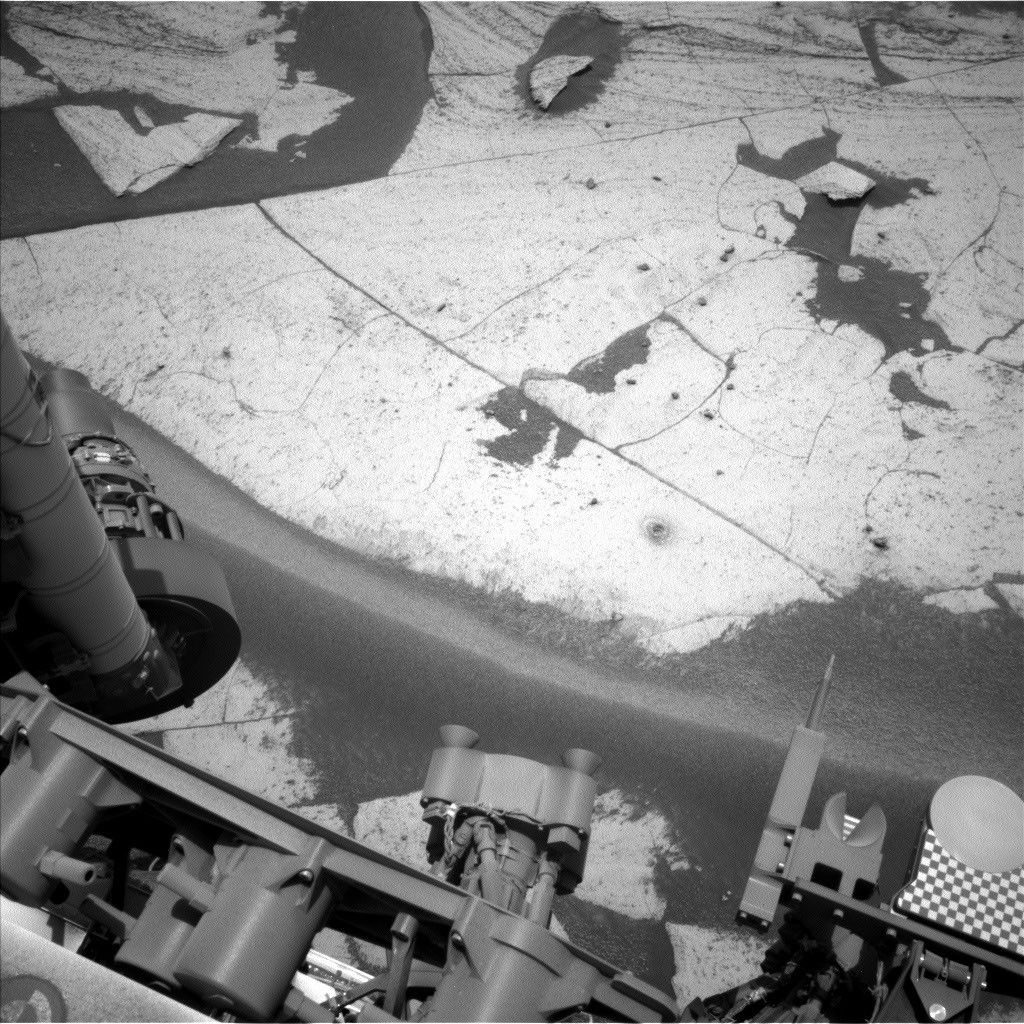
But during a drilling campaign, Curiosity shifts into what its mission name promises—a true Mars Science Laboratory. In the period covering sols 5029 to 5035, the rover’s science team concentrated on lab-style analysis of rock powder collected from the “Basque Lakes” drill hole. The week’s headline task was finishing a run with CheMin, the instrument that determines mineralogy by examining how X-rays interact with powdered samples. Those CheMin results play a gatekeeping role: they were a major factor in whether the Sample Analysis at Mars (SAM) suite would proceed with deeper chemical work on the same material.
With CheMin wrapping up, the team also readied SAM for its own sequence. A key step was using SAM’s Tunable Laser Spectrometer (TLS) to measure volatile compounds released from the sample. SAM’s next move depends on what TLS finds. The plan, as the week ended, was for SAM to wait for the TLS outcome—essentially a read on what gases are present—before deciding whether to commit to an additional mass spectrometry analysis in the following week.
These laboratory operations come with a cost: they draw heavily on Curiosity’s daily energy budget. As a result, many instruments take a temporary back seat while CheMin and SAM are working. The tradeoff is intentional. The mineralogical and volatile measurements these tools provide are among the mission’s most scientifically rich datasets for understanding how Martian rocks formed and what they have been exposed to over time.
Even with power at a premium, the team used remaining capacity to strengthen the geological and environmental context for the drilled sample. Mastcam collected a full 360-degree panorama to document the broader setting around the workspace. Because Mastcam offers color imaging and higher resolution than the rover’s navigation cameras, that panorama also served as a planning tool: it helped identify features worth follow-up, including targeted Mastcam views of nearby structures and a ChemCam Remote Micro-Imager (RMI) look at the “Cordillera” butte.
Mastcam and Navcam also coordinated a set of seven photometry observations scheduled at fixed times across the Martian day. By tracking how a target’s spectral appearance changes as the Sun’s angle shifts, the team can better interpret rover images—and connect them to orbital measurements observing similar materials from above.
ChemCam continued building the chemical story of the area by sampling a range of materials: the interior of the Basque Lakes drill hole, sand ripples dubbed “French Creek” that mantle parts of the bedrock, and scattered loose gray clasts—“Wooley” and “Fireside”—whose origin remains uncertain.
Meanwhile, Curiosity kept up its baseline weather-and-radiation surveillance. REMS, RAD, and DAN recorded regular measurements, while Navcam and Mastcam monitored atmospheric dust, clouds, and signs of dust devils.
Why it matters
Drilled samples are one of Curiosity’s best windows into Mars’ geological history because CheMin and SAM can reveal mineral makeup and volatile chemistry that surface imaging alone can’t. The week’s work will shape what SAM does next, including whether mass spectrometry is warranted, potentially adding key evidence about past environmental conditions. For researchers and mission planners, the results also help refine how rover and orbital observations are interpreted together.