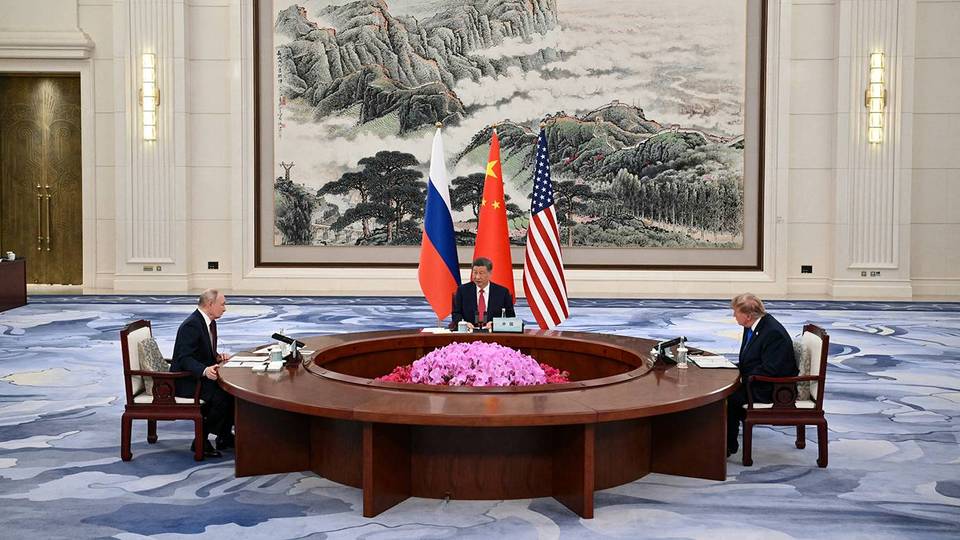
A Xi–Trump–Putin summit billed as historic produced more political theater than policy substance, sidestepping key tensions such as China’s export-led growth model.
Chinese President Xi Jinping, US President Donald Trump, and Russian President Vladimir Putin met in Shenzhen on November 19 for a highly choreographed trilateral summit that Beijing cast in historic terms. Chinese messaging around the gathering went so far as to suggest that “world history” had been made through a US–Russia–China Heads of State Declaration toward Peace.
But whatever the branding, the meeting did not resemble a landmark diplomatic breakthrough on the scale of the great power conferences that reshaped the postwar order. The event functioned far more as political theater than as a forum for resolving the deep, overlapping challenges facing the three countries—or the broader international system.
The core dynamic, according to critics of the summit, was the prioritization of optics. The leaders presented themselves as dealmakers capable of lowering global tensions, but the public narrative outpaced any clear evidence of concrete policy progress. The emphasis fell on image management and personal positioning, rather than on sustained negotiations over difficult issues.
That gap between presentation and substance mattered because there was no shortage of urgent topics demanding serious engagement. The three governments sit at the center of many of today’s most consequential disputes and risks, from economic friction to geopolitical rivalry. Yet the meeting, as described, offered little sign of grappling with those interlinked problems in a meaningful way.
One particularly notable omission was economic: the summit did not address China’s export-driven growth model, a longstanding flashpoint in global finance and trade. China’s reliance on external demand has wide spillover effects, influencing global imbalances, trade tensions, and competitive pressures across industries. For the United States, such dynamics often feed political and economic concerns about trade deficits and manufacturing competitiveness. For Russia, shifts in global demand and the structure of international commerce can shape its own growth prospects and strategic choices. And for the rest of the world, the sustainability of China’s growth pattern has implications for everything from supply chains to financial stability.
Against that backdrop, the criticism is not simply that the Shenzhen gathering fell short of grand claims, but that it missed an opportunity to confront problems that are both complex and closely connected. If the stated aim was “peace,” the harder work would involve addressing the underlying economic and political drivers of tension—not merely signing a declaration or staging a summit.
In that sense, the Shenzhen meeting can be read less as a turning point and more as a reminder of how easily high-level diplomacy can be reduced to performance. A carefully produced announcement may create the appearance of momentum, but without tackling foundational issues—like the global consequences of export-led growth—such moments risk fading quickly, leaving the same disputes unresolved.
Why it matters
When major powers frame photo-op diplomacy as historic progress, markets and governments can misread the state of global risk. The failure to engage with structural economic issues such as China’s export-led model means the drivers of trade and financial tensions remain in place. Investors, policymakers, and businesses should watch whether follow-up talks produce real commitments—or whether “declarations” continue to substitute for policy change.