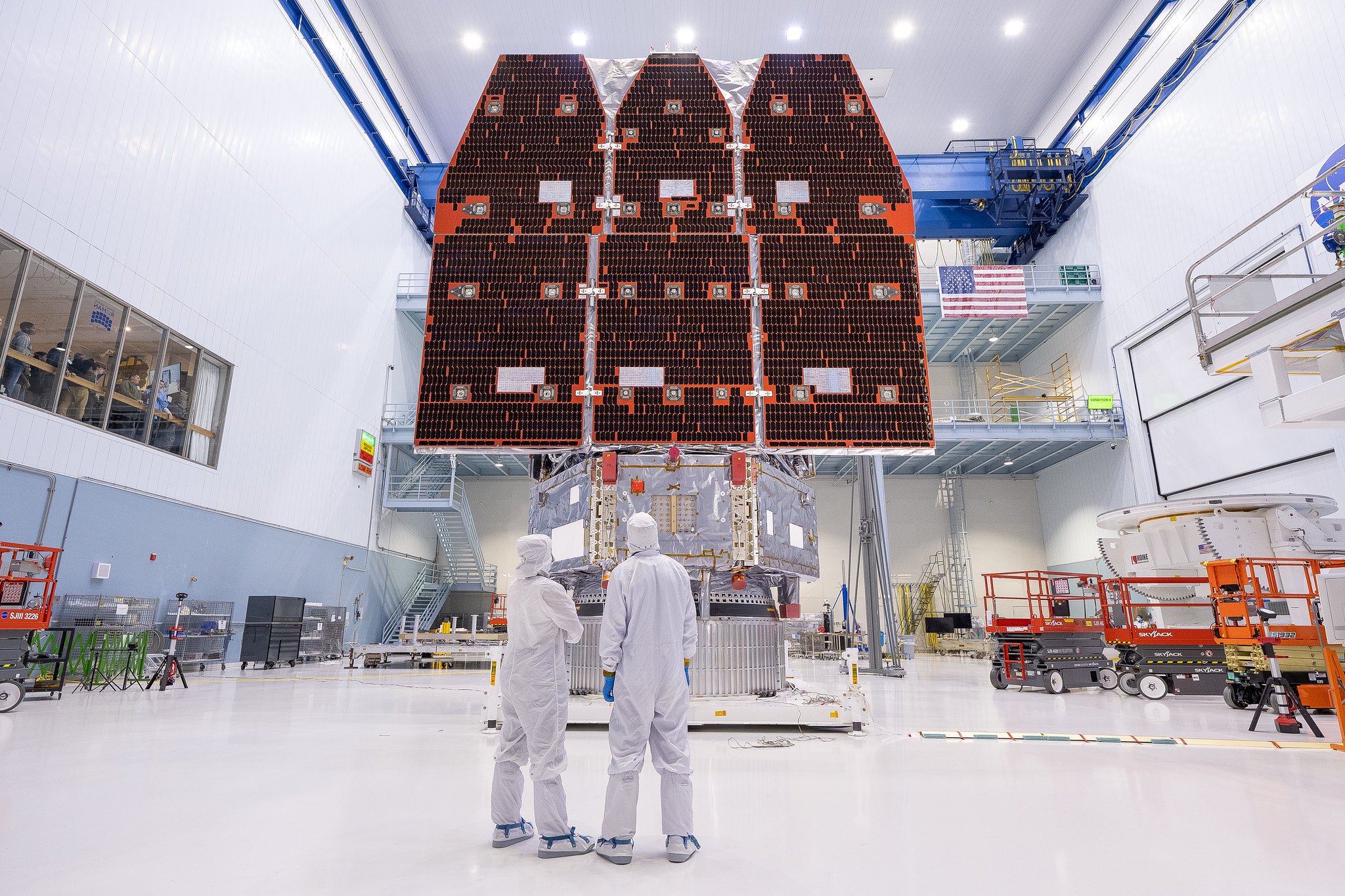
NASA will unveil the first images from the Nancy Grace Roman Space Telescope in a livestream, previewing its wide-field infrared vision for dark energy, exoplanets and more.
NASA is preparing to show the public the first images from its new Nancy Grace Roman Space Telescope, with the unveiling set for a live stream from the American Geophysical Union (AGU) Annual Meeting in San Francisco. The agency plans to reveal the pictures at 3:30 p.m. EST (12:30 p.m. PST) on Monday, Dec. 7.
The debut images are intended to highlight what Roman can do as it readies for full science operations. Equipped to deliver wide, sharply detailed infrared views, the observatory is designed to sweep across large regions of sky while also peering deep into the universe’s past. NASA says Roman will ultimately provide expansive, high-resolution panoramas that have not been possible before—data expected to help researchers investigate dark energy and dark matter and to expand the search for planets beyond the solar system.
Viewers will be able to watch the release online across multiple platforms, and the images will also be posted at the same time on NASA’s website. NASA said it will update its media advisory closer to the event with the list of briefing participants. Registered journalists will be offered interviews under embargo after the briefing ends, and a recording of the media briefing will be posted on the AGU website once the embargo lifts at 3:30 p.m. on Dec. 7.
NASA is also building public participation into the moment. In a program the agency is promoting as a way to “claim a corner of the universe,” participants will be able to identify “their” pixel within one of Roman’s selected first images after it is released. Each pixel corresponds to a distinct location in the scene, and NASA plans to provide a shareable digital “trading card” tied to that pixel, along with mission-related information for posting on NASA social channels. The agency is encouraging astronomy clubs, educators, and other community groups to organize their own watch parties for the first-image reveal.
Roman launched Aug. 30 from NASA’s Kennedy Space Center in Florida atop a SpaceX Falcon Heavy rocket. The mission is currently in a three-month journey of roughly a million miles to its operational destination: orbit around the Sun–Earth Lagrange Point 2 (L2), a gravitationally balanced region of space frequently used by astronomy missions for its stable thermal and viewing conditions.
During the cruise to L2, Roman has been going through commissioning, a methodical phase in which engineers activate the spacecraft’s systems, tune and calibrate instruments, and verify that everything is ready for scientific observations.
Beyond its core investigations of dark matter, dark energy, and exoplanets, NASA emphasizes that Roman’s planned sky surveys are expected to generate data useful for a wide range of astrophysical studies. The mission also includes a technology demonstration coronagraph, a sophisticated instrument intended to directly image planets around other stars by blocking their host stars’ glare.
The telescope is managed by NASA’s Goddard Space Flight Center in Greenbelt, Maryland, with participation from NASA’s Jet Propulsion Laboratory in Southern California; Caltech/IPAC in Pasadena, California; the Space Telescope Science Institute; and a science team drawn from multiple research institutions. NASA lists BAE Systems, Inc., L3Harris Technologies, and Teledyne Scientific & Imaging as the mission’s primary industrial partners.
Why it matters
Roman’s first images mark the start of a major new survey mission built to map the universe on wide scales while maintaining fine infrared detail—capabilities that could reshape research on cosmic acceleration, unseen matter, and planetary systems beyond our own. Scientists, educators, and space enthusiasts alike will be watching to see how Roman’s performance compares with expectations after commissioning. What comes next is the ramp-up from early imagery to sustained surveys and the coronagraph technology test that could influence future planet-imaging missions.