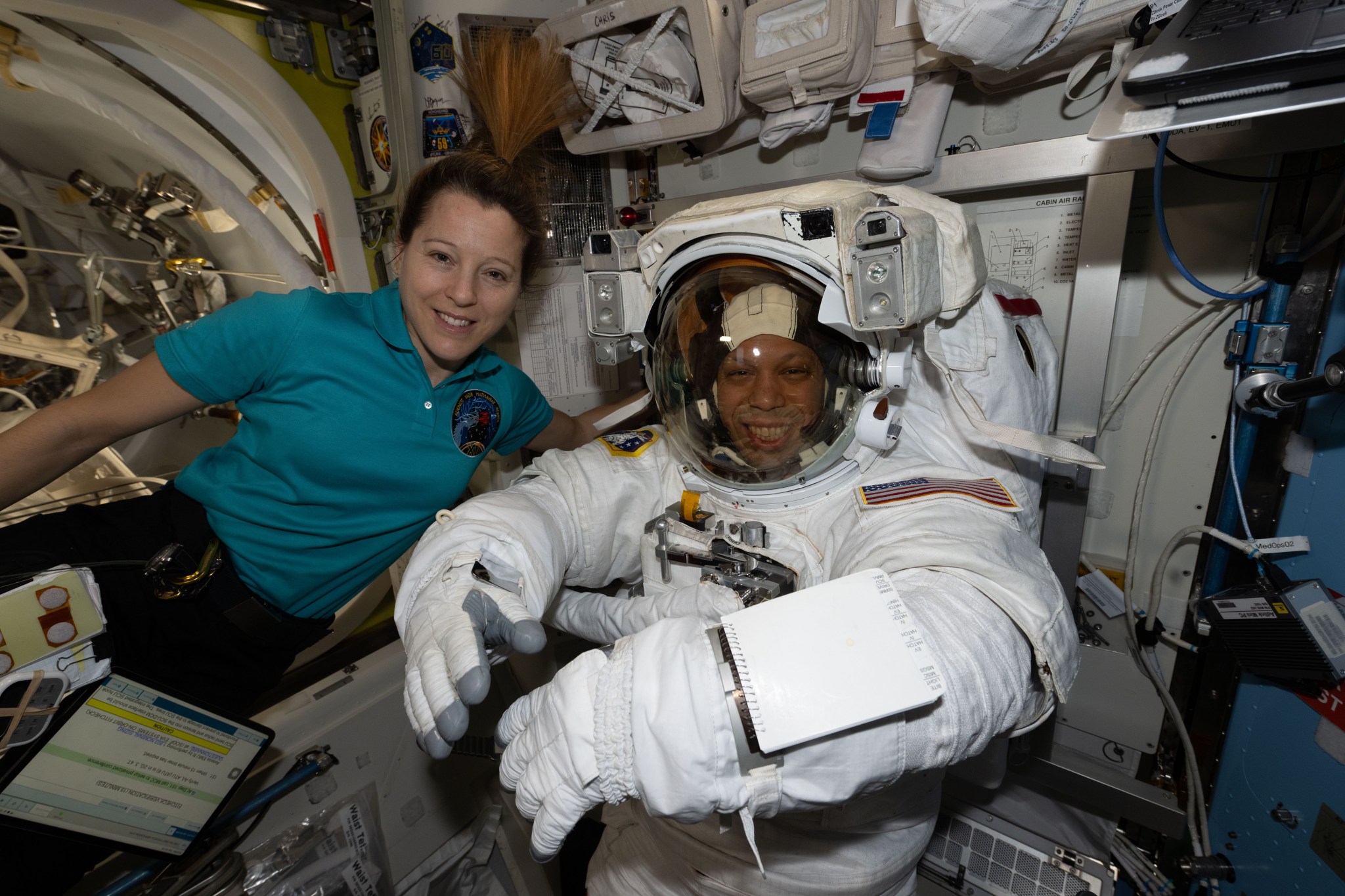
Inside the International Space Station’s Quest airlock, NASA astronaut Chris Williams spent part of this week doing something far less glamorous than floating past Earth…
Inside the International Space Station’s Quest airlock, NASA astronaut Chris Williams spent part of this week doing something far less glamorous than floating past Earth with a tool bag: he tried on his spacesuit.
The fitting, conducted June 23, was a full systems check as much as it was a comfort test. European Space Agency flight engineer Sophie Adenot assisted Williams as he evaluated the suit’s mobility, communications and life-support performance in the tight confines of the airlock where U.S. spacewalks begin and end. The rehearsal is a routine but critical step ahead of Williams’ next major assignment outside the station—an excursion scheduled for Tuesday, June 30, when he and NASA astronaut Jessica Meir are set to perform U.S. Spacewalk 95.
According to mission briefings, the two astronauts will exit the orbital laboratory to replace a wrist joint on Canadarm2, the station’s large robotic arm. The device is a key workhorse for station operations: it positions visiting spacecraft, helps move payloads and equipment, and supports spacewalks by allowing crews and hardware to be maneuvered around the exterior. The arm’s “wrist” joints are among the system’s most heavily used components because they provide fine pointing and rotation control at the end of the arm, where tools and payloads interface.
The planned repair underscores a recurring reality of long-duration spaceflight: the International Space Station is an aging, high-value scientific platform that depends on continuous maintenance. Many of its major systems were designed with redundancy and replaceable parts, but the work still requires careful choreography. Even tasks that resemble terrestrial maintenance—swapping a mechanical component—become complex when performed in a pressurized suit, with limited dexterity, strict time budgets and the constant need to manage power, consumables and safety margins.
That is why suit checks like Williams’ June 23 session matter. The U.S. Extravehicular Mobility Unit is, in effect, a compact spacecraft worn on the body. It must maintain pressure, regulate temperature, remove carbon dioxide, deliver oxygen, and keep communications stable, all while permitting an astronaut to translate across handrails and apply controlled force with gloved hands. Mobility assessments—arm reach, joint range, and how the suit responds when an astronaut bends or twists—feed directly into task planning. Communications tests and life-support verification reduce the risk of an otherwise manageable mechanical repair being complicated by unexpected hardware behavior.
The June 30 spacewalk is also a reminder of how international the station remains in practice, even when a particular excursion is labeled a U.S. EVA. Adenot’s role supporting suit operations reflects a broader division of labor on the ISS, where crews routinely backstop one another across agencies. Inside the station, intravehicular crew members coordinate timelines, monitor suit telemetry and systems, and act as an interface between the spacewalking team and ground controllers. Outside, astronauts follow procedures refined through underwater training and simulations, but must still adapt to the physical realities of working in microgravity.
NASA’s coverage plans also highlight the agency’s emphasis on transparency and public engagement for human spaceflight. The June 30 EVA is scheduled to be carried live on NASA’s streaming platform beginning at 7 a.m. Eastern, with the spacewalk expected to proceed as crews reach critical milestones such as depressurization, egress, and the start of robotic arm work.
The Canadarm2 repair comes as NASA simultaneously pushes on multiple fronts—robotics, planetary science, astrophysics, and exploration technology—reflecting an agency portfolio that spans from station upkeep to Moon- and Mars-enabling capabilities. Recent NASA announcements and research updates have ranged from testing new hardware aimed at future in-space refueling to reporting new exoplanet findings from the Transiting Exoplanet Survey Satellite, as well as continued astronomy deliverables from major observatories. The message is consistent: maintaining operational infrastructure in low Earth orbit is not a distraction from discovery, but a prerequisite for it.
For Williams and Meir, the near-term focus is narrower and more immediate: execute a demanding repair outside the station while ensuring the robotic arm returns to full function. For the ISS program, the objective is broader—keep a unique research outpost healthy, safe and capable as it continues to support science and technology demonstrations.
And for Adenot’s role in the spacesuit checks, the moment captures something the public often misses: before any spacewalk makes headlines, the work begins with careful preparation, methodical testing, and teamwork—starting in the airlock.