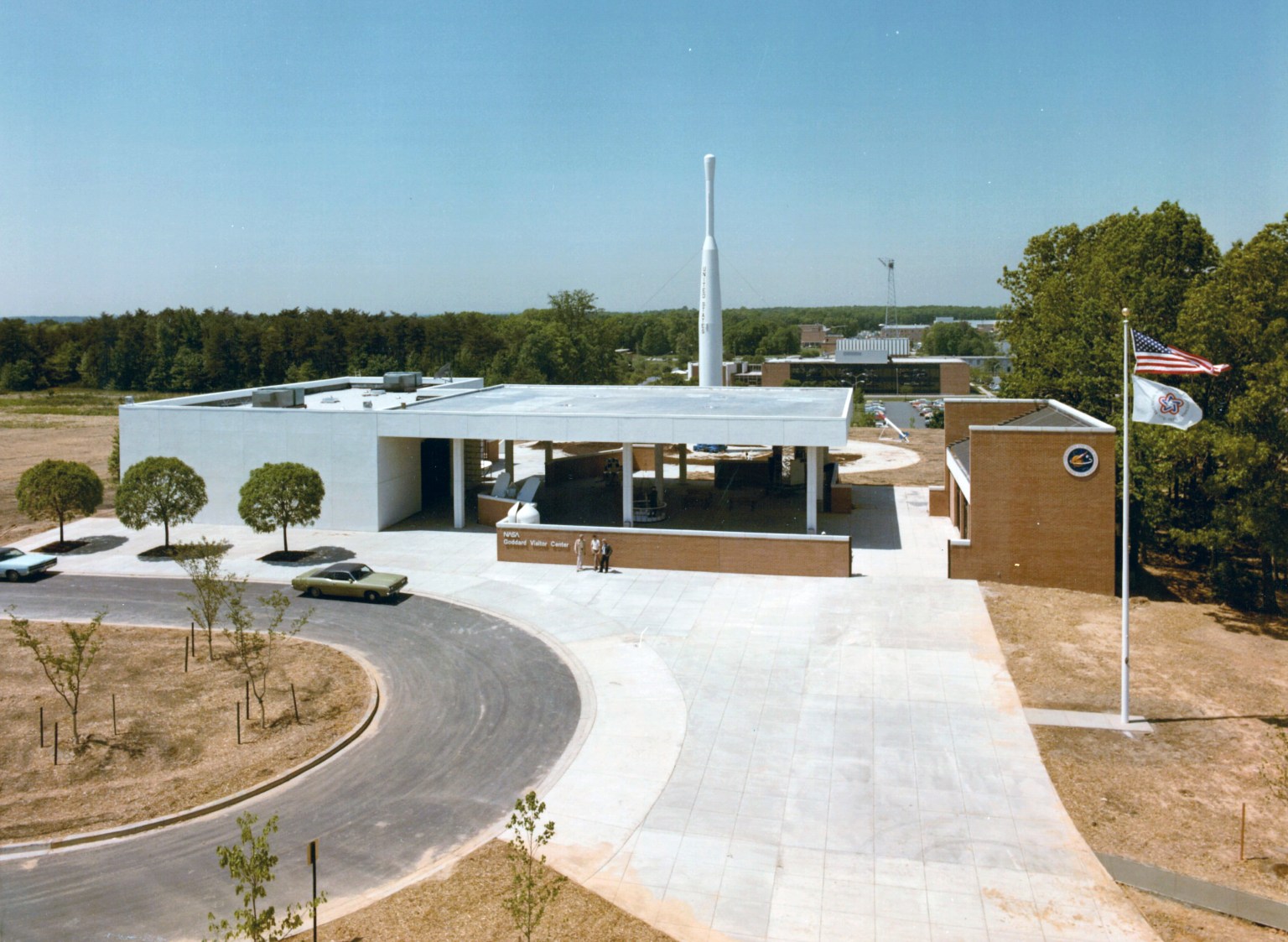
Decked out in America’s bicentennial spirit, NASA opened a new public gateway to spaceflight at its Goddard Space Flight Center in Greenbelt, Maryland, in May 1976.
Decked out in America’s bicentennial spirit, NASA opened a new public gateway to spaceflight at its Goddard Space Flight Center in Greenbelt, Maryland, in May 1976. Half a century later, the NASA Goddard Visitor Center is still fulfilling that mission—inviting the public to explore the agency’s work through exhibits, films, hands-on activities, and community programs that trace the history of space exploration while spotlighting what comes next.
When the center debuted—only weeks before the Smithsonian’s National Air and Space Museum opened in Washington, D.C.—visitors encountered a site that was, in many places, literally open to the air. The opening ceremony also departed from the usual ribbon-cutting script. Instead of ceremonial scissors, organizers staged a reenactment of rocket pioneer Robert H. Goddard’s first launch to “cut” the ribbon in a snap, nodding to the man whose name the center bears.
From the start, the experience was designed to be interactive and tied closely to current space technology. Early displays included a full-scale mockup of the Orbiting Astronomical Observatory, a forerunner to the Hubble Space Telescope era. Guests could also speak into a phone station that relayed their voices on a 45,000-mile round trip via Applications Technology Satellite-3. Another feature—an operating meteorology station—showed real-time satellite views of weather across the Western Hemisphere.
“The visitor center serves the community by providing engaging exhibits and programming focused on the work of NASA overall and NASA’s Goddard Space Flight Center in particular,” said Amanda Harvey, the center’s engagement coordinator. “We are an important place for people to discover, explore, and experience what it is that NASA does.”
For longtime staff member D.J. Emmanuel, that statement is personal history. His first encounter with Goddard came through a visitor center talk in 1993 on tools astronauts used during the first Hubble servicing mission. He began volunteering, then moved into a full-time role. Harvey and Emmanuel work under the NASA Communication Services contract and run the center alongside a team of volunteers.
The building itself has a pre-NASA past. The site once housed WWV, a radio station operated by what was then the Bureau of Standards—today’s National Institute of Standards and Technology (NIST). WWV moved to Colorado in the mid-1960s. Local lore holds that the station’s broadcasts disrupted Apollo program testing and helped drive the relocation. Goddard later used the old transmitter building for maintenance storage until preparations for a visitor center ramped up in 1975.
As NASA’s science and engineering have advanced, the center’s offerings have expanded. Today visitors can watch science films in a 4K theater, see Hubble-related artifacts, and play a custom Roman Space Telescope video game on an arcade-style console—no coins needed—along with a range of additional exhibits and activities. Emmanuel says the displays still reward repeat visits: “I keep going back and looking at the exhibits and reading something new that I haven’t read before,” he said, calling the center a strong entry point for children into science and space.
Harvey says the inspiration runs both ways. Some of her favorite moments involve young guests arriving in astronaut outfits, their enthusiasm fueling her push for more programming.
The visitor center drew nearly 600,000 people in its first decade, and many more in the years since. In recent years, virtual field trips have also extended Goddard’s reach beyond Maryland. Yet several signature elements remain unchanged: a 100-foot-tall Delta-B rocket still towers outside; a sycamore grown from a seed carried to the Moon on Apollo 14 still stands near the entrance; and admission remains free.
The NASA Goddard Visitor Center plans to mark its 50th anniversary on Saturday, May 2, from 1 p.m. to 3 p.m., with no RSVP required. NASA Goddard Archives provided research and multimedia support for the story, and reference requests can be directed to history@mail.nasa.gov.