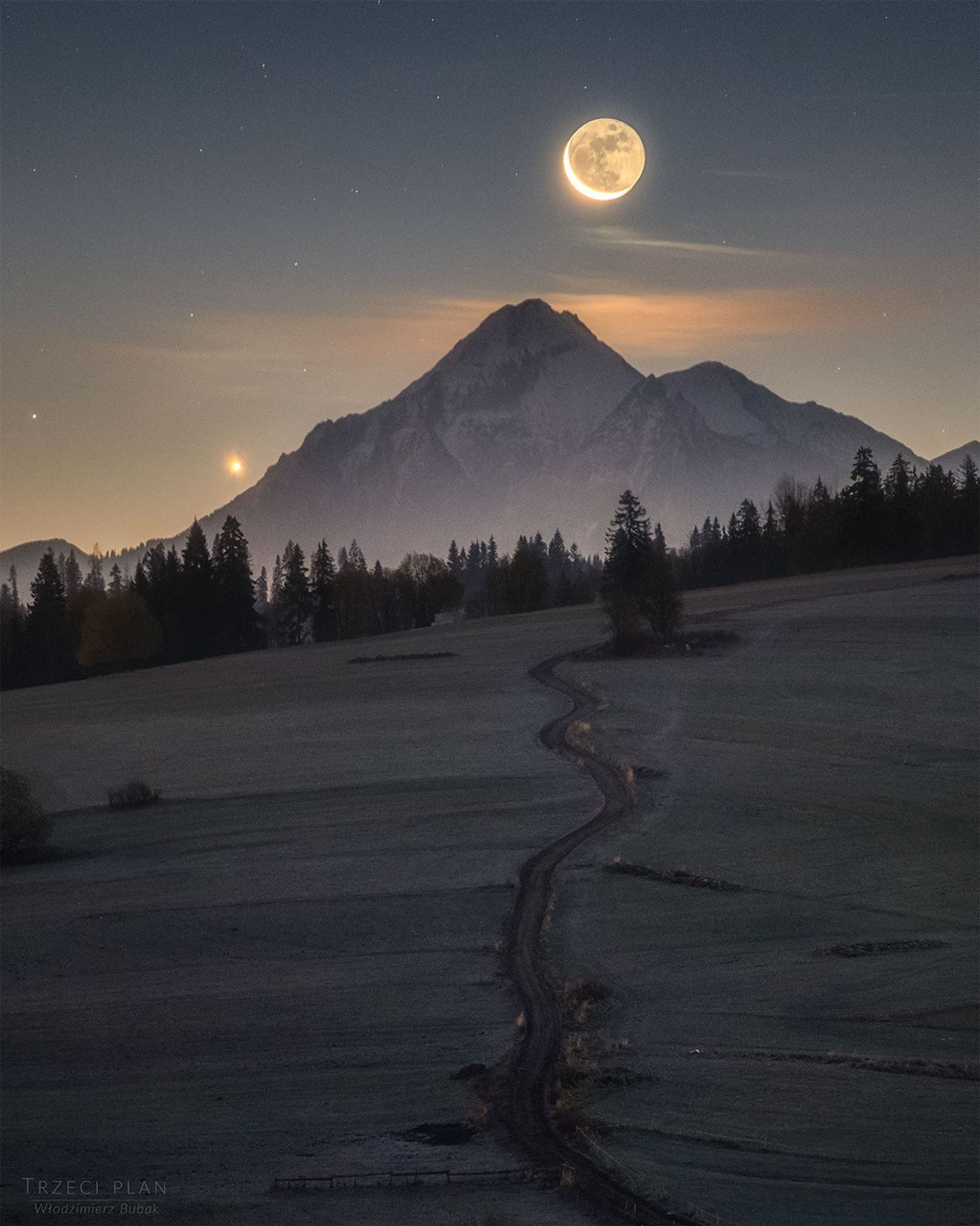
A crescent Moon, Venus and the star Spica appear in a striking sky conjunction, highlighting predictable celestial motion. Spica is a bright stellar system reported to be triple.
Daily skywatchers are often treated to scenes that look almost choreographed: familiar lights drifting into striking alignments against the background of stars. Astronomers have a name for these apparent close passes. They are called conjunctions—moments when two or more objects in the sky seem to draw near each other from Earth’s point of view.
The idea fits an old linguistic clue. The word “planet” traces back to the Greek concept of a “wandering star,” reflecting how planets change position night to night compared with the seemingly fixed patterns of the constellations. As these wanderers move along their paths, they periodically line up with the Moon or prominent stars, creating the kind of quiet “meeting” captured in a recent photograph from Poland.
In the image, a slender crescent Moon hangs above the rugged silhouette of the Tatra Mountains. Below it, low toward the horizon, Venus stands out as an intense beacon—one of the brightest objects in the night sky. Just to the left of Venus appears Spica, the leading star of the constellation Virgo, the Maiden. Spica is among the sky’s most luminous stars and lies at a distance of roughly 250 light-years from Earth, close enough to be a well-studied stellar neighbor by astronomical standards.
While conjunctions can look like happenstance, their timing and geometry are anything but random. They follow the predictable rules of celestial mechanics that govern how the Moon and planets move along the ecliptic and how Earth’s own motion sets the viewing angle. The result is a shifting celestial tableau in which Venus can seem to “keep company” with the Moon one night and then slide onward toward other landmarks in the following evenings.
Spica itself has a history of revealing hidden complexity. In 1890, astronomers determined that Spica is not a single star but a binary system: two massive, hot blue stars locked in a tight orbit, circling each other every four days. That rapid dance makes Spica a classic example of how careful measurements can uncover multiple stars where the eye sees only one point of light.
And the story has continued to evolve. Reports earlier this year indicated that Spica is not merely a pair, but a triple system—suggesting an additional stellar companion beyond the famous close binary. If confirmed and further characterized, that makes Spica an even richer laboratory for studying how massive stars form and interact in multi-star families.
For skywatchers, though, the appeal remains immediate and simple: a crescent Moon, dazzling Venus, and brilliant Spica sharing the same patch of sky in a serene, mountainous landscape—an elegant reminder that “wandering stars” really do wander.
Why it matters
Conjunctions like this help connect casual stargazers with the underlying clockwork of the solar system, turning a beautiful view into a lesson in orbital motion. Spica’s evolving status—from single star to binary to a reported triple—also highlights how even bright, familiar objects can still hold surprises. Watch for follow-up observations that refine the architecture of Spica’s system and for upcoming conjunctions that make the night sky’s dynamics easy to see with the unaided eye.