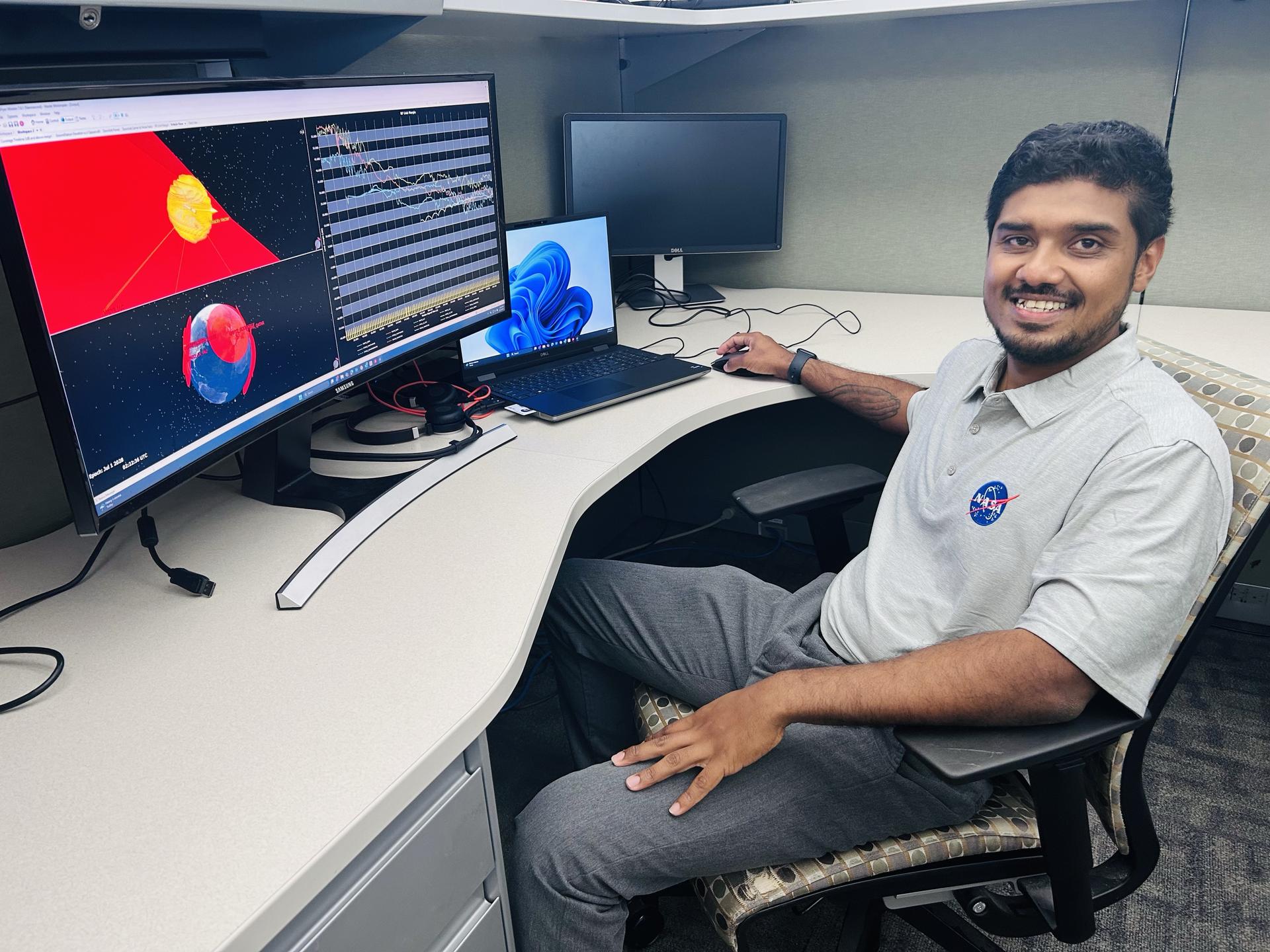
Rohit Goeptar’s path to NASA began far from Florida’s launch pads, in a struggling household in Suriname.
Rohit Goeptar’s path to NASA began far from Florida’s launch pads, in a struggling household in Suriname. He grew up in a family where both parents worked multiple jobs and still could only cover the basics—food and a roof overhead. When he was about six, the family relocated to California in search of a better future. The move did not bring immediate stability. Two years later, Goeptar returned to South America with his father, while his mother remained in the United States and later remarried. At 13, he became a U.S. citizen and moved back to California with his brothers to live with their mother.
At 19, Goeptar enlisted in the U.S. Marine Corps, spending six years as a technical operator. One deployment left a lasting mark: after a typhoon tore through communities in the Philippines, he helped build communications capabilities so people could reach relatives in the aftermath. “I was lost, the Marine Corps gave me an opportunity,” he said, describing the service as both a lifeline and a training ground.
Yet his life outside the uniform carried heavy losses. Goeptar says he lost two father figures to suicide. His first marriage ended, and he spent six months without housing on the streets of Kissimmee, Florida. The turning point, he explains, came with the support of the woman who would become his wife—someone who recognized his potential when he could not. Not long after they met, she told him his mind worked in unusual ways, then took a practical step: she filled out college applications on his behalf and encouraged him to aim higher, including applying to NASA’s Kennedy Space Center.
By spring 2025, Goeptar was raising three children while attending school full-time and pursuing two degrees at once—computer engineering and electrical engineering. That’s when the phone rang. He was driving to pick up his son from school when a Kennedy recruiter called after reviewing his résumé. Goeptar pulled over and completed a spontaneous interview from the roadside. Two weeks later came an in-person interview, and two weeks after that he was wearing a contractor badge at the nation’s busiest launch site.
He started as an intern under the Expendable Launch Vehicle Integrated Support (ELVIS) contract, then worked part-time while completing his studies at the University of Central Florida in Orlando. He transitioned to full-time work in early 2026. More recently, he was among ELVIS contractors selected to become a NASA civil servant.
Now part of NASA’s Launch Services Program, Goeptar focuses on electromagnetic interference, electromagnetic compatibility, and radio-frequency systems—work essential to preventing electrical components from disrupting one another during a mission. His responsibilities span the full mission timeline: evaluating avionics boxes and other powered hardware for interference risks, ensuring compatibility when systems are integrated, and running radio-frequency link analyses for rockets and scientific demonstration payloads, whether flown by NASA or commercial partners. The goal is uninterrupted communication between space and ground.
In a short tenure at Kennedy, he has supported missions including Sentinel-6B, JPSS-4 (Joint Polar Satellite System), and IMAP (Interstellar Mapping and Acceleration Probe). He also made an early technical mark: within his first year, he identified a flaw in an analysis his team was not accounting for. Rocket flight involves pitch, yaw, and roll after liftoff, and he realized the existing approach did not reflect those dynamics, reducing accuracy. After presenting a fix to his team lead, the updated method improved alignment between NASA data and partner data.
For Goeptar, the work is personal. “There is no greater feeling, being able to serve,” he said, fighting back tears. To him, joining NASA is not just a career milestone—it is a way to give back to the country and institutions that, he says, gave him a chance to rebuild his life.