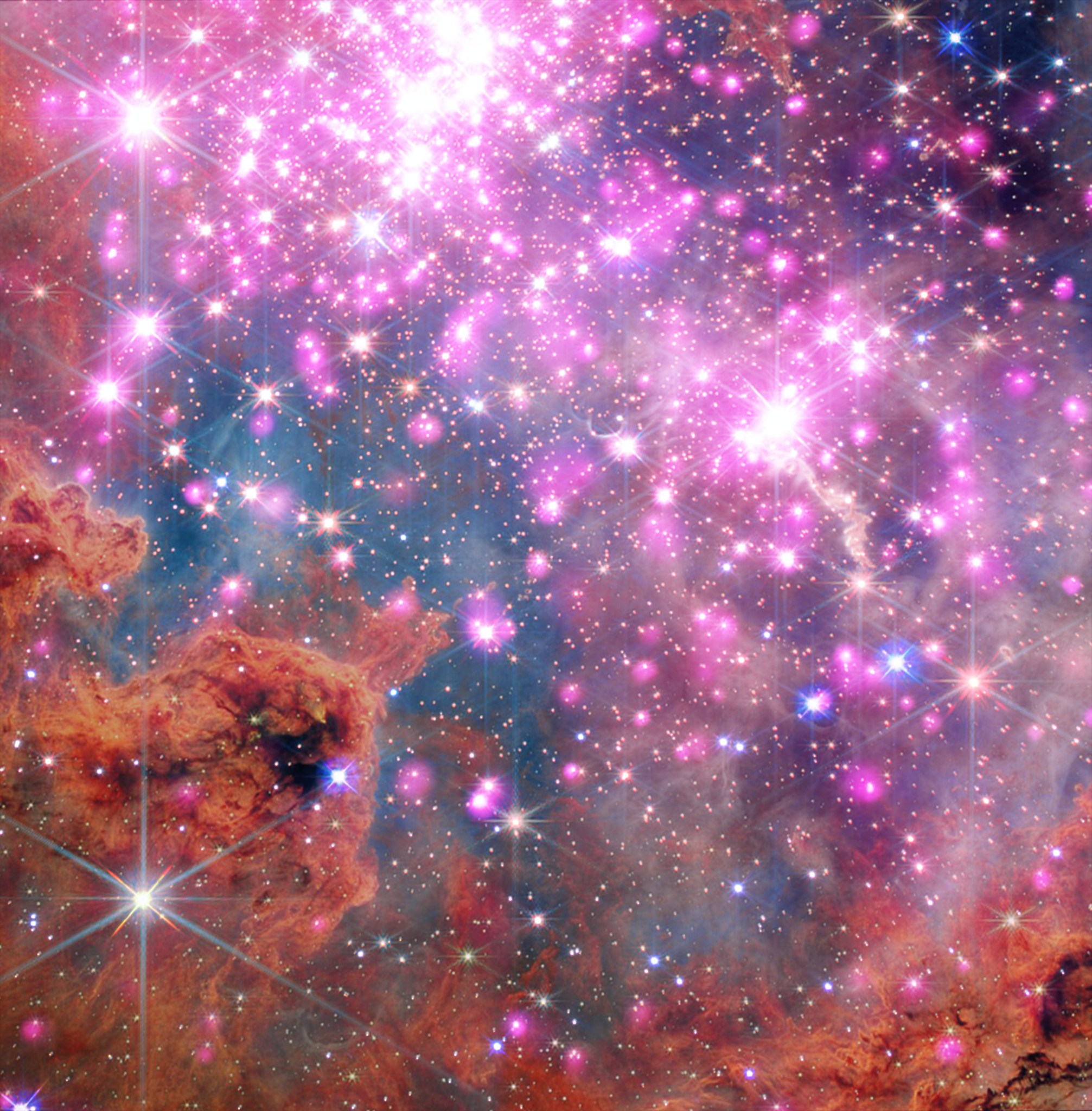
A newly released composite view of the star cluster Westerlund 2 blends high-energy and infrared observations to spotlight a turbulent region where stars are being born at a rapid pace.
A newly released composite view of the star cluster Westerlund 2 blends high-energy and infrared observations to spotlight a turbulent region where stars are being born at a rapid pace. Published March 19, 2026, the image combines pink X-ray light captured by NASA’s Chandra X-ray Observatory with infrared colors from NASA’s James Webb Space Telescope—rendered in shades of red, orange, green, cyan, and blue—to reveal both the hot, energetic processes around young stars and the cooler material that surrounds them.
Across the scene, dozens of bright stars appear to sparkle, many outlined by an intense neon-pink glow from Chandra’s X-ray data. Those X-ray signatures trace energetic activity common in youthful stellar populations, emphasizing that Westerlund 2 is a relatively young cluster: its stars are estimated to be only about one to three million years old. The result is a portrait of a system still in its early stages, where powerful radiation and stellar winds shape the environment as the cluster evolves.
The image also draws attention to the ingredients that make such star formation possible. Along the lower edge of the frame, thick dust clouds show up in warm brick-orange tones in Webb’s infrared view. These dense concentrations of dust—and the gas associated with them—represent the raw material from which new stars can form. Infrared wavelengths are particularly effective at highlighting these cooler structures, which can obscure starlight in visible images but glow in the infrared as they absorb and re-emit energy.
Westerlund 2 sits within Gum 29, a chaotic and active “stellar nursery” known for ongoing star formation. The region lies about 20,000 light-years from Earth in the constellation Carina, placing it deep within a part of the Milky Way that hosts multiple prominent sites of star birth. By layering Chandra’s X-ray perspective with Webb’s infrared sensitivity, astronomers can better separate the energetic young stars from the surrounding dust and map how the cluster interacts with its broader environment.
The image credits include X-ray data from NASA/CXC/SAO/Sejong University/Hur and collaborators, and Webb data from ESA/Webb, NASA and CSA, with contributions from V. Almendros-Abad, M. Guarcello, K. Monsch, and the EWOCS team. Image processing was carried out by NASA/CXC/SAO’s L. Frattare and K. Arcand.