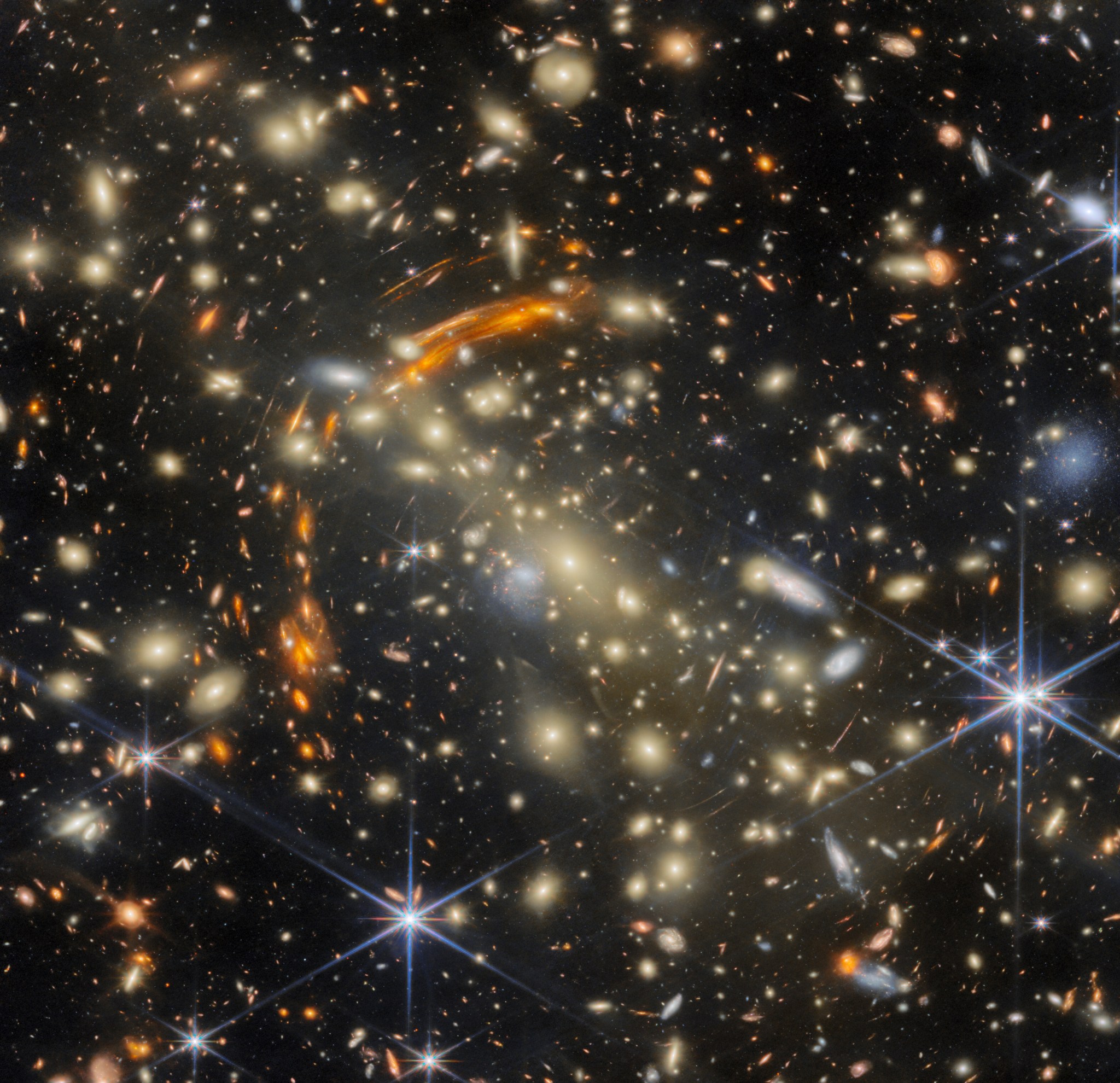
NASA’s James Webb Space Telescope has captured galaxy cluster MACS J0454.1-0300 warping distant galaxies into stretched arcs and duplicates via gravitational lensing.
Galaxies appear stretched, duplicated and distorted in a newly released image from NASA’s James Webb Space Telescope, offering a dramatic example of the universe acting like a funhouse mirror. The picture, made public on Sept. 29, 2026, centers on a massive galaxy cluster known as MACS J0454.1-0300.
Several of the brightest objects in the scene glow with a warm, golden hue. Those luminous galaxies belong to the cluster itself—an enormous congregation of galaxies bound together by gravity. But not everything that looks clustered in the image is actually part of MACS J0454.1-0300. A striking group of orange-tinted galaxies packed to one side is, in fact, located far beyond the cluster.
Their unusual appearance is the result of gravitational lensing, a natural optical effect predicted by Einstein’s general theory of relativity. In gravitational lensing, the intense gravitational pull of a massive foreground object—such as a galaxy cluster—warps spacetime enough to bend the path of light traveling from more distant background sources. To an observer, that bending can make remote galaxies look brighter, stretched into arcs, or even copied into multiple images across the sky.
In this Webb view, MACS J0454.1-0300 serves as the lens. The cluster’s immense mass acts like a cosmic magnifying glass, redirecting and amplifying the light from galaxies that sit much farther away along the same line of sight. The result is a layered scene in which some of the most eye-catching features are not members of the cluster at all, but magnified background galaxies whose light has been reshaped on its long journey to Earth.
The image was produced by an international Webb team, with credit to ESA/Webb, NASA and the Canadian Space Agency, along with L. Furtak and S. Fujimoto.
Why it matters
Gravitational lensing turns galaxy clusters into powerful tools for studying parts of the universe that would otherwise be too faint to detect. By magnifying distant galaxies, Webb can probe the structure and evolution of early galaxies and refine maps of mass—especially invisible dark matter—inside lensing clusters. Future observations of systems like MACS J0454.1-0300 will help astronomers sharpen lensing models and better interpret what these warped, amplified images reveal about the distant cosmos.