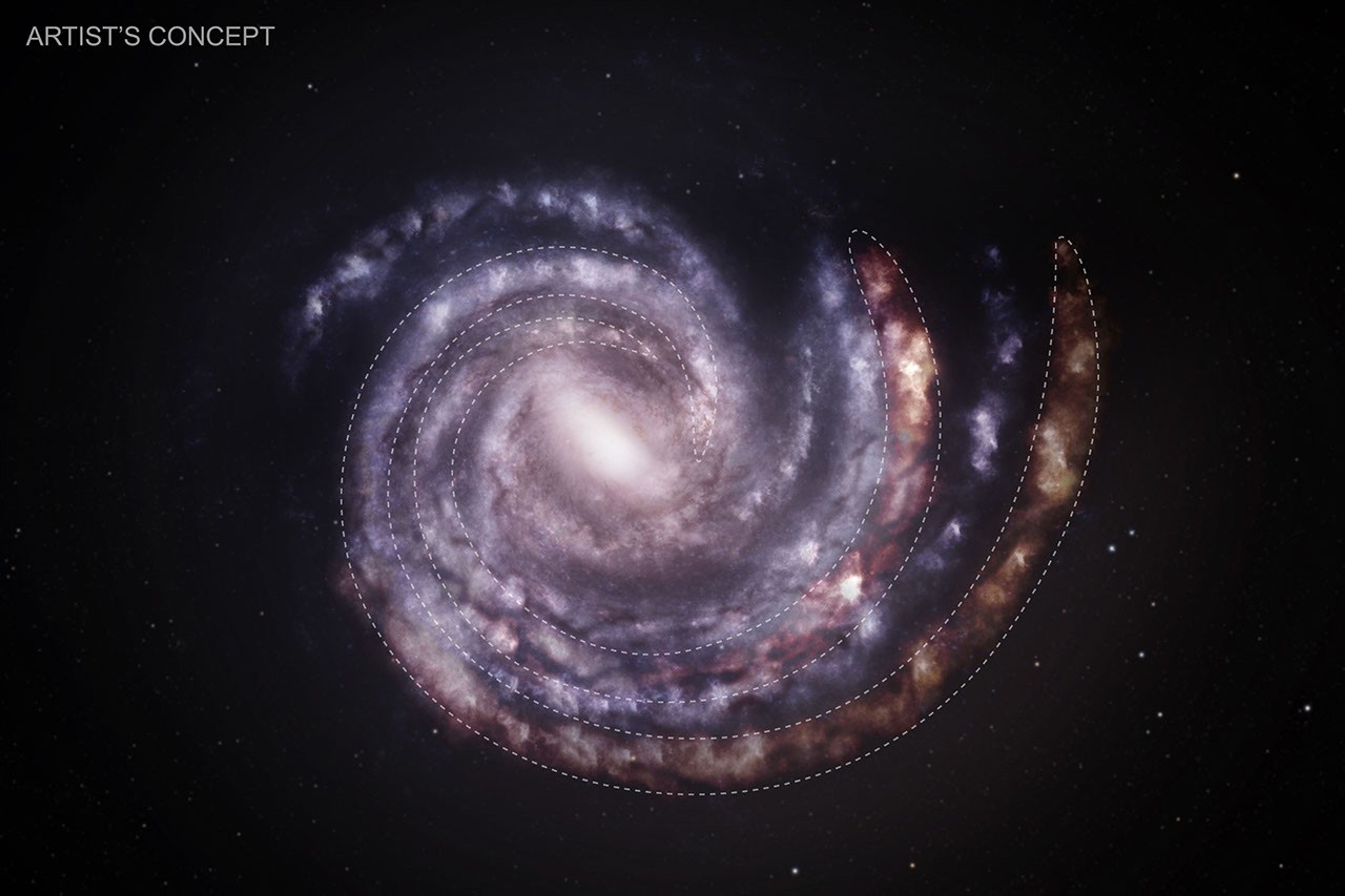
New observations from NASA’s Chandra X-ray Observatory suggest the Milky Way’s outer spiral arms may extend farther into space than astronomers had believed—a shift that…
New observations from NASA’s Chandra X-ray Observatory suggest the Milky Way’s outer spiral arms may extend farther into space than astronomers had believed—a shift that could prompt updates to widely used models of our galaxy’s architecture.
The result comes from a study that made unusually precise distance measurements to dusty structures embedded in the Milky Way’s spiral arms. To do it, researchers combined X-ray data from Chandra with observations from XMM-Newton, the European Space Agency’s X-ray telescope to which NASA contributes. Their findings were published Wednesday in the journal Astronomy & Astrophysics.
Measuring the shape of the Milky Way has never been straightforward. Although scientists have known for about a century that our galaxy has spiral arms, Earth sits inside one of them, making it difficult to view the overall pattern from within. Compounding the problem, dense gas and dust obscure large portions of the galactic plane, limiting how clearly other arms can be traced. Many existing methods depend on assumptions about galactic rotation—assumptions that become less reliable in the remote outskirts of the Milky Way.
The new work instead relies on geometry. The team used “light echoes” produced by gamma-ray bursts—brief, extraordinarily luminous flashes that originate far beyond our galaxy, typically when massive stars collapse or when neutron stars merge. As the burst’s light travels toward Earth, some of it scatters off intervening dust clouds in the Milky Way’s spiral arms. In X-rays, this scattering can appear as expanding rings around the burst position. The apparent ring size carries a key clue: larger rings correspond to dust clouds that are closer to Earth, while smaller rings indicate more distant dust.
“This is a very direct way—relying only on geometry—to precisely measure distances to the Milky Way’s spiral arms,” said Beatrice Vaia, who led the study during her PhD work in a joint program between Scuola Universitaria Superiore IUSS Pavia and the University of Trento in Italy.
Using three separate gamma-ray bursts, the researchers derived distances to dust associated with three spiral arms: the Perseus arm, the Outer arm, and the Outer Scutum–Centaurus arm, listed in order of increasing distance from the galactic center. In the direction of one of the bursts, the analysis indicates that both the Outer and Outer Scutum–Centaurus arms lie about 10% farther away than earlier estimates suggested.
The adjustment is modest but significant, researchers say, because these distances underpin fundamental properties of the Milky Way. “The differences are small, but any revision of these distances is important because they are so fundamental for understanding our galaxy,” said co-author Ilaria Fornasiero, also a former PhD student in the same program. One implication, she noted, is that stretching the arms outward could affect estimates of the galaxy’s total mass.
The team also used the measurements to infer that the dust cloud associated with the most distant arm spans roughly 3,500 light-years, indicating the result reflects the full thickness of a spiral arm rather than an isolated pocket of dust.
Despite the method’s improved accuracy, it is not easy to repeat. Gamma-ray bursts bright enough to be seen through the Milky Way’s dust-laden disk are rare. “We’re relying on the universe to provide us with these events, and so far, over 25 years, we’ve only found a handful that we can use,” said co-author Andrea Tiengo of Scuola Universitaria Superiore IUSS Pavia, adding that the team will continue searching for more suitable bursts.
NASA’s Marshall Space Flight Center in Huntsville, Alabama, manages the Chandra program. Science operations are run by the Smithsonian Astrophysical Observatory’s Chandra X-ray Center in Cambridge, Massachusetts, with flight operations based in Burlington, Massachusetts.