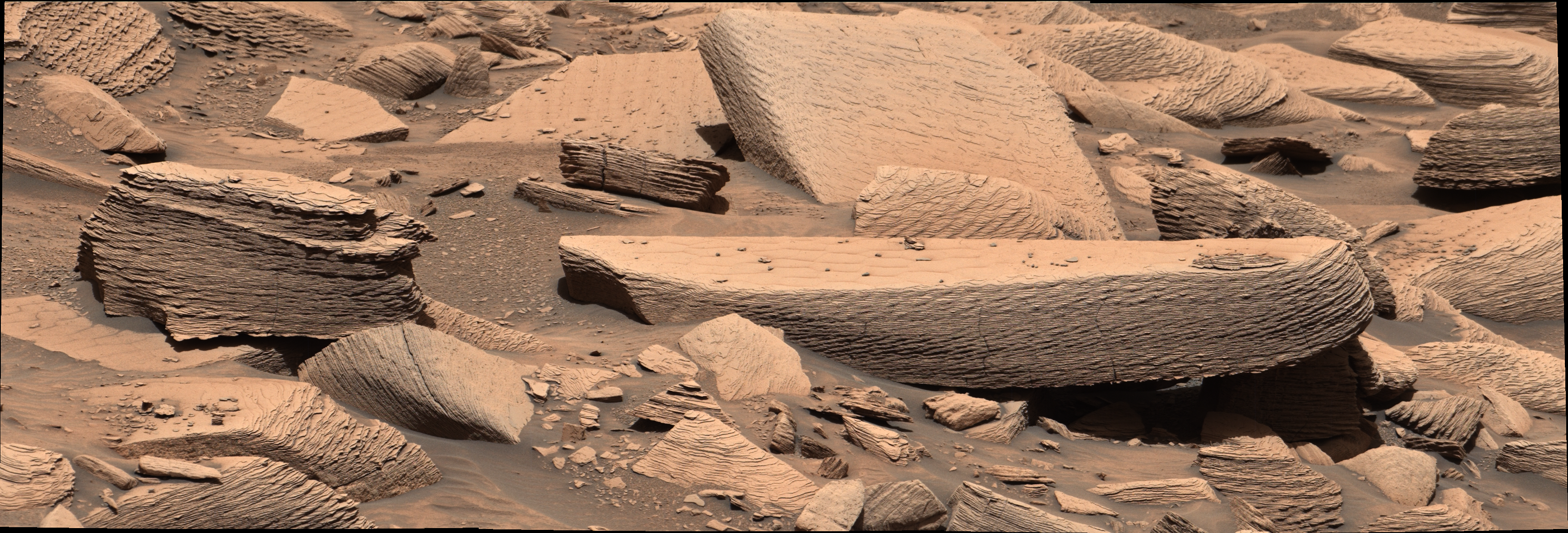
A fierce sandstorm swept across Mars billions of years ago, lasting for hours and driving sand so forcefully that migrating ripples began stacking on top of one another as they advanced.
A fierce sandstorm swept across Mars billions of years ago, lasting for hours and driving sand so forcefully that migrating ripples began stacking on top of one another as they advanced. Over time, those ripple-built layers were buried and cemented, turning into the distinctive banded rock now captured in a photograph from NASA’s Curiosity rover.
Curiosity recorded the scene on Dec. 12, 2024—mission sol 4,391—while exploring an area informally dubbed “Jawbone Canyon.” The image reveals multiple, finely layered beds that researchers interpret as the preserved record of “climbing” wind ripples, a type of sedimentary structure formed when ripples continue to move even as new sand accumulates quickly enough to build upward. On Earth, such features can occur during particularly intense wind events when both transport and deposition are high, allowing ripple crests to effectively overtake earlier ones and create a telltale, overlapping architecture in the resulting strata.
According to the science team, this appears to be the first time climbing wind-ripple strata have been identified on Mars. That makes the outcrop more than just an eye-catching rock formation: it is a rare snapshot of an energetic episode in the planet’s early environmental history, preserved in stone.
The rocks at Jawbone Canyon are being described as a geological “time capsule” because they capture evidence of a dramatic wind-driven event rather than the slower, more routine sedimentation that often dominates the record. The layered pattern suggests the sandstorm was not merely dusty and widespread, but capable of reshaping the surface rapidly, generating ripples that piled upward as they migrated.
The discovery was detailed in a research paper that drew prominent attention in the scientific community, appearing on the cover of the journal Geology on July 1, 2026. Researchers say the find adds an important new data point to efforts to reconstruct Mars’ ancient climate and surface processes, indicating that powerful, sustained winds once produced conditions capable of building complex sedimentary structures now observable by rover-scale investigations.