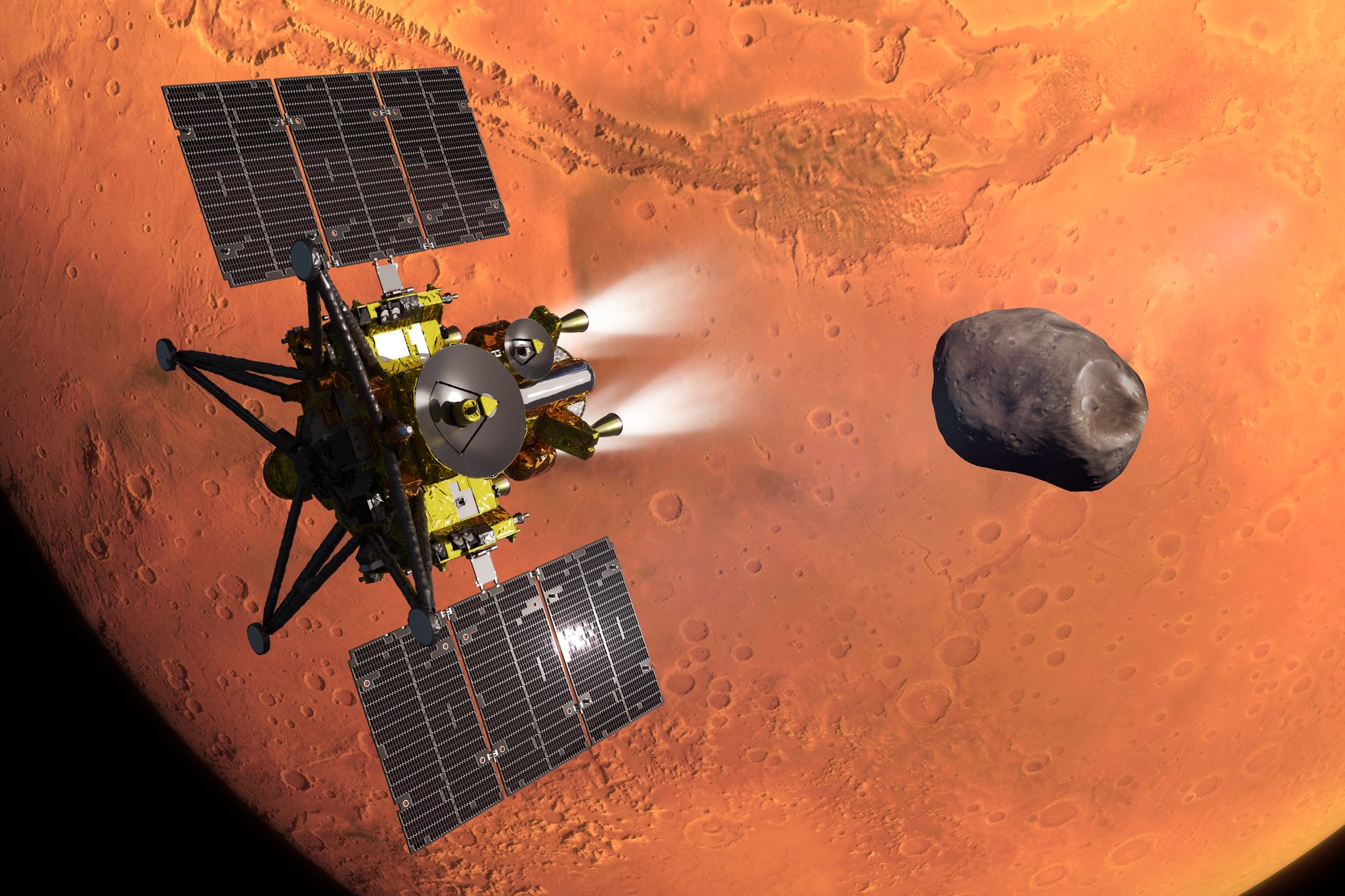
NASA will support JAXA’s MMX mission to study Phobos and Deimos and return Phobos samples, providing key instruments, sampling tech, and Deep Space Network support.
NASA is taking a central supporting role in Japan’s upcoming Martian Moons eXploration (MMX) mission, an effort led by the Japan Aerospace Exploration Agency (JAXA) to investigate the puzzling origins of Mars’ small satellites, Phobos and Deimos, and to return pieces of Phobos to Earth.
MMX is scheduled to lift off from JAXA’s Tanegashima Space Center, with a targeted launch time of 3:41 p.m. EDT on Monday, Oct. 19 (4:41 a.m. Japan Standard Time on Tuesday, Oct. 20). If the mission unfolds as planned, it will deliver the first samples ever collected from a Martian moon—material scientists hope will help settle a decades-long debate about how these bodies formed.
“The samples from MMX will bring forth paradigm-shifting science on the Mars system for generations to come, especially as NASA prepares to send the first humans to Mars,” said Nicky Fox, associate administrator for NASA’s Science Mission Directorate in Washington. She emphasized that NASA and JAXA’s partnership on handling the returned material is designed to ensure broad scientific access over many years.
One of NASA’s most visible contributions is an instrument called MEGANE—short for Mars-moon Exploration with Gamma rays and Neutrons. By measuring neutrons and gamma rays naturally emitted from Phobos’ surface, the spectrograph will allow researchers to infer the moon’s elemental makeup. Those chemical fingerprints are expected to provide clues about whether Phobos resembles Mars, an asteroid, or something in between. MEGANE (pronounced “meh-GAH-nay,” the Japanese word for “eyeglasses”) will effectively let the mission “see” beneath the surface in a way cameras cannot.
NASA is also providing a sampling technology demonstration known as the Pneumatic Sampler, or P-Sampler. Mounted on one of the spacecraft’s landing legs, the system is designed to kick up and capture surface grains using short blasts of high-pressure nitrogen gas. That approach is meant to complement JAXA’s coring system, the C-Sampler, which will collect material from several inches below the surface.
In addition to hardware, NASA is supplying communications and navigation support through its Deep Space Network and funding U.S. scientists on the MMX science team. The agency will also receive and preserve roughly 15% of the returned sample at the Astromaterials Laboratory at NASA’s Johnson Space Center in Houston, where it will be curated and made available to researchers for decades.
The scientific stakes are high. Researchers have long argued over whether Phobos and Deimos are captured asteroids—objects pulled in by Mars’ gravity early in solar system history—or whether they formed from debris blasted into orbit by a massive impact on Mars. “Having the answer will help illuminate that early era when Earth and the other inner planets may have been acquiring much of their water and organic compounds,” said Tom Statler, NASA’s MMX program executive and program scientist.
MMX is expected to reach Mars in August 2027, begin detailed reconnaissance of both moons, then attempt to collect samples from Phobos no earlier than December 2028. The mission is slated to return the sample capsule to Earth in 2031.
MEGANE was developed by the Johns Hopkins Applied Physics Laboratory, while Honeybee Robotics—a Blue Origin company—built the pneumatic sampling mechanism. NASA’s contributions were produced under the agency’s Discovery Program, managed by NASA’s Marshall Space Flight Center in Huntsville, Alabama, for the Science Mission Directorate.
Why it matters
Phobos and Deimos could preserve a record of how the inner solar system evolved, including processes that may have delivered water and organic materials to rocky planets. Returning samples from Phobos would give laboratories on Earth the chance to answer questions remote sensing alone cannot resolve. The mission’s timeline—arrival in 2027 and sample return in 2031—will also shape near-term international planning for Mars exploration and future human missions.