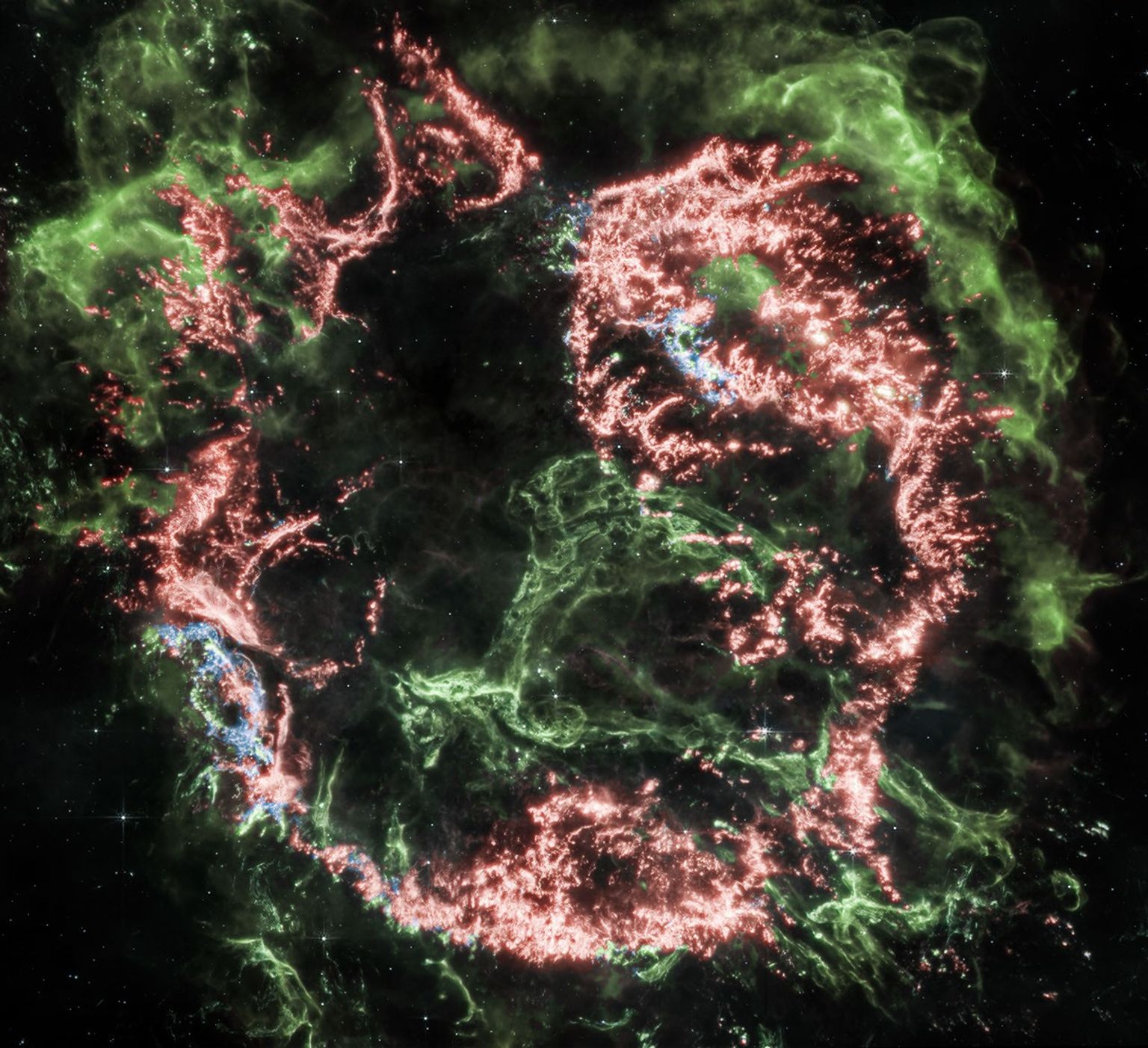
James Webb’s mid-infrared view of Cassiopeia A reveals distinct dust chemistry and clumps, pointing to late-stage mixing of burning shells inside the star.
NASA’s James Webb Space Telescope has delivered a striking new mid-infrared view of Cassiopeia A (Cas A), one of the Milky Way’s most famous supernova remnants—and a key laboratory for understanding how massive stars live and die. Supernova remnants are expanding clouds of hot gas and dust left behind after a star’s catastrophic explosion. Over time, that material mixes into interstellar space, helping supply the raw ingredients for future generations of stars and planets.
In a study published Monday in The Astrophysical Journal Letters, astronomers report that Webb’s sharp vision is revealing chemical patterns in Cas A that point to a dramatic internal upheaval in the progenitor star shortly before it collapsed. The new data bolster a picture in which distinct burning layers inside the star began to mix—possibly only hours before the supernova.
Massive stars build their interiors like an onion as they age. They form from collapsing molecular clouds dominated by hydrogen gas and dust. As the nascent star heats up, nuclear fusion ignites: hydrogen fuses into helium, and later the star begins fusing helium into heavier elements. The process continues in stages, creating multiple nested shells where different fuels burn, ultimately producing iron in the core. Those shells preserve a chemical record of the star’s final evolutionary phases.
When the star explodes, its layered contents are blasted into space. Some of the expelled elements cool and condense into tiny dust grains that can gather into clumps—structures that can span distances comparable to the scale of the solar system. By analyzing these individual dust clumps in Cas A, Webb allowed scientists to trace the chemistry back to the star’s internal architecture.
The Webb observations support evidence for a “shell merger,” a phenomenon where neighboring burning layers churn, circulate, and blend before the explosion, reshaping the star’s interior. Lead author Tea Temim of Columbia University explained that such mixing can combine, for instance, oxygen-burning and carbon-burning shells, altering the star’s structure and leaving behind different chemical signatures in the supernova debris than would be expected from neatly separated layers.
To target Webb’s high-resolution observations, the team first relied on earlier guidance from NASA’s now-retired Spitzer Space Telescope. Spitzer lacked Webb’s ability to resolve fine structure, but it helped identify three promising regions for closer inspection. Two of those regions lie within Cas A’s reverse-shocked zone, where an inward-moving shock wave plows into the outward-flying supernova ejecta. Webb found that one of these sites is dominated by silica-rich dust, while the other is primarily carbon-rich.
The third region is a feature nicknamed the “Green Monster,” first identified by Webb. Unlike the other two targets, the Green Monster appears to originate from material the star expelled before it detonated. Webb’s spectra show it is rich in complex magnesium silicates, underscoring that Cas A contains not only products of the explosion but also relics of the star’s pre-supernova mass loss.
By combining Webb’s dust map with X-ray perspectives—drawing on NASA’s Chandra X-ray Observatory and the JAXA-led XRISM mission—the researchers extended their analysis across the full remnant. Together, the multiwavelength data indicate the shell-merging process was underway extremely late in the star’s life, close to the moment of core collapse.
Dan Milisavljevic of Purdue University, a co-author on the study, said Webb’s ability to distinguish individual clumps enables more advanced dust-chemistry work—linking what astronomers see today to the progenitor star’s internal conditions centuries ago, and potentially to events unfolding in its final hours.
Why it matters
The chemical makeup of supernova dust is one of the main ways galaxies recycle material into new stars, planets, and—eventually—habitable environments. Webb’s results suggest that the last stages of massive-star evolution may be more dynamic than standard layered models imply, with late mixing reshaping what a supernova contributes to space. Next, researchers will be watching for similar shell-merger signatures in other remnants to learn whether Cas A is typical or an outlier.