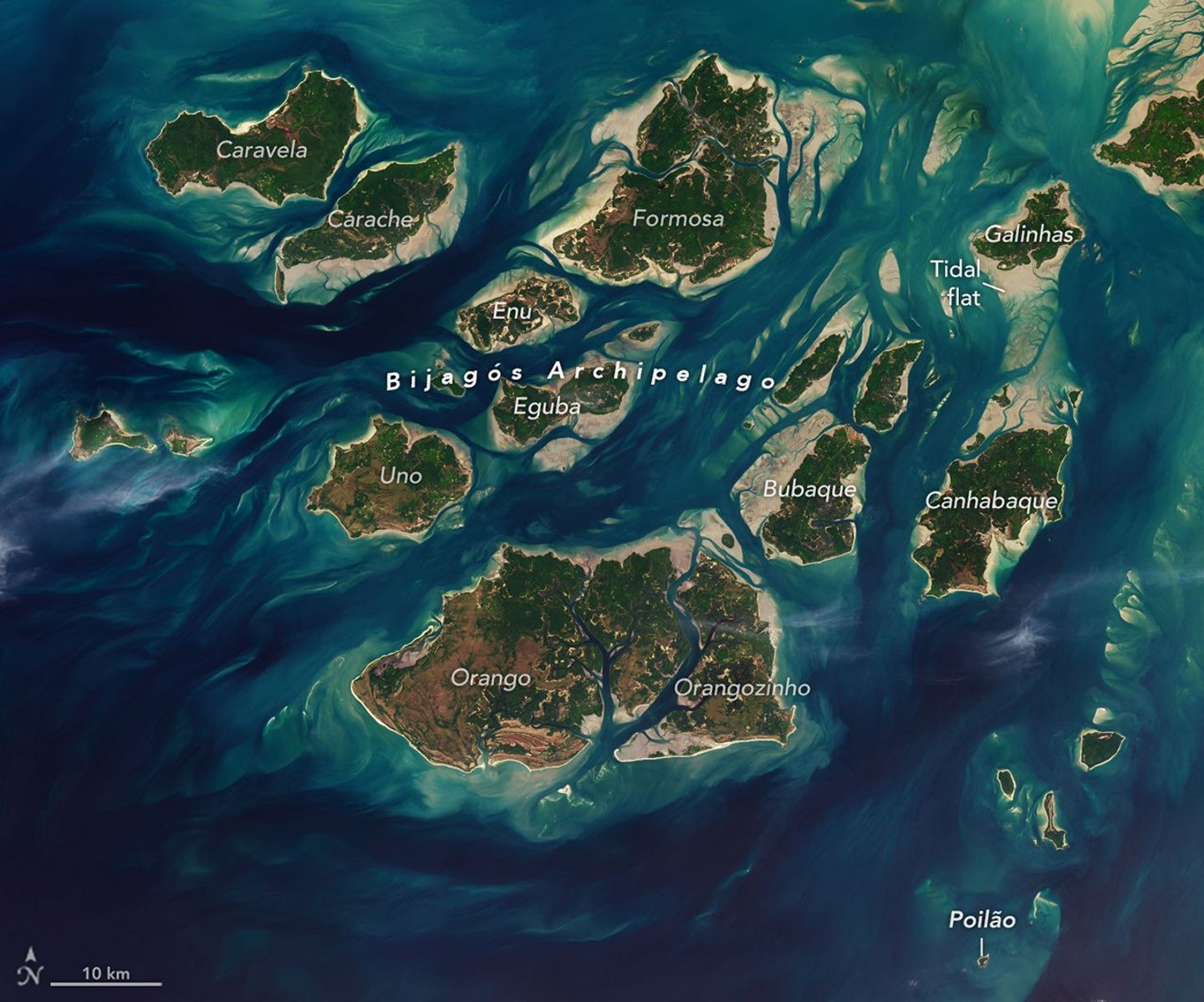
Across Guinea-Bissau’s Bijagós Archipelago, the sea rewrites the map twice a day.
Across Guinea-Bissau’s Bijagós Archipelago, the sea rewrites the map twice a day. As tides surge and retreat through a lattice of sandy channels, broad mudflats and mangrove-lined inlets appear and vanish around the chain’s 88 islands and islets. From above, the transformation is striking: at low tide, intertidal sand and mud surfaces are exposed, making the islands seem to expand dramatically before the water returns and the visible land contracts again just hours later.
That steady tidal pulse is more than a visual spectacle. It underpins one of the most biologically productive coastal systems in West Africa—an ecological engine now formally recognized on the world stage. In 2025, the Bijagós Archipelago was added to the UNESCO World Heritage list. The designation highlights the site as the only active deltaic archipelago on Africa’s Atlantic coast, where multiple forces—strong tides, river-borne sediments, coastal currents, and nutrient-rich upwelling—work together to build and continually reshape fertile island habitats.
For wildlife, the consequences are profound. UNESCO estimates the archipelago supports about 870,000 migratory shorebirds, placing it among the most important feeding grounds in West Africa along the East Atlantic Flyway. When the tide drops, vast foraging areas open up. Hundreds of bird species take advantage of the exposed flats, probing and picking through a dense mix of prey that includes marine worms, crustaceans, mollusks, and small fish.
As the water returns, the cast of characters changes. High tide draws marine mammals and fish closer to shore, with manatees and dolphins moving into waters around the islands. Fish schools press inward as well, slipping into channels and pushing deeper toward the mangrove forests that ring much of the archipelago.
Sea turtles also respond to this daily rhythm on a grand scale. Tens of thousands swim toward the islands’ sandy margins, searching for suitable nesting beaches. One of the most significant nesting sites is Poilão, a small island within João Vieira and Poilão Marine National Park, known for hosting an exceptionally large population of nesting green sea turtles.
For hatchlings, however, the journey begins with hazard. After emerging from their nests, young turtles typically make nighttime runs to the surf, where crabs, lizards, and birds can quickly turn the dash into a deadly gauntlet. Reaching the water does not end the danger. In the shallows, predators such as jacks, barracudas, groupers, and snappers patrol for easy prey. Farther out, larger hunters—including tuna, mackerel, sharks, and rays—add to the risk. Some estimates suggest fewer than 1 percent of green sea turtle hatchlings survive to adulthood.
Scientists are also working to understand the physical dynamics that make the Bijagós so productive. A 2025 study examining local tides investigated why the area experiences some of the largest tidal ranges in West Africa. The researchers concluded that the combination of a broad, shallow continental shelf and the geometry of the estuary amplifies the incoming tide, producing ranges as large as 7 meters (23 feet). In many other parts of the West African coast, tidal ranges are closer to about 1 meter (3 feet). To check their results, the team relied in part on satellite altimetry measurements from NASA/CNES TOPEX/Poseidon and the Jason-1 and Jason-2 missions.
The result is an archipelago where physics and biology are tightly interwoven—a place where the rise and fall of the sea helps sustain a remarkable concentration of life.