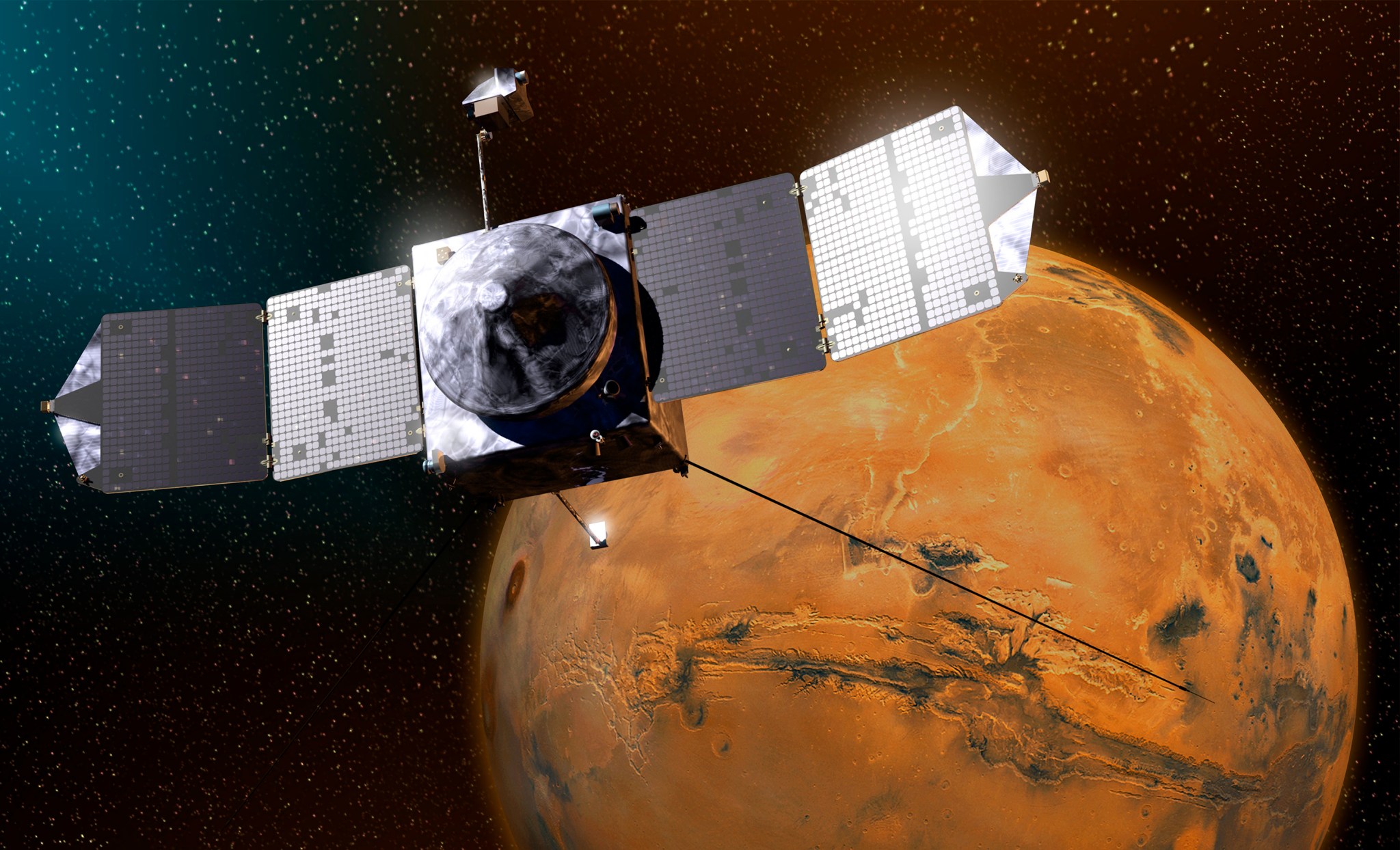
NASA’s MAVEN spacecraft, the agency’s first mission dedicated to tracking the Martian atmosphere and how it has changed over time, has reached the end of its run after…
NASA’s MAVEN spacecraft, the agency’s first mission dedicated to tracking the Martian atmosphere and how it has changed over time, has reached the end of its run after more than 11 years circling Mars—far outlasting its planned one-year prime mission.
The orbiter was last heard from on Dec. 6, when contact was unexpectedly lost after MAVEN passed behind Mars. NASA plans to review the mission’s scientific legacy during a media teleconference scheduled for 2 p.m. EDT today, Wednesday, June 3.
Following months of recovery attempts, NASA convened an anomaly review board in February to analyze what might have happened and to judge whether the spacecraft could be brought back. The board has now concluded MAVEN is not recoverable and can no longer carry out either its science observations or its role relaying data, aligning with earlier assessments by the mission team.
Before the communications failure, telemetry indicated the spacecraft was healthy. Data sent prior to the December occultation showed all major subsystems functioning normally. But when MAVEN should have reappeared from behind the planet, NASA’s Deep Space Network detected no signal.
Investigators did, however, glean a small but telling clue from radio recordings captured by the DSN’s open-loop receivers. Analysis of that fragment suggested MAVEN emerged in safe mode and was spinning far faster than expected—evidence consistent with a disturbance that affected the spacecraft’s trajectory. The review board’s preliminary assessment is that the unusually rapid rotation likely exhausted MAVEN’s batteries. Once depleted, the communications system would have lost power, leaving the spacecraft unable to re-establish contact.
NASA emphasized that these early conclusions do not yet identify the underlying trigger for the anomaly. Work to determine a root cause is continuing, and the board expects to deliver a final report later this year.
With recovery no longer considered possible, NASA has started formal decommissioning steps. As part of standard closeout procedures, the agency will archive the complete MAVEN dataset so it remains accessible to scientists and mission planners.
“The science MAVEN has given us is key to informing what kind of radiation protection and safety measures we must take before sending humans to Mars,” said Louise Prockter, director of NASA’s Planetary Science Division in Washington. She added that MAVEN’s observations should keep shaping Mars research for decades.
Launched in November 2013, MAVEN—short for Mars Atmosphere and Volatile Evolution—was built to probe the planet’s upper atmosphere and ionosphere and to track how they interact with the Sun. Its central goal was to understand how Mars lost much of its atmosphere to space, a process tied to the planet’s climate history, the fate of liquid water, and long-term habitability.
“The MAVEN mission has truly advanced our understanding of the Martian atmosphere and evolution,” said principal investigator Shannon Curry of the University of Colorado Boulder’s Laboratory for Atmospheric and Space Physics. She noted that the mission’s dataset has been highly influential across the field.
Among MAVEN’s early headline findings: atmospheric escape intensifies during solar storms. By measuring the solar wind—a constant flow of charged particles from the Sun—and the planet’s response, MAVEN helped clarify how space weather steadily strips Mars’ air away, contributing to its transformation from a potentially more hospitable world into today’s cold, dry landscape. The mission also captured auroral displays on Mars, including varieties produced by protons. Unlike Earth’s proton auroras, which are confined to limited polar regions, MAVEN data showed they can occur across the Martian sky.