Paul Krugman argues that Scott Bessent’s tenure as Treasury secretary has become a cautionary tale about the reputational costs of aligning oneself with Donald Trump.
Paul Krugman argues that Scott Bessent’s tenure as Treasury secretary has become a cautionary tale about the reputational costs of aligning oneself with Donald Trump. In Krugman’s telling, Bessent is not simply making a bad bet on policy; he is surrendering his standing and seriousness to an administration that offers little in return. The pattern, Krugman suggests, has become familiar in contemporary U.S. politics: officials attach themselves to Trump, spend their credibility defending him, and emerge diminished—often without even the courtesy of gratitude.
What makes Bessent’s case notable is that he began with real professional capital. When Trump chose him, the Financial Times highlighted supportive assessments, including comments from Jason Furman, the former chief economist to President Barack Obama, who described Bessent as a credible pick with a genuine grasp of the global economy. Krugman contrasts that initial stature with what he portrays as Bessent’s current public posture—more propagandist than steward—particularly on the question of interest rates and market confidence.
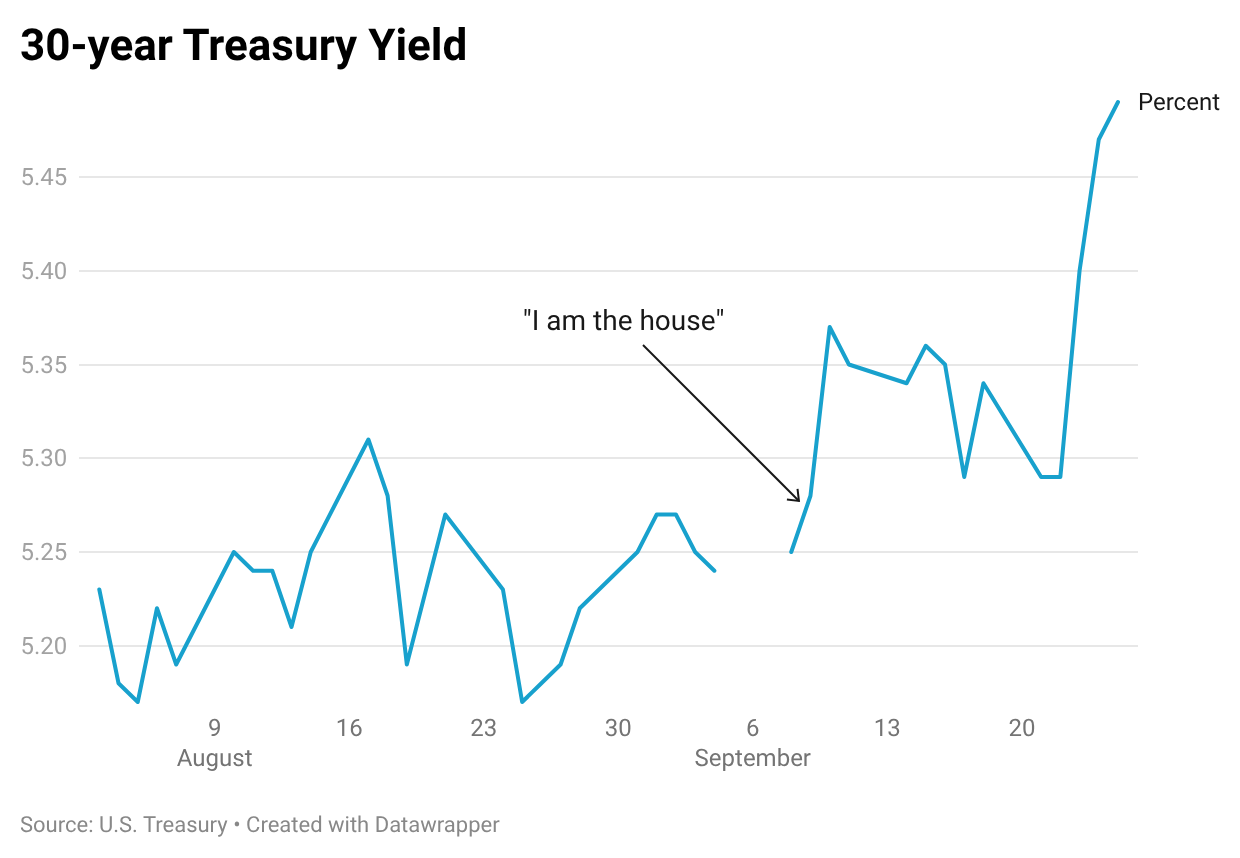
The latest episode began three weeks ago, after Bessent took the unusual step of intervening in currency markets to bolster the Japanese yen, a move whose rationale Krugman says was never fully clarified. Bessent then escalated rhetorically, publicly challenging investors and projecting dominance over market outcomes with a blunt declaration: “I am the house now.” He followed the jawboning with action, purchasing 30-year U.S. Treasury bonds in an apparent effort to push down long-term yields. Krugman likens the tactic to the household financial maneuver of paying down part of a mortgage by increasing credit-card debt—shifting the burden rather than resolving the underlying pressure.
Yet long-term interest rates continued to climb, reaching levels not seen since the waning period of the dotcom boom. Krugman situates the broader rise in yields in a larger economic environment that includes a surge in investment linked to artificial intelligence, though he treats that as background context rather than the immediate trigger for the most recent jump.
In his account, the proximate catalyst was geopolitical: Trump’s rejection of an Iranian proposal aimed at ending the war. That decision, Krugman writes, helped reverse a period of easing in crude prices, sending oil sharply higher again. He notes an additional complication in global energy logistics: despite continued flows through the Strait of Hormuz—sometimes routed at night on smaller ships—much of that crude must be transferred to larger tankers before heading to Europe and Asia. Roughly 15 percent of the world’s large crude carriers, Krugman reports, are now sitting off Oman awaiting loads, a bottleneck that tightens shipping capacity.
The economic consequences, in Krugman’s view, flow quickly. With crude elevated and refined fuels—especially diesel—near record highs, inflation pressures are likely to persist. That outlook, in turn, reinforces expectations that the Federal Reserve will keep short-term interest rates high. And when markets believe tight policy will endure, those expectations feed into longer-term borrowing costs—overwhelming any attempt by Treasury officials to talk yields down.
The result, Krugman contends, is that Bessent’s bravado has been overtaken by the very administration he has chosen to serve. He further criticizes Bessent for compounding the spectacle by predicting Iran’s economic collapse “within two weeks,” presenting it as another instance where political messaging has displaced disciplined economic analysis.