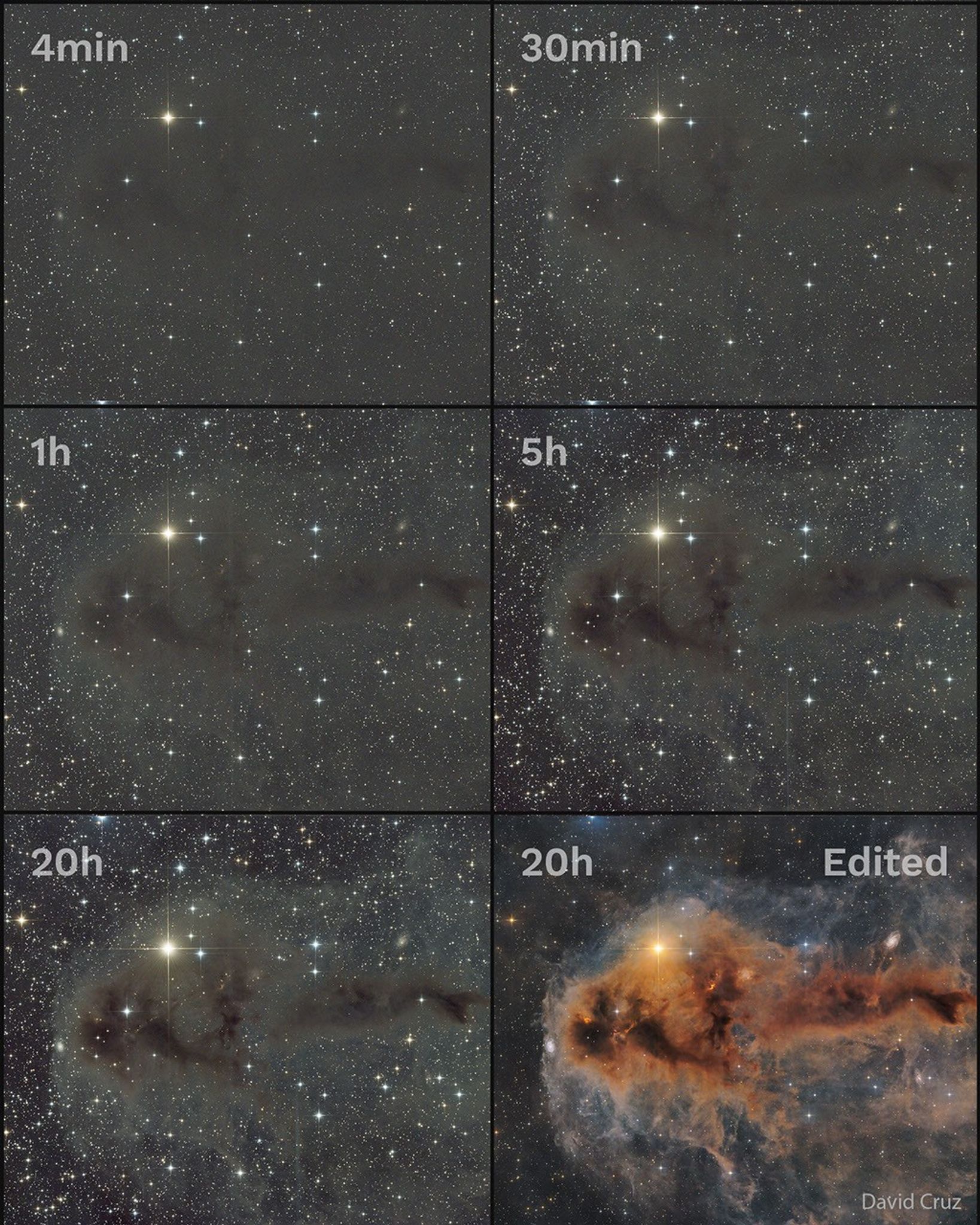
A 20-hour deep-sky exposure and processing reveal the dark nebula Lynds 1251, where dense dust blocks starlight. The “Rotten Fish” region is a stellar nursery with jets and shocks.
Spending a few moments looking into a patch of sky can give the impression that space is mostly empty, punctuated only by the brightest stars. But the featured astronomical image illustrates what happens when observation time stretches from minutes to many hours: the universe starts to reveal not just what is shining, but also what is blocking the light.
In this view, a short exposure would initially show a familiar star field. After several minutes of light-gathering, however, something subtler begins to emerge—areas where stars appear to be missing. Those “blank” regions are not truly empty. They are places where dense material in the foreground is absorbing and scattering starlight, hiding background stars from view.
With continued observing, the dark patches become more sharply outlined. After an observing run totaling about 20 hours, the shape resolves into a distinctive, complex structure: the dark nebula Lynds 1251, also cataloged as LDN 1251. Astronomers classify it as a star-forming region, threaded and veiled by interstellar dust so thick that it looks opaque, taking on a brownish cast in processed color images.
The final presentation of the scene relies not only on long exposure time but also on digital image processing. By carefully increasing brightness and emphasizing color differences, the processed image brings out details that would be difficult to see in raw data—subtle contrasts in the dust and surrounding emission that help define the nebula’s form.
LDN 1251 is also known by a more evocative nickname: the Rotten Fish Nebula. Behind the playful moniker is a serious astrophysical environment. Dark nebulae like this one are not merely cosmic silhouettes; they are reservoirs of gas and dust where young stars are born. The image’s depth hints at that activity: embedded youthful stars, along with the turbulent consequences of stellar formation.
The region hosts energetic phenomena associated with newborn and developing stars. Observations indicate the presence of shock waves moving through the surrounding material, fast winds driven by stars, and narrow, strongly directed jets—features commonly linked to the earliest stages of stellar evolution, when forming stars interact violently with their natal clouds.
The result is a portrait of emergence in two senses: a nebula revealed gradually by persistent observing, and a stellar nursery where new suns are actively taking shape amid dust and dynamic outflows.
Why it matters
Long integrations and modern processing techniques can uncover structures that are effectively invisible in casual observing, turning “empty” sky into a detailed map of dust and star formation. Regions like LDN 1251 help astronomers study how stars form and how jets, winds, and shocks reshape their birth clouds. Continued deep imaging and follow-up observations can clarify which young objects drive the observed outflows—and how common such activity is in similar dark nebulae.