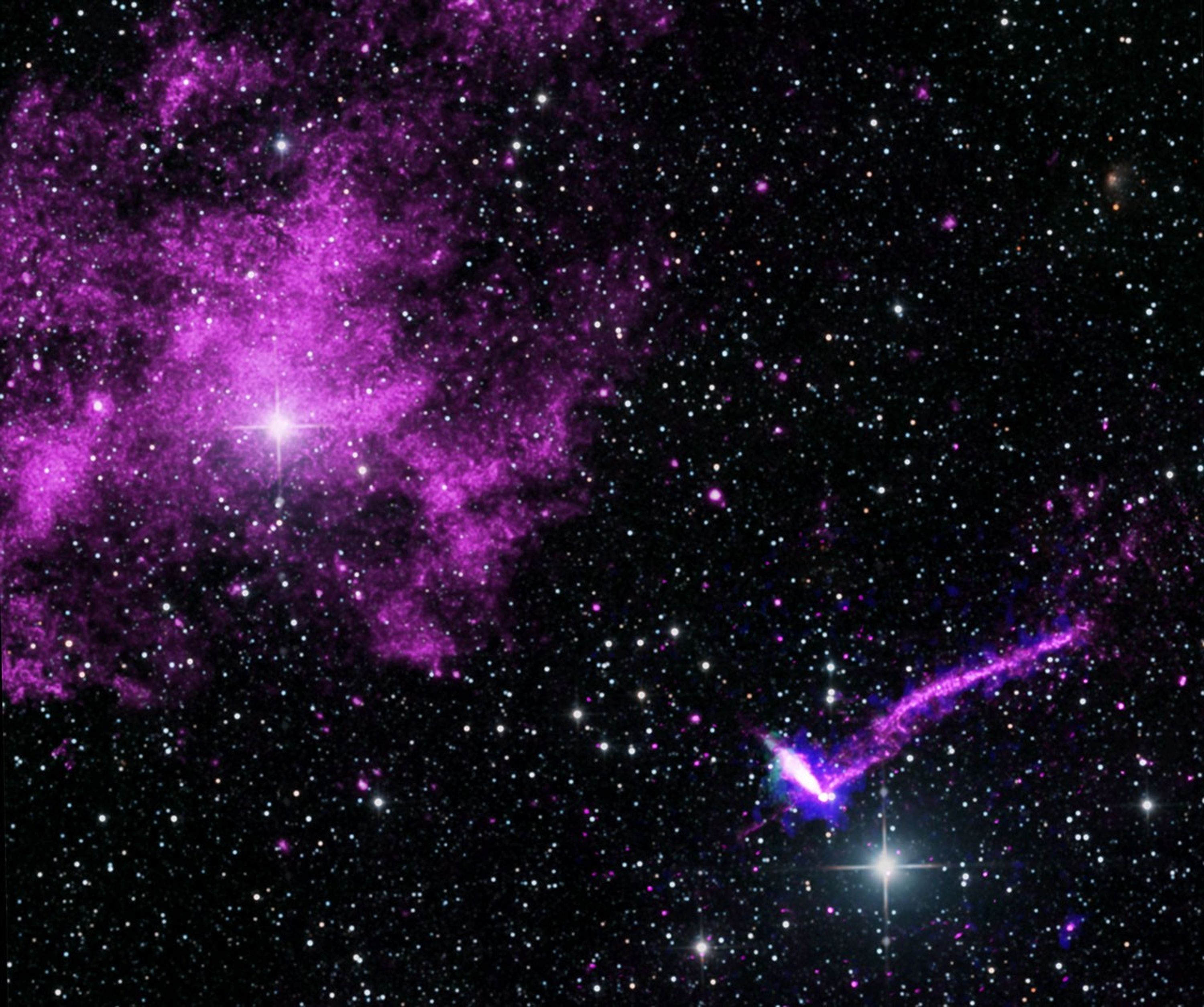
NASA’s Imaging X-ray Polarimetry Explorer IXPE has delivered the first direct measurements that trace the magnetic field geometry around PSR J1101−6101, a fast-moving…
NASA’s Imaging X-ray Polarimetry Explorer (IXPE) has delivered the first direct measurements that trace the magnetic field geometry around PSR J1101−6101, a fast-moving pulsar embedded in the object popularly called the Lighthouse Nebula. The findings, reported Thursday in The Astrophysical Journal, sharpen astronomers’ picture of how some of the galaxy’s most extreme particle accelerators channel matter and energy into their surroundings.
IXPE trained its instruments on the Lighthouse Nebula for nearly 18 days in June 2025, collecting enough photons to probe two thin X-ray features that extend away from the pulsar. One is a long, needle-like structure known as the filament; the other is a shorter, more chaotic feature called the trail. Both are thought to be produced by electrons and other particles pushed to near-light speed by the pulsar’s intense environment.
As PSR J1101−6101 plows through interstellar gas, its outflow slams into the ambient medium and creates a bow shock—an astrophysical analogue of the wave that forms ahead of a fast boat. Most of the energetic particles are believed to be bottled up behind that shock, where they churn into the turbulent wake seen in X-rays as the trail. But since 2008, researchers have argued that the very highest-energy particles may leak through the shock and escape into interstellar space, then stream along the Milky Way’s magnetic field to form the remarkably straight filament.
The new IXPE observations were designed to put that idea to a decisive test. The key is polarization: the preferred orientation of light waves, which carries an imprint of magnetic field direction in the region where the radiation is produced. “The ‘smoking gun’ would come by measuring the polarization of the light,” said study lead Jack Dinsmore, an undergraduate at Stanford University. If the field direction aligned with the filament, it would strongly support the picture of particles flowing outward along ordered galactic field lines.
Because the Lighthouse Nebula is faint, the team also had to overcome a practical hurdle—extracting a polarization signal from scarce data. IXPE scientists developed analysis approaches aimed at preserving as much information as possible, avoiding shortcuts that can discard subtle statistical power. Using these methods, the team obtained polarization measurements not only for the filament but also for the trail and for X-ray emission associated with the pulsar itself.
The result: with more than 99% confidence, the analysis shows the magnetic field runs in the same direction as the particle flow in the filament, consistent with the long-suspected escape-and-streaming scenario. At the same time, the degree of polarization was unexpectedly high. Co-author Roger Romani, a Stanford professor, noted that many filament models rely on strongly turbulent magnetic fields—conditions that would tend to reduce polarization. The new measurement instead implies a more ordered field than those models typically assume.
IXPE also found that the magnetic field tied to the X-ray-emitting region of the trail must be oriented parallel to that trail. Yet complementary radio observations collected by the authors indicate a field direction that is close to perpendicular—an apparent mismatch that points to a complex, layered structure. Co-author Niccolò Bucciantini of the Italian National Institute for Astrophysics said the contrasting orientations across radio and X-ray bands are strong evidence that particles of different energies occupy different zones, suggesting multiple—and potentially very different—acceleration processes operating within the same system.
IXPE is a joint mission of NASA and the Italian Space Agency, with partners and science collaborators in 12 countries. The mission is led by NASA’s Marshall Space Flight Center in Huntsville, Alabama; BAE Systems manages spacecraft operations together with the University of Colorado’s Laboratory for Atmospheric and Space Physics in Boulder.