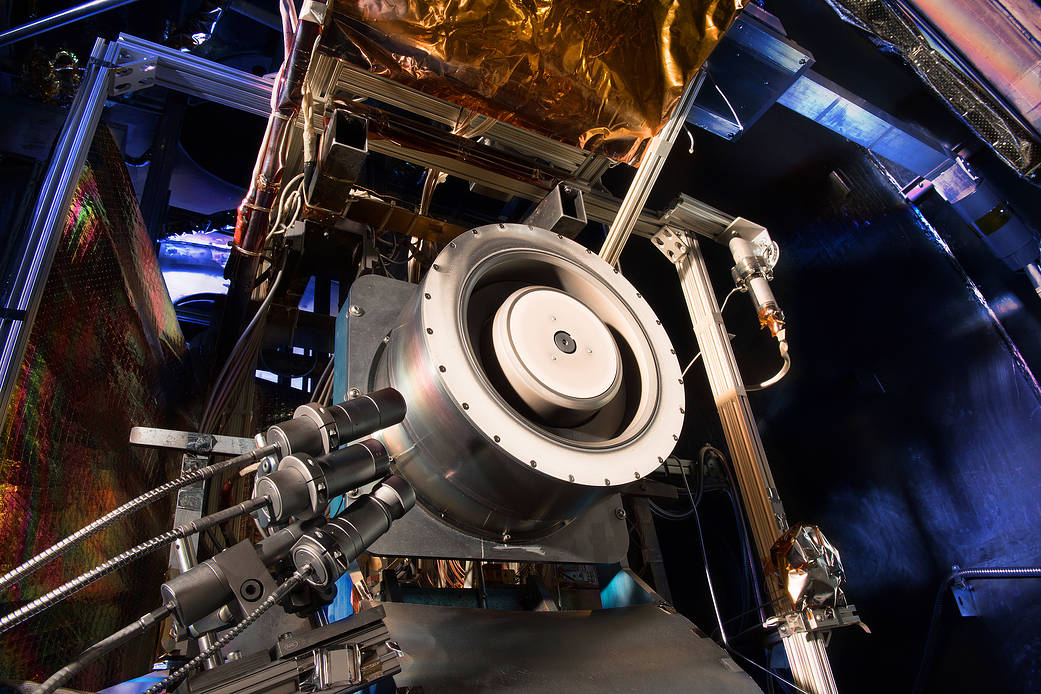
NASA is launching the AMPERE Challenge to spur U.S. companies to build mid-power Hall effect thruster prototypes, offering up to $500,000 plus NASA expertise and testing.
NASA is turning to American industry in a new bid to speed the development of a workhorse technology for future spaceflight: mid-power Hall effect thrusters, a class of electric propulsion systems widely used to move satellites and send robotic spacecraft on long journeys.
The agency’s newly announced Advanced Mid-Power Electric Rocket (AMPERE) Challenge invites U.S. companies to design and build prototype Hall thrusters that fit into the “mid-power” category—systems NASA sees as a key building block for both government and commercial missions. Hall effect thrusters generate thrust by using an electric field to accelerate a propellant gas, producing high efficiency suited to missions where low thrust applied over long periods can deliver significant changes in velocity.
To encourage participation and help push the technology closer to operational readiness, NASA is offering a total of 250,000 if selected. Beyond the cash award, the agency is also positioning the challenge as a pathway to reduce technical and business hurdles that can slow commercialization.
“This challenge approach seeks to remove key barriers and facilitate commercialization by providing access to NASA subject matter expertise, state-of-the-art technologies, and world-class facilities at no cost to challenge winners,” said Dr. Jason Frieman, AMPERE project co-owner at NASA’s Glenn Research Center in Cleveland. He added that NASA hopes entrants will use the program to showcase their capabilities to a broad audience of potential customers, including government and commercial decision-makers.
AMPERE is the inaugural competition in NASA’s Tech Maturation Prize series, an effort aimed at accelerating breakthrough technologies needed for NASA missions while also reinforcing the U.S. space economy.
The competition is structured in three stages. In Phase 1, teams submit a concept design along with a manufacturing plan and projections for cost and performance. NASA may then choose two winners to proceed to Phase 2, in which the selected teams build prototypes and work alongside NASA experts. As part of that phase, teams may obtain early access—through no-cost licensing—to NASA-developed Hall thruster technology that uses krypton propellant.
Phase 3 moves into testing. The prototypes will be evaluated at NASA Glenn, with test services provided at no cost to the competitors. The goal is to validate performance in a setting equipped for propulsion development and to help the most promising designs advance toward real-world application.
NASA will host an AMPERE Virtual Industry Day on Thursday, Nov. 19, offering prospective competitors a chance to learn more about the opportunity. Registration for the challenge remains open until Jan. 27, 2027, at 5 p.m. EST.
The challenge supports the broader Advanced Mid-Power Electric Rocket project, managed by NASA Glenn and NASA’s Jet Propulsion Laboratory in Southern California. Funding comes from NASA’s Research and Technology Mission Directorate. Program administration is handled by Yet2 under contract with the NASA Center of Excellence for Collaborative Innovation within the same directorate. Full details—including eligibility requirements, rules, and submission guidance—are available through NASA’s official competition materials.
Why it matters
Electric propulsion is already central to many satellite missions, and more capable mid-power thrusters could expand what spacecraft can do while using propellant more efficiently. By pairing prize funding with access to NASA expertise, facilities, and krypton-based thruster technology, the agency is trying to shorten the path from concept to flight-ready hardware. The results could influence future NASA exploration architectures and give U.S. companies an edge in a growing commercial propulsion market.