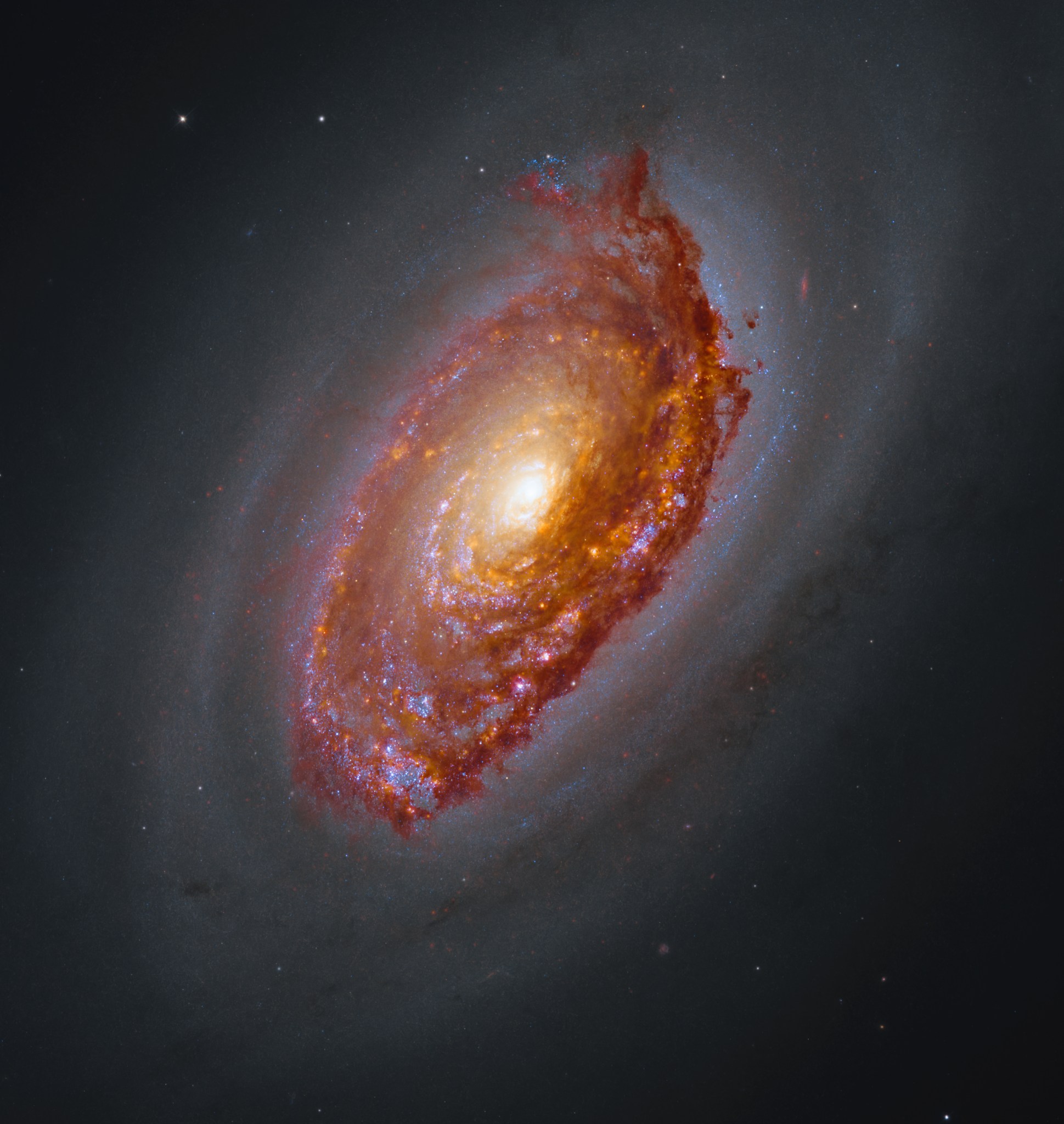
A newly released image dated March 20, 2026, offers an unusually rich look at Messier 64—better known as the Black Eye Galaxy—by combining observations from NASA’s…
A newly released image dated March 20, 2026, offers an unusually rich look at Messier 64—better known as the Black Eye Galaxy—by combining observations from NASA’s Hubble Space Telescope and the James Webb Space Telescope. The composite brings together multiple parts of the electromagnetic spectrum, allowing astronomers to compare structures that become prominent at different wavelengths.
In the new view, Webb contributes near- and mid-infrared observations, which are especially effective at tracing cooler material such as dust and regions where stars are forming. Hubble’s data, meanwhile, spans ultraviolet, visible, and near-infrared light, highlighting hotter, younger stars as well as the broader distribution of starlight across the galaxy. Together, the two space observatories provide a multiwavelength portrait that is more informative than either telescope could deliver on its own.
Messier 64 is notable not only for its appearance but also for its internal dynamics. Astronomers have long been intrigued by the galaxy’s unusual rotational pattern: gas in the galaxy’s outer parts moves in the opposite direction from the gas and stars nearer the center. This counter-rotation is rare in spiral galaxies and points to a complex history, suggesting that M64’s present-day structure did not arise from undisturbed, steady evolution.
One leading explanation ties the galaxy’s odd motions to an ancient collision. Researchers suspect that Messier 64 may have merged with a smaller companion—often described as a satellite galaxy—more than a billion years ago. Such an encounter could have delivered gas with angular momentum opposite to that of the pre-existing inner disk, leaving behind the striking split in rotational direction seen today. Over cosmic time, the aftermath of that event would shape the galaxy’s gas flows and influence where new stars could form.
The image is credited to NASA, the Canadian Space Agency (CSA), and the European Space Agency (ESA), with scientific contributions from F. Belfiore of the European Southern Observatory in Germany, J. Lee of the Space Telescope Science Institute, A. Leroy of The Ohio State University, and D. Thilker of The Johns Hopkins University. The final processing of the composite was carried out by Gladys Kober of NASA and the Catholic University of America.